Hotel Per La
Hotel Per La sits inside the Los Angeles hotel conversation as a downtown address where the dining and drinking programme matters as much as the room key.With no verified public sources for awards, pricing, chef, or booking method, it should be read through its city context: a DTLA stay shaped by restaurants, bars, and access to Los Angeles dining rather than resort-style seclusion.
 Discover on Pearl
Pearl is the En Primeur Club membership app — saves, bookings, and concierge access live there. Same editors, same standards.
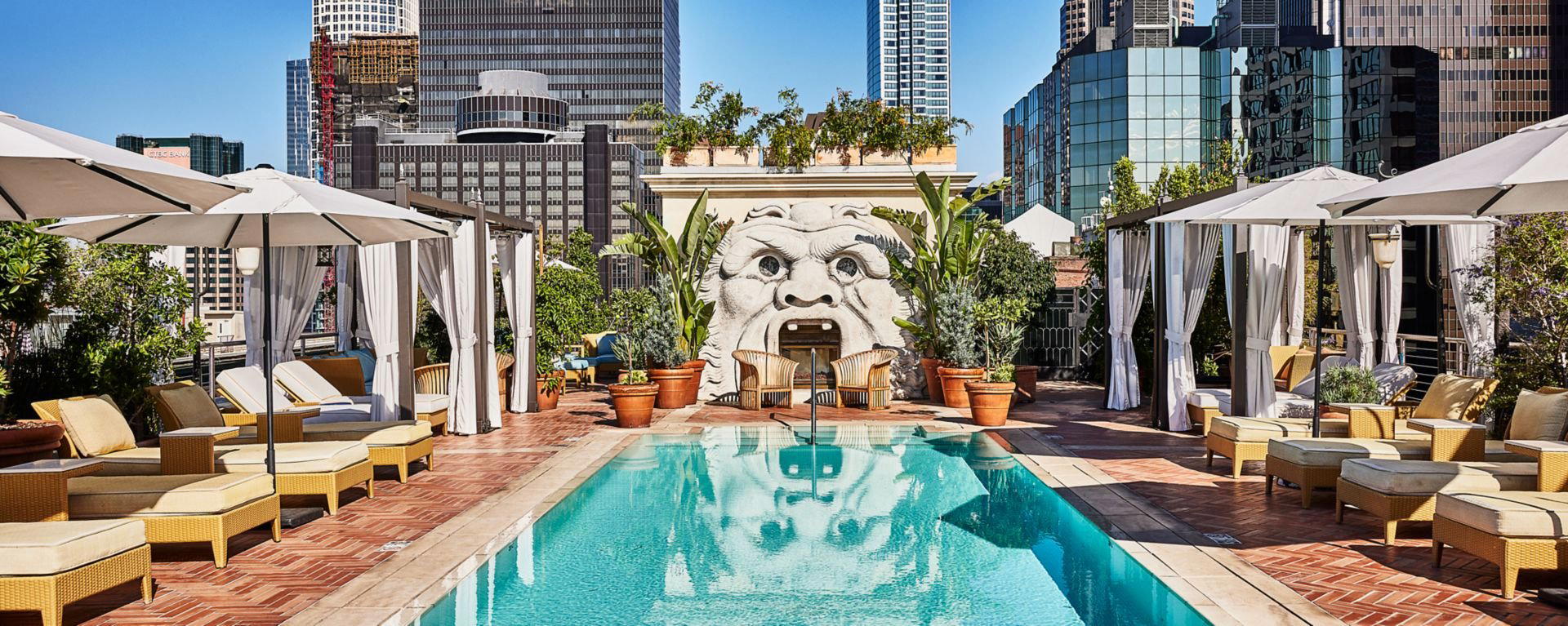
Hotel Per La and the downtown dining-hotel question
Approaching a downtown Los Angeles hotel is different from arriving at a canyon retreat or a Beverly Hills grande dame. The city comes in layers: office towers emptying after work, theatre marquees, lobby bars absorbing the first wave of evening traffic, and restaurants doing the work of giving a neighbourhood its after-dark rhythm. Hotel Per La belongs to that urban category. Its editorial interest is not just the room product. The stronger way to read it is through the dining-hotel format in Los Angeles, where restaurants and bars often determine whether a property feels connected to the city or sealed off from it.
Los Angeles luxury hospitality has fractured into several clear camps. On the west side, resort-like privacy remains the currency at addresses such as Hotel Bel-Air, while old Beverly Hills social theatre defines The Beverly Hills Hotel. In Hollywood and West Hollywood, the hotel can function as a nightlife stage, a legacy script associated with Chateau Marmont and a more contemporary entertainment-hotel model around The Sun Rose West Hollywood. Downtown asks for a different grammar: restaurants must serve guests, locals, business travellers, pre-theatre diners, and late-evening drinkers without collapsing into generic hotel dining.
That is why the dining programme is the right lens for Hotel Per La. In DTLA, the hotel restaurant is rarely judged only against other hotel restaurants. It competes with independent dining rooms, cocktail bars, members-club-adjacent lounges, and casual counters that serve the lunch and dinner needs of a dense weekday district. A downtown hotel that treats food and drink as an amenity reads thin; one that understands the neighbourhood becomes part of the city’s evening map. The responsible assessment is contextual rather than promotional: this is a Los Angeles hotel to evaluate by how its restaurants and bars fit the downtown circuit.
Why food and drink carry more weight in DTLA hotels
Downtown Los Angeles has spent the past two decades shifting between office district, residential quarter, arts corridor, and event hub. That makes hospitality unusually dependent on timing. Breakfast and coffee speak to business travel; dinner has to catch both hotel guests and neighbourhood diners; the bar must work before and after performances, arena events, and late meetings. A dining programme in this part of the city needs range, but range alone is not enough. The better comparison is with Downtown LA Proper Hotel, where the surrounding conversation is already tied to design-led urban hospitality rather than resort isolation.
The practical consequence for travellers is simple: a downtown hotel should be judged less by fantasy and more by daily use. Can the lobby absorb a work conversation without feeling like an airport lounge? Does the bar have a reason to exist after dinner service begins elsewhere? Is the restaurant positioned for locals, or only for guests who do not want to leave the building? Those questions matter in Los Angeles because the city rewards movement. A hotel that offers a credible first drink, a convenient dinner option, or a late return point changes the entire stay, especially when cross-town traffic makes a single ambitious reservation feel like an operation.
Hotel Per La’s verified database entry does not provide cuisine type, chef name, signature dishes, seat count, or hours, so none should be invented. The absence of that data is meaningful for an editorial reader. Without confirmed awards or pricing, the property cannot be placed in an awards-led hotel dining set or a clearly defined luxury dining price tier. Instead, it sits in the broader downtown hotel category, where the deciding factors are access, urban mood, and whether the property helps guests connect to restaurants and bars beyond the lobby.
How it compares with Los Angeles hotel peers
Los Angeles is not a single hotel market. Beverly Hills properties, including L'Ermitage Beverly Hills, The Maybourne Beverly Hills, and The Peninsula Beverly Hills, draw on a guest profile that prioritises service cadence, shopping access, and quieter residential prestige. Downtown hotels play a tougher game. They have to translate architectural density and commercial energy into something that feels intentional by night. Food and drink are the usual tools.
That comparison matters because Hotel Per La should not be evaluated by the wrong standard. A guest seeking poolside retreat, garden arrival, and a west-side residential cocoon is comparing across a different peer group. A guest who wants proximity to downtown restaurants, bars, galleries, business addresses, and performance venues is asking the right question. In that frame, the dining programme is not an accessory. It becomes part of the property’s reason for being in the city.
The hotel also belongs to a national pattern. Across the United States, urban luxury hotels increasingly use restaurants as their strongest public interface. The Fifth Avenue Hotel in New York City reflects the way a restaurant can help a hotel compete in a dense culinary capital. Raffles Boston in Boston shows how a new luxury property uses food, beverage, and public rooms to enter a city with established hotel rituals. Los Angeles is looser and more car-shaped, but the principle holds: dining gives a hotel civic presence.
The Los Angeles restaurant context around a hotel stay
For many travellers, the smarter Los Angeles hotel decision begins with restaurants rather than room square footage. The city’s dining map is spread across the Arts District, Koreatown, Hollywood, Beverly Hills, Santa Monica, Silver Lake, West Adams, and beyond. Staying downtown can make sense when the itinerary leans toward DTLA, the Arts District, museums, theatres, or business appointments. It is less convenient for a coast-heavy trip, and no amount of lobby polish changes the physics of Los Angeles traffic.
Hotel Per La therefore works as part of a broader dining strategy. Use the hotel’s food and beverage spaces as anchor points, then plan outward with care. For travellers building a wider itinerary, our Los Angeles guide helps compare restaurants, bars, and hotels across neighbourhoods.
This is the planning intelligence that matters: Los Angeles rewards clusters. A downtown dinner works better when paired with a downtown bar, gallery visit, concert, or business meeting. A Beverly Hills dinner pairs better with west-side hotel stays. A Hollywood evening should not be treated as interchangeable with DTLA. The hotel’s value rises when the day’s geography is disciplined. That is a stronger and more honest recommendation than presenting any single hotel as the answer to every Los Angeles trip.
What can and cannot be said from the verified record
It confirms the name, city, state, and country. It does not confirm awards, review volume, cuisine type, chef, hotel group, website, phone, address, booking method, hours, seat count, signature dishes, or detailed description. That limits the claims a responsible editorial page can make. It also prevents the usual lazy hotel writing: no invented chef narrative, no unsourced dish descriptions, no fabricated cocktail programme, no precise booking advice, and no claimed accolades.
What remains is still useful. The city context is strong enough to guide the reader’s decision. In Los Angeles, a downtown hotel with a serious dining identity belongs to the same conversation as design-led city hotels rather than resort properties. The absence of verified awards means it should not be sold as an accolade-driven stay. The record places it at about $300 per night, so the stay sits in a clear mid-to-upper price tier. The absence of confirmed reservation policy means dining and room planning should be checked through official channels before relying on a meal or bar visit as the centre of an evening.
For a premium traveller, that transparency is practical. Some hotel pages overstate certainty because it reads more smoothly. The better approach is to separate verified facts from useful context. Hotel Per La is a Los Angeles hotel in downtown’s dining-oriented hotel conversation. The editorial question is whether that downtown position supports the trip being planned.
Who the hotel suits
Hotel Per La suits travellers who want an urban Los Angeles base and intend to use the city at night. That includes guests with downtown meetings, theatre or concert plans, Arts District dinners, gallery stops, or a schedule that keeps them east of the Beverly Hills and Santa Monica orbit. It is a less natural choice for travellers whose days centre on the beach, canyon retreats, or the quieter rituals of west-side luxury.
The dining-programme angle also makes it relevant for guests who prefer a hotel with public life. Some travellers want a property that disappears around them. Others want the lobby, bar, and restaurant to give the stay a social pulse. Downtown Los Angeles tends to reward the second type, as long as the guest accepts the city’s uneven street rhythm and plans movement with intent.
For a contrasting set of American luxury stays, compare the urban hotel logic here with Amangiri in Canyon Point, where isolation is central to the appeal, or Troutbeck in Amenia, where the country-house model changes the pace entirely. Four Seasons at The Surf Club in Surfside offers another contrast, with coastal club culture shaping the hotel experience. In California wine country, SingleThread Farm Inn in Healdsburg and Auberge du Soleil in Napa show how restaurants and place can merge in a slower, destination-dining format. Hotel Per La’s logic is faster, more urban, and more dependent on how the guest uses Los Angeles.
Planning a stay around food, bars, and the wider city
Practical planning should be handled directly through the hotel before arrival. That matters in Los Angeles, where a meal can shape the whole evening. If a dinner reservation is central to the trip, confirm the restaurant schedule, bar access, and any dress expectations in advance. If the hotel is being used as a base for a broader itinerary, pair downtown meals with downtown plans rather than forcing long cross-city transfers at peak traffic hours.
Visitors with more than one day should also use the hotel as one piece of a city-wide map. Use the wider Los Angeles guide to connect meals to cultural programming, and to extend the trip into wine-focused planning. Beyond Los Angeles, destination hotels such as Kona Village, A Rosewood Resort in Kailua Kona and Sage Lodge in Pray show another version of hospitality, where the property itself may dominate the day. Downtown LA operates differently: the city should be scheduled, not treated as background.
For international comparison, Hôtel de Paris Monte-Carlo in Monte Carlo, Badrutt's Palace Hotel in St. Moritz, and Aman Venice in Venice sit in cities or resort settings where hotel dining can carry historic or destination weight. Los Angeles hotel dining is less ceremonial and more situational. It succeeds when it understands neighbourhood, timing, and the way guests move through the city.
How It Compares
Comparable venues nearby, for context on price, style, and recognition.
| Venue | Cuisine | Price | Awards | Notes |
|---|---|---|---|---|
| Hotel Per LaThis venue — the venue you are viewing | Lifestyle, design-led luxury hotel in a restored historic bank building with grand public spaces and rooftop hangout. | $$$ | 4-Star | |
| Hotel Erwin Venice Beach | Elevated beachfront boutique blending bold design with Venice Beach culture | $$$ | 4-Star | Venice Beach |
| STILE Downtown Los Angeles by Kasa | Historic building with contemporary boutique accommodations | $$$ | 4-Star | Downtown |
| The LINE LA | Culture-led design hotel celebrating its Koreatown location and mid-century architectural heritage with contemporary creative programming. | $$$ | 4-Star | Wilshire Center |
| The Garland | Retro Californian urban oasis | $$$ | 4-Star | North Hollywood |
| Hyatt Regency Los Angeles International Airport | Mid-century modern gateway to Los Angeles with innovative design and extensive event spaces. | $$$ | 4-Star | Westchester |
Continue exploring
More in Los Angeles
Hotels in Los Angeles
Browse all →
Bars in Los Angeles
Browse all →

Restaurants in Los Angeles
Browse all →
Wineries in Los Angeles
Browse all →
At a Glance
- Sophisticated
- Elegant
- Modern
- Trendy
- Scenic
- Business Trip
- Weekend Escape
- Romantic Getaway
- Celebration
- Group Retreat
- Rooftop Pool
- Historic Building
- Design Destination
- Panoramic View
- Terrace
- Wifi
- Pool
- Fitness Center
- Room Service
- Concierge
- Business Center
- Valet Parking
- Skyline
- Garden
Sophisticated and design-centric with preserved neoclassical bank architecture—Doric columns, ornate golden ceilings, and marble floors—balanced by warm, modern Italian-inspired interiors and a lively yet polished rooftop scene.