Hotel Montevideo


An 80-room Leading Hotels of the World member set in Pocitos, one of Montevideo's most sought-after residential districts, Hotel Montevideo pairs custom-designed interiors with balcony-equipped rooms and a skybar overseen by two of Uruguay's most recognised culinary figures. At rates from $184 per night, it occupies the upper tier of the city's boutique luxury market without the scale of its larger rivals.
 Discover on Pearl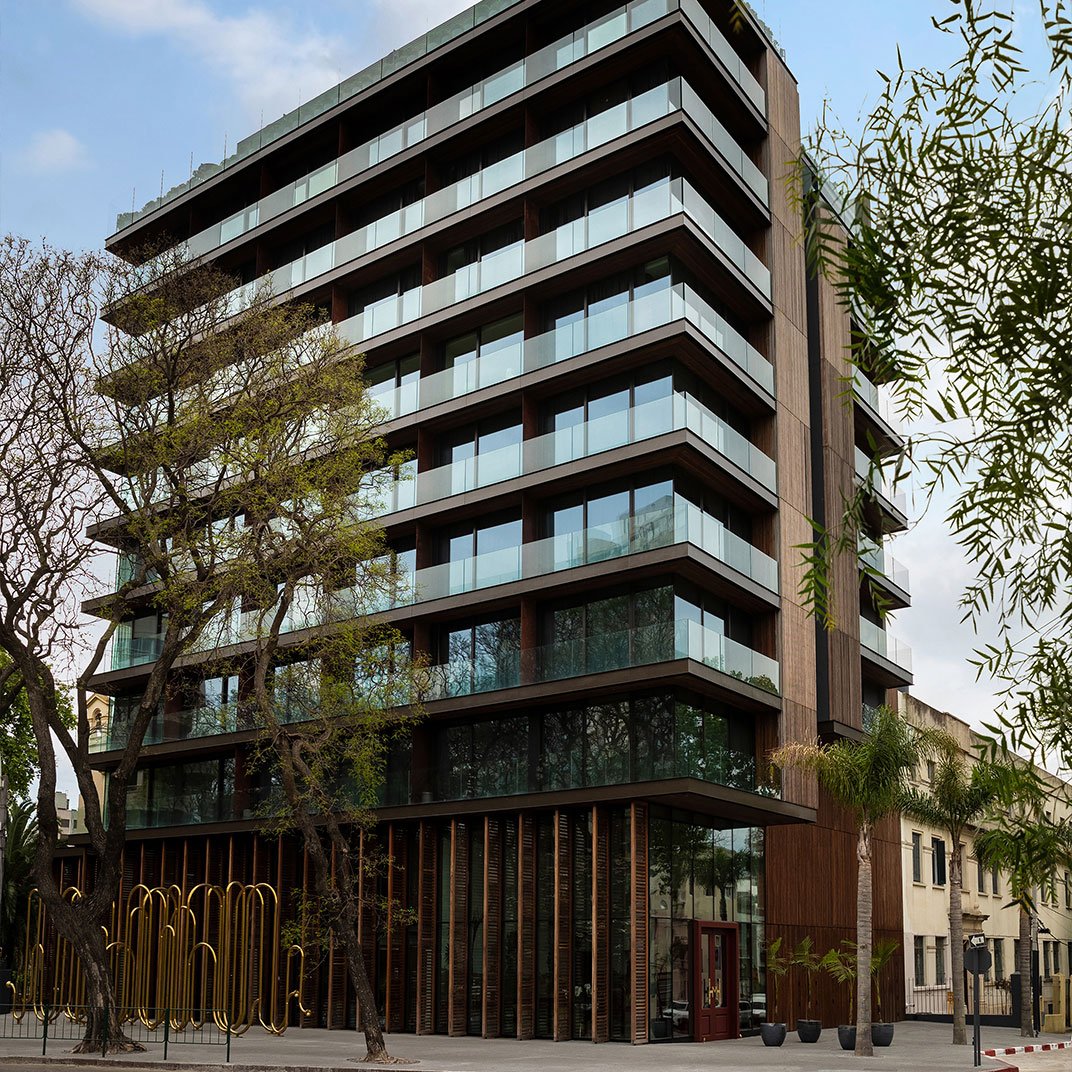
Pocitos and the Architecture of Confident Luxury
There is a particular kind of confidence required to name a hotel after its own city. It announces, without qualification, that the property intends to be the reference point — not one of several options, but the default answer to the question of where to stay in Montevideo. Arriving at José Benito Lamas 2901, in the partially residential, upscale district of Pocitos, the building does not undercut that ambition. The structure is a contemporary one, its facade making no attempt to blend into the neighbourhood's older residential stock. Instead, it reads as a deliberate architectural statement: this is a hotel that has decided what it is and built accordingly.
Pocitos is worth understanding on its own terms before stepping inside. The district sits between the Rambla and the tree-lined streets of Montevideo's more prosperous residential quarters, barely a quarter-mile from Playa Pocitos, a broad urban beach that functions as the city's social backbone from December through March. The location places Hotel Montevideo in a different register from properties near the Old City or the Ciudad Vieja waterfront. This is residential Montevideo — calmer, more local in its rhythms, and considerably less tourist-heavy than the historic centre. For a visitor who wants the city rather than the postcard version of it, that positioning matters.
The shortlist, unlocked.
Hard-to-book tables, cellar releases, and concierge-planned trips.
Get Exclusive Access →What the Building Communicates From the Outside In
Luxury hotels operating outside the world's most competitive markets , think Cheval Blanc Paris, Aman Venice, or Le Bristol Paris , often face a choice between importing a global aesthetic or committing to local material culture. Hotel Montevideo has taken the latter path, at least in its interiors. The 80 rooms and suites are furnished with custom-designed pieces that draw on two distinct reference points: the warmth and patina of well-loved antiques, and the clean geometry of modernist design classics. Neither register dominates. Instead, the rooms occupy a middle ground that reads as specifically curated rather than generically luxurious.
Every room includes at least one balcony, which in a building of this height and position means that the city itself becomes a consistent design element. The urban panorama shifts depending on orientation and floor, but the principle holds throughout: the exterior is treated as part of the room's visual identity, not something to be managed with blackout curtains. The longer-stay Residences extend that logic with kitchenettes and walk-in closets, a format that acknowledges the growing segment of travellers who want hotel-quality service without the daily rhythm of hotel-only living. This is an approach that properties like La Réserve Paris have applied in a European context; in South America, it remains less common at this price tier.
The Polo Bamba Question: Food and Drink as Architecture
The food and beverage program at a boutique luxury hotel of this scale often functions as a secondary concern, a convenience amenity rather than a reason to visit. Hotel Montevideo has taken a different position. Polo Bamba, the hotel's restaurant, and the Polo Bamba Skybar, its rooftop bar, are both overseen by Ale Morales and Florencia Courreges, two figures with a profile in Montevideo's culinary community that extends well beyond the hotel's own walls. That distinction matters more than it might initially appear. It means the food and beverage operation is positioned as a genuine destination rather than a captive audience play, and it changes the social geography of the hotel: guests mix with locals who have come specifically for the bar or the restaurant, which in turn affects the atmosphere across the property.
Skybar formats have proliferated across South American city hotels over the past decade, and their quality varies considerably. The Polo Bamba Skybar's position above Pocitos, with views across the city skyline, places it in a competitive set that includes rooftop operations at far larger and better-resourced properties. The involvement of established local culinary figures is what differentiates it within that set. For context on how Uruguay's broader hospitality scene positions itself, properties like Bahia Vik José Ignacio and Estancia Vik Jose Ignacio have made food and design central to their identity in the countryside; Hotel Montevideo applies a version of that logic to the capital's urban context.
Where It Sits in the Montevideo Market
The Montevideo luxury hotel market is not especially deep. The city receives a fraction of the international visitor traffic that flows through Buenos Aires across the Río de la Plata, and the high-end accommodation supply reflects that. The Sofitel Montevideo Casino Carrasco and Spa operates at the larger, more amenity-heavy end of the market, with a casino and spa that Hotel Montevideo does not attempt to replicate. The absence of a spa is noted by the hotel itself as the primary gap relative to full-service luxury competitors, and it is an honest assessment. Travellers for whom spa access is a non-negotiable will need to weigh that against the property's other strengths.
What Hotel Montevideo does offer in lieu of that breadth is a coherence that larger properties often sacrifice: a consistent design identity, a food and beverage program with genuine local credibility, and a neighbourhood position that places guests in the city rather than at its margins. Its membership in the Leading Hotels of the World , confirmed for 2025 , provides the external validation that positions it unambiguously in the upper tier of the Uruguayan capital's accommodation market. For regional comparison, Fasano Las Piedras Punta Del Este and Casa Flor Hotel Boutique in La Barra represent the design-led boutique approach in Uruguay's coastal resort corridor; Hotel Montevideo occupies an analogous position within the capital itself.
Planning a Stay: Practical Considerations
Rates start at $184 per night, which positions the hotel accessibly within the Leading Hotels of the World tier globally , compare that entry point against equivalent members like Badrutt's Palace Hotel in St. Moritz or Hotel Du Cap-Eden-Roc, and the value proposition in a less trafficked market becomes clear. The 80-room count keeps the property in boutique territory; service ratios at that scale tend to be more attentive than at larger city hotels. The heated outdoor pool with skyline views adds a leisure dimension that the Pocitos location reinforces , the beach is walkable, and the Rambla, Montevideo's coastal promenade, is within easy reach for the long evening walks that define the city's social rhythm. For a broader view of what the city offers across restaurants, bars, and cultural programming, the EP Club Montevideo guide covers the full range.
The shortlist, unlocked.
Hard-to-book tables, cellar releases, and concierge-planned trips.
Get Exclusive Access →Frequently Asked Questions
Fast Comparison
A fast peer set for context, pulled from similar venues in our database.
Preferential Rates?
Our members enjoy concierge-led booking support and priority upgrades at the world's finest hotels.
Get Exclusive AccessThe shortlist, unlocked.
Hard-to-book tables, cellar releases, and concierge-planned trips.
Get Exclusive Access →