A converted 15th-century Carthusian monastery on one of Bruges' most photographed canal stretches, Hotel De Orangerie occupies a distinct tier among the city's intimate heritage properties. Wood panelling, gilded mirrors, and canal-facing rooms place it firmly in the understated-luxury category, where the physical fabric of the building does the heavy lifting that larger hotels assign to amenity lists.
 Discover on Pearl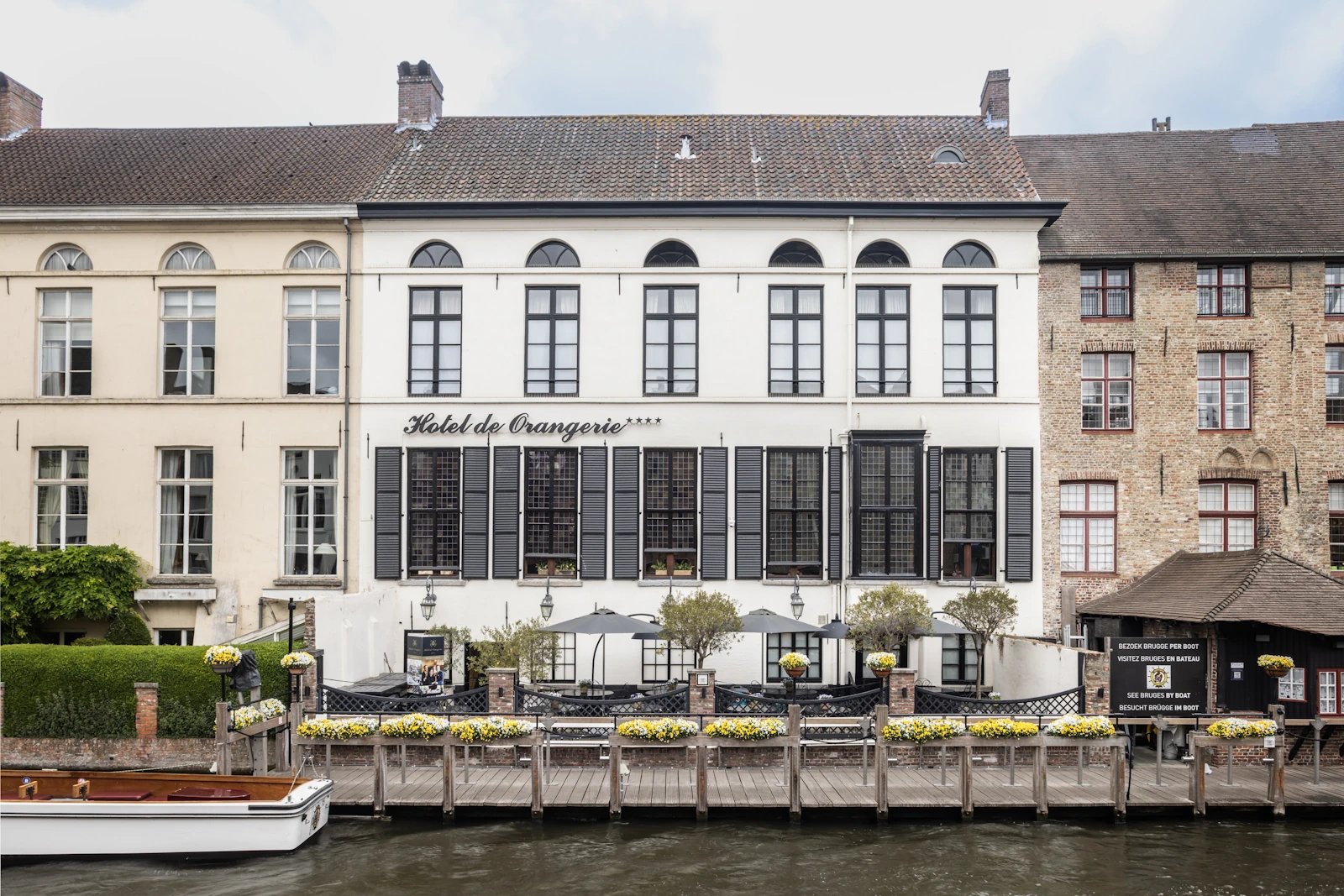
Canal-Side Heritage in Bruges' Premium Accommodation Tier
Bruges operates a compressed but layered hotel market. At one end sit chain properties clustered near the train station; at the other, a small cohort of heritage conversions that trade on architectural provenance, canal adjacency, and the kind of intimacy that large lobbies structurally cannot deliver. Hotel De Orangerie belongs to this second group, occupying a 15th-century Carthusian monastery on Kartuizerinnenstraat, a narrow street that runs directly along one of the city's most historically significant waterways. The building's monastic origins are not incidental decoration — they explain the proportions, the quiet, and the sense that time moves at a different pace here than it does three streets over near the Markt.
For visitors comparing options in this tier, the competitive peer set includes Hotel Heritage, Hotel de Tuilerieën, and The Pand Hotel — all of which share the same general positioning around heritage fabric, limited room counts, and canal or historic-core addresses. What distinguishes De Orangerie within that set is the specific character of its interiors: rich wood panelling, gilded mirrors, and period details that read as genuinely accumulated rather than retrospectively applied. The difference between those two things is one of the harder things to explain in writing, but it is immediately legible when you are standing in the room.
The shortlist, unlocked.
Hard-to-book tables, cellar releases, and concierge-planned trips.
Get Exclusive Access →What the Physical Environment Tells You
The monastery-to-hotel conversion genre is well established across European cities, but the quality of conversion varies considerably. In the better examples , and De Orangerie sits in this category , the original architectural logic of the building is preserved rather than overridden. Monastic structures were designed around quiet, natural light, and spatial hierarchy, all of which translate well into intimate hospitality. The canal-side position amplifies this: Bruges' waterways are genuinely quieter than the streets, and a room facing the water carries a different ambient quality from one that faces a pedestrian thoroughfare, however charming.
The wood panelling and gilded mirrors that characterise the interiors are period-appropriate to the building's long post-monastic history rather than generic period styling. This matters because Bruges itself is a UNESCO World Heritage city, and the leading properties here understand that the city's physical fabric is the primary attraction , the hotel's job is to connect guests to that fabric rather than to compete with it through contemporary design statements. Properties that attempt the latter tend to feel slightly at odds with their surroundings. De Orangerie does not have that problem.
Service Calibration at This Scale
Intimate heritage hotels in Bruges carry a specific service expectation that differs from both large international chain operations and from the more informal boutique properties represented by options like Boutiquehotel 't Fraeyhuis or Hotel Van Cleef. At the heritage-luxury end of the market, guests arrive with a formed idea of what the stay should feel like , rooted, quiet, attentive , and the service model needs to confirm rather than contradict that expectation.
Properties of this type typically operate with staff-to-guest ratios that allow for recognition and anticipation rather than transactional efficiency. The small scale that might look like a limitation on a comparison site is, in practice, the mechanism that makes this possible. A staff member who has seen the same twenty rooms for several seasons knows what each one offers and can match guests to spaces with a precision that larger hotels can only approximate through software. That kind of matching , room orientation, floor height, canal-facing versus courtyard-facing , is one of the most consequential service decisions in a heritage property, and it happens before the guest arrives.
For context on how Bruges' premium properties approach this, consider also The Notary and Dukes' Palace Brugge, which sit in adjacent tiers and use different architectural registers , one converted townhouse, one ducal palace , to deliver a broadly similar promise of personalised, historically grounded stays.
Bruges as Context: Why Location Specificity Matters
Kartuizerinnenstraat is not one of the addresses that first-time Bruges visitors arrive knowing. The Markt, the Burg, the Groeninge Museum , these are the reference points most guests carry in from prior reading. The canal streets that run south and west of the historic core are known primarily to visitors who have been before, or who have done more than surface-level research. This address specificity is actually a useful signal: guests who choose De Orangerie on the basis of its canal position have typically already resolved their interest in Bruges at a level of detail that produces better stays. They know what they are there for.
The Bruges hotel market at this tier is small enough that most of the credible options can be assessed in a single afternoon of research. For those building a Belgium itinerary that extends beyond Bruges, the broader context includes properties like Hotel Julien in Antwerp, B&B The Verhaegen in Ghent, and in Brussels, options ranging from Le Louise Hotel Brussels to Corinthia Grand Hotel Astoria Brussels , each occupying a distinct position in terms of scale, formality, and architectural character. For those extending further, Domaine La Butte aux Bois in Lanaken and Kasteel van Ordingen in Sint-Truiden represent the Belgian countryside end of the same premium-heritage category.
Planning Your Stay
Bruges is a year-round destination with distinct seasonal characters. Spring and early autumn are the periods when canal light and crowd levels balance most favourably , summer brings peak visitor numbers to what is a genuinely small medieval city, and navigation of the historic core becomes noticeably more effortful. Winter, particularly around the Christmas market period, has its own appeal but books out the heritage-tier hotels several months in advance. Guests considering De Orangerie for a winter visit should treat advance booking as non-negotiable rather than precautionary.
The hotel's address on Kartuizerinnenstraat places it within walking distance of the Groeninge Museum, the Begijnhof, and the southern canal network , the quieter half of the historic core. This positioning suits guests whose priorities are the city's art and canal character over its commercial centre. For a broader orientation to the city's dining and experience options, our full Bruges guide covers the key neighbourhoods and what each one delivers. For context on how De Orangerie's category compares globally, the same intimate heritage-conversion model appears at very different scales in properties like Aman Venice , useful for understanding what distinguishes European city-centre conversions from resort-scale equivalents.
The shortlist, unlocked.
Hard-to-book tables, cellar releases, and concierge-planned trips.
Get Exclusive Access →Frequently Asked Questions
Cuisine-First Comparison
Comparable venues for orientation, based on our database fields.
| Venue | Cuisine | Awards | Notes |
|---|---|---|---|
| Hotel De Orangerie | This venue | ||
| Hotel Heritage | |||
| Boutiquehotel 't Fraeyhuis | |||
| Dukes' Palace Brugge | |||
| Hotel de Tuilerieën | |||
| Hotel Van Cleef |
Preferential Rates?
Our members enjoy concierge-led booking support and priority upgrades at the world's finest hotels.
Get Exclusive AccessThe shortlist, unlocked.
Hard-to-book tables, cellar releases, and concierge-planned trips.
Get Exclusive Access →