
Hotel Bagués occupies a historic palace on La Rambla, housing an in-hotel museum of Bagués Masriera modernist Art Nouveau jewellery alongside intimate boutique accommodation in one of Ciutat Vella's most architecturally significant addresses. For travellers who want a property that earns its position through heritage and cultural depth rather than scale, this is a considered choice in central Barcelona.
 Discover on Pearl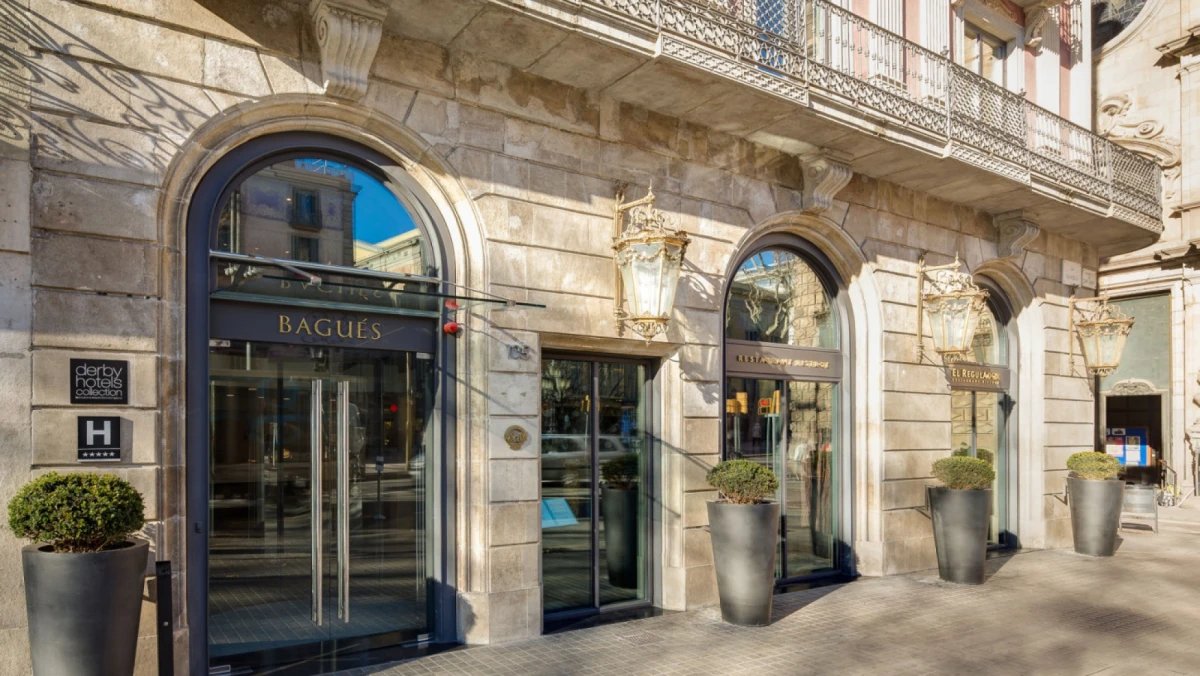
A Palace on La Rambla, Read Against the City
La Rambla polarises Barcelona visitors more than almost any other address in the city. The boulevard is simultaneously the most walked street in Catalonia and the most dismissed by locals who long ago abandoned it to tourist foot traffic. And yet its flanking architecture tells a different story: the buildings lining it are among the densest concentration of historic facades in Ciutat Vella, many of them occupied by institutions and hotels that understand the street's symbolic weight even when its pavement-level commerce disappoints. Hotel Bagués sits inside that contradiction, occupying the Palau del Regulador, one of the avenue's genuinely distinguished palaces, and choosing to make its interior the argument for why the address still matters.
For boutique hotels in European city centres, the question of how to wear a historic building is rarely direct. Some properties treat their heritage as decor, papering over original structure with contemporary styling that competes with rather than responds to the fabric beneath. Others subordinate the guest experience to preservation, leaving rooms feeling more like museum annexes than places to sleep. Hotel Bagués charts a third course: the building's most significant cultural content, the Bagués Masriera jewellery collection spanning Art Nouveau and modernist work, is presented as an integrated museum within the property rather than as a lobby amenity or a footnote in the welcome brochure. That decision places the hotel in a specific peer set among Barcelona boutique properties, closer in sensibility to Mercer Hotel Barcelona, which built its identity around Roman archaeological remains, than to the design-led luxury of Alma Barcelona or the international scale of Mandarin Oriental Barcelona.
The shortlist, unlocked.
Hard-to-book tables, cellar releases, and concierge-planned trips.
Get Exclusive Access →Heritage as Framework, Not Decoration
Barcelona's boutique hotel sector has fragmented along clear lines over the past decade. At one end sit the internationally branded properties with significant key counts and full-service infrastructure. At the other, smaller buildings with genuine architectural identity have been converted into properties where the structure itself generates most of the editorial interest. Antiga Casa Buenavista and Hotel Boutique Mirlo operate in this latter space, as does Hotel Bagués, where the Palau del Regulador's status as one of the city's more architecturally coherent La Rambla facades gives the property a structural argument that no amount of interior investment could manufacture from scratch.
What distinguishes Hotel Bagués within this sub-category is the jewellery museum. The Bagués Masriera house has deep roots in Catalan modernisme, the same cultural movement that produced Gaudí, Domènech i Montaner, and the architectural vocabulary that defines Barcelona's premium tourist identity. Positioning an active collection of that work inside an operating hotel is an editorial decision as much as a commercial one: it commits the property to a particular kind of guest who values access to genuine cultural material over the convenience of proximity to the city's more predictable luxury amenities. That commitment is also, in a subtle way, a durability argument. Trends in hotel design cycle quickly; a museum-grade collection of Art Nouveau jewellery does not go out of fashion on the same schedule.
Sustainability Through Longevity: The Boutique Heritage Model
The sustainability conversation in luxury hospitality has largely been dominated by operational metrics: energy sourcing, water management, supply chain transparency, single-use material reduction. Those are necessary conversations, and properties from Cap Rocat in Cala Blava to Terra Dominicata in Escaladei have made them central to their identities. But there is a parallel strand of sustainability thinking that the heritage boutique model embodies more quietly: the decision to inhabit and preserve an existing historic structure rather than build new is itself a form of environmental consciousness, one that reduces embodied carbon, maintains urban fabric, and creates a case for adaptive reuse over demolition and replacement.
Hotel Bagués makes this argument by existing. The Palau del Regulador was not purpose-built as a hotel; it was converted, maintained, and given new programmatic life. The jewellery collection housed within it extends that logic: objects made a century ago by Catalan craftspeople using techniques that prioritised material quality and longevity are now accessible to hotel guests as part of their stay. That is a different kind of sustainability story than solar panels and composting programmes, and it deserves to be read as such. In a city where new hotel development continues to displace residential communities and strain infrastructure, the choice to operate within existing footprint and around existing cultural material carries genuine ethical weight.
For travellers who connect sustainability to the broader question of what tourism does to the cities it enters, Hotel Bagués represents a considered position. It does not extract a historic building from its context; it activates that context as the primary reason to stay. Properties like Atrio Restaurante Hotel in Cáceres and Abadía Retuerta LeDomaine in Teruel take comparable approaches in different Spanish contexts, grounding their propositions in the specific historical and cultural material of their locations rather than importing a transferable luxury template.
Positioning Within Barcelona's Boutique Tier
Barcelona's premium boutique sector offers a range of positions for travellers who want something more specific than a large international property. ABaC Restaurant & Hotel anchors its proposition in its Michelin-starred restaurant, drawing a guest profile weighted toward serious dining. Almanac Barcelona pitches at a design-forward audience with a central address and contemporary programming. Hotel Bagués sits in a different slot: its anchor is cultural and architectural rather than gastronomic or design-led, which makes it a natural fit for guests who treat the city's moderniste heritage as a primary interest rather than background context.
La Rambla itself is a practical asset that the property's more fashion-conscious competitors occasionally overlook in their eagerness to claim hipper postcodes. The boulevard places guests within walking distance of the Boqueria, the Gothic Quarter, the Liceu opera house, and the waterfront, making it genuinely central in a city where the interesting neighbourhoods are more dispersed than they appear on a map. For first-time visitors to Barcelona who want to be close to significant cultural sites without sacrificing the character of their accommodation, the address resolves a real logistical tension.
Planning Your Stay
Hotel Bagués operates on La Rambla in the Ciutat Vella district, meaning it sits at the geographic and transit heart of Barcelona. The nearest metro stations connect quickly to the airport and the broader city network, and the property's position makes it walkable to most of the central cultural sites without requiring transport. Booking directly through the hotel is generally advisable for boutique properties of this scale, where room categories matter and direct contact allows for clearer communication about what the museum access involves and when the collection is viewable. Given La Rambla's year-round tourist volume, the hotel receives consistent demand across seasons, though spring and early autumn remain Barcelona's most comfortable periods for extended on-foot exploration of the surrounding neighbourhoods.
For a broader view of where Hotel Bagués sits relative to the city's full accommodation and dining spectrum, our full Barcelona restaurants guide maps the options by neighbourhood and category. Travellers comparing boutique heritage properties across Spain may also find relevant context in Hotel Can Cera in Palma and Mas de Torrent Hotel & Spa in Torrent, both of which operate within historic structures and make that fact central to their appeal. For those extending a Spain itinerary into the north, Akelarre in San Sebastián and Casa Beatnik Hotel in A Coruña represent properties with similarly specific positioning and cultural anchors.
The shortlist, unlocked.
Hard-to-book tables, cellar releases, and concierge-planned trips.
Get Exclusive Access →Frequently Asked Questions
Comparison Snapshot
A compact peer set to orient you in the local landscape.
| Venue | Cuisine | Price | Awards | Notes |
|---|---|---|---|---|
| Hotel Bagués | This venue | |||
| Mandarin Oriental Barcelona | Michelin 2 Key | |||
| Soho House Barcelona | Michelin 1 Key | |||
| ABaC Restaurant & Hotel | Michelin 1 Key | |||
| Alma Barcelona | Michelin 1 Key | |||
| Almanac Barcelona | Michelin 1 Key |
Preferential Rates?
Our members enjoy concierge-led booking support and priority upgrades at the world's finest hotels.
Get Exclusive AccessThe shortlist, unlocked.
Hard-to-book tables, cellar releases, and concierge-planned trips.
Get Exclusive Access →