Asilomar Hotel and Conference Grounds
A California State Historic Landmark occupying 107 acres of Monterey pine forest and dune above the Pacific, Asilomar was designed between 1913 and 1928 by Julia Morgan, the first woman licensed to practice architecture in California. The property operates today as a conference and retreat destination where the Arts and Crafts buildings, open to registered guests, sit directly within a coastal nature preserve. It occupies a tier of American heritage lodging that few properties on the West Coast can match.

Pearl is the En Primeur Club membership app, where members save venues, book tables and use the concierge.
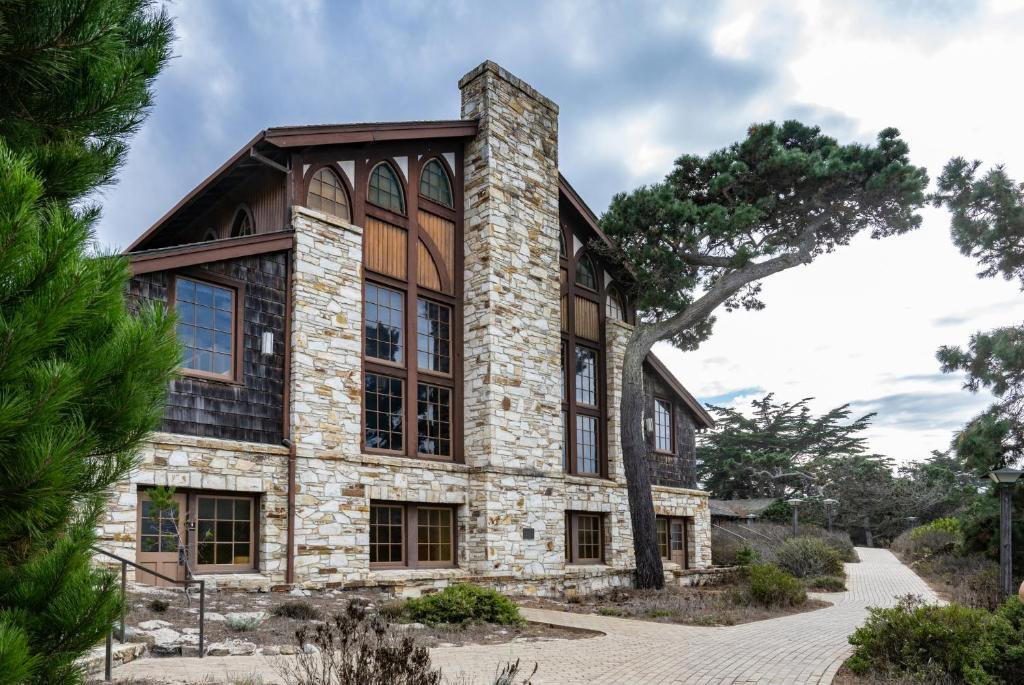
A Julia Morgan Campus on the Monterey Coast
The approach to Asilomar along Asilomar Avenue sets the register before you reach the door. Monterey pines close overhead, the road narrows, and the Pacific appears in flashes between dunes rather than as a panoramic reveal. What you are arriving at is not a resort in any conventional sense but a working campus of Arts and Crafts buildings commissioned over fifteen years by the YWCA, designed almost entirely by Julia Morgan, and now protected as a California State Historic Landmark. That designation matters because it shapes every decision about how the property operates, what it looks like, and how it fits into the wider category of heritage lodging on the American West Coast.
Morgan, who in 1904 became the first woman licensed to practice architecture in California, built her reputation on commissions that required both structural discipline and sensitivity to natural setting. Asilomar, which she began in 1913 and continued shaping through 1928, is the clearest expression of that combination available to overnight guests anywhere in the state. The buildings use local materials, unpainted wood, stone, and clinker brick, in ways that have aged into the landscape rather than against it. Where comparable Arts and Crafts properties on the East Coast often feel museological, Asilomar retains the functional grain of a place still in use. For a direct comparison in the heritage-lodge category, Troutbeck in Amenia occupies a similar position: historic provenance, working-retreat purpose, design integrity that precedes the boutique-hotel era.
The Architecture as the Experience
The Phoebe Apperson Hearst Social Hall, completed in 1913, is the architectural anchor of the campus. Its exposed-beam ceiling, large fireplace, and window arrangement facing the dunes establish the proportion and mood that the later buildings echo. Morgan returned to add the Merrill Hall auditorium, the Scripps recreation building, and a sequence of residential structures that step down toward the beach, each one negotiating the slope and tree line without imposing a uniform footprint. The result is a campus that reads as a single coherent design despite having been built across three decades, which is a more demanding architectural achievement than it first appears.
The residential buildings cluster into named groups with varying configurations. Some accommodate single guests or couples; others are arranged for groups. The architecture does not change by category: board-and-batten exteriors, brick hearths in some rooms, and windows oriented to trees rather than to corridors. This is not the design language of a luxury hotel, and guests who arrive expecting the finish levels of, say, Hotel Bel-Air in Los Angeles or Four Seasons at The Surf Club in Surfside will need to recalibrate. Asilomar's case rests on provenance, setting, and spatial quality rather than on amenity stacking. The closest analog in the California premium-lodge tier is probably Post Ranch Inn in Big Sur, where architecture-and-landscape integration is also the primary value proposition, though Post Ranch operates at a substantially higher price point and with a very different aesthetic register.
Landscape and Location on the Monterey Peninsula
107-acre property sits within the Asilomar State Beach and Conference Grounds, which means the dunes, the beach boardwalk, and the coastal scrub habitat surrounding the buildings are under state protection. That buffer is not incidental to the guest experience; it is the reason the property retains a character that urban-edge hotels cannot replicate regardless of their renovation budget. The boardwalk trail through the dunes to the beach is open to registered guests year-round, and the Pacific Grove shoreline beyond the property boundary offers tidepooling and whale-migration viewing depending on the season. Humpback and gray whale sightings are most frequent from December through April, and the monarch butterfly overwintering at nearby Natural Bridges State Beach typically peaks in late October and November.
Pacific Grove itself sits at the northern tip of the Carmel-Monterey corridor, roughly two hours south of San Francisco. The town has a distinct character compared to the more developed Carmel-by-the-Sea: smaller restaurant density, fewer galleries, a more residential feel. For guests who want the Monterey Peninsula's dining options alongside Asilomar's setting, the distance to Carmel Valley's wine-and-table scene is navigable in under thirty minutes. Bernardus Lodge and Spa in Carmel Valley operates in that same regional corridor and represents the alternative for guests who prioritize wine-country amenity over historic architecture. For the wider Pacific Grove dining context, our full Pacific Grove restaurants guide covers the options by neighborhood.
Where Asilomar Sits in the American Heritage-Lodge Category
American heritage lodging has bifurcated over the past decade. One branch has moved toward lifestyle-brand renovation, where historic bones receive contemporary interiors and bar programs pitched at a younger demographic. The other branch maintains operational continuity with the property's original purpose, accepting that the guest profile self-selects accordingly. Asilomar belongs clearly to the second group. It functions as a conference and retreat center with overnight accommodation, which means the atmosphere on any given stay depends substantially on who else is booked. A quiet midweek visit in the off-season reads very differently from a weekend when a large conference occupies Merrill Hall.
That operational reality places Asilomar in a different competitive set from destination retreats like Amangiri in Canyon Point or Canyon Ranch Tucson, where guest-experience management is the explicit product. It sits closer to properties like Blackberry Farm in Walland or SingleThread Farm Inn in Healdsburg in terms of purpose-driven identity, though those properties operate at higher price tiers with more controlled programming. For guests arriving for the architecture and the landscape rather than for curated hospitality, that distinction is largely immaterial.
Planning a Stay
Booking logistics at Asilomar require some lead time, particularly for weekend stays in summer and early autumn when coastal demand across the Monterey Peninsula peaks. The property is managed by Delaware North, a large hospitality-and-services company that operates several state and national park lodges across the United States, which means the reservation process is more standardized than at independent heritage properties. Rates vary by room type and season; the property does not position itself at the luxury end of the Pacific Grove accommodation range, which makes it an accessible entry point for guests interested in the Morgan architecture without the price floor of comparable design-led stays elsewhere in California. Those planning to visit during monarch butterfly season or the December-to-April whale-watching window should book several weeks ahead, as those periods draw consistent regional demand.
Guests looking at comparable design-and-nature propositions elsewhere in the American West might also consider Sage Lodge in Pray, Amangani in Jackson Hole, or Ambiente in Sedona, each of which places architecture-in-landscape at the center of its offer. For urban-heritage comparison on the East Coast, The Fifth Avenue Hotel in New York City, Raffles Boston, and Chicago Athletic Association occupy the restored-historic tier in their respective cities. For international heritage lodging benchmarks, Aman Venice and Badrutt's Palace Hotel in St. Moritz represent the best of that category. Additional California options worth comparing include Auberge du Soleil in Napa and 1 Hotel San Francisco. Other noteworthy U.S. properties in the nature-integrated lodging tier include Little Palm Island Resort and Spa in Little Torch Key, Kona Village, A Rosewood Resort in Kailua Kona, and Alpine Falls Ranch in Superior. For a comparable Auberge-brand experience closer to Asilomar's region, Bowie House in Fort Worth and Aman New York round out the comparison set for guests benchmarking across different U.S. luxury tiers.
Fast Comparison
| Venue | Price | Awards |
|---|---|---|
| Asilomar Hotel and Conference GroundsThis venue (the venue you are viewing) | Not listed | Not listed |
| Aman New York | Not listed | 3 Michelin Keys · World's 50 Best #87 |
| Amangiri | $1,000–1,500 | 3 Michelin Keys · World's 50 Best #45 |
| Hotel Bel-Air | $750–1,000 | 3 Michelin Keys · World's 50 Best #57 |
| The Beverly Hills Hotel | Not listed | 3 Michelin Keys · World's 50 Best #65 |
| The Carlyle, A Rosewood Hotel | $1,500–2,500 | 2 Michelin Keys · World's 50 Best #64 |
Continue exploring
More in Pacific Grove
Hotels in Pacific Grove
All hotels in Pacific Grove →
Bars in Pacific Grove
Browse all →



Restaurants in Pacific Grove
All restaurants in Pacific Grove →
Wineries in Pacific Grove
Browse all →
Details
- Quiet
- Scenic
- Rustic
- Classic
- Group Retreat
- Weekend Escape
- Business Trip
- Beachfront
- Historic Building
- Wi Fi
- Outdoor Pool
- Beach Access
- Pool
- Waterfront
Tranquil and rustic with natural wood interiors, high ceilings, exposed beams, and seamless indoor-outdoor flow offering peaceful forest and ocean views.