El Capitan Hotel

A Michelin Selected hotel in downtown Merced, El Capitan occupies a historic Main Street address that places it in an uncommon tier for California's Central Valley. The building's architecture anchors its identity, offering travelers passing between the Bay Area and Yosemite a stop with genuine character rather than chain-standard convenience.
Pearl is the En Primeur Club membership app — saves, bookings, and concierge access live there. Same editors, same standards.
- Address
- 609 W Main St, Merced, CA 95340
- Phone
- (209) 383-1234
- Website
- elcapitanhotelmerced.com
- Directions
- Get directions
 Saves & bookings on Pearl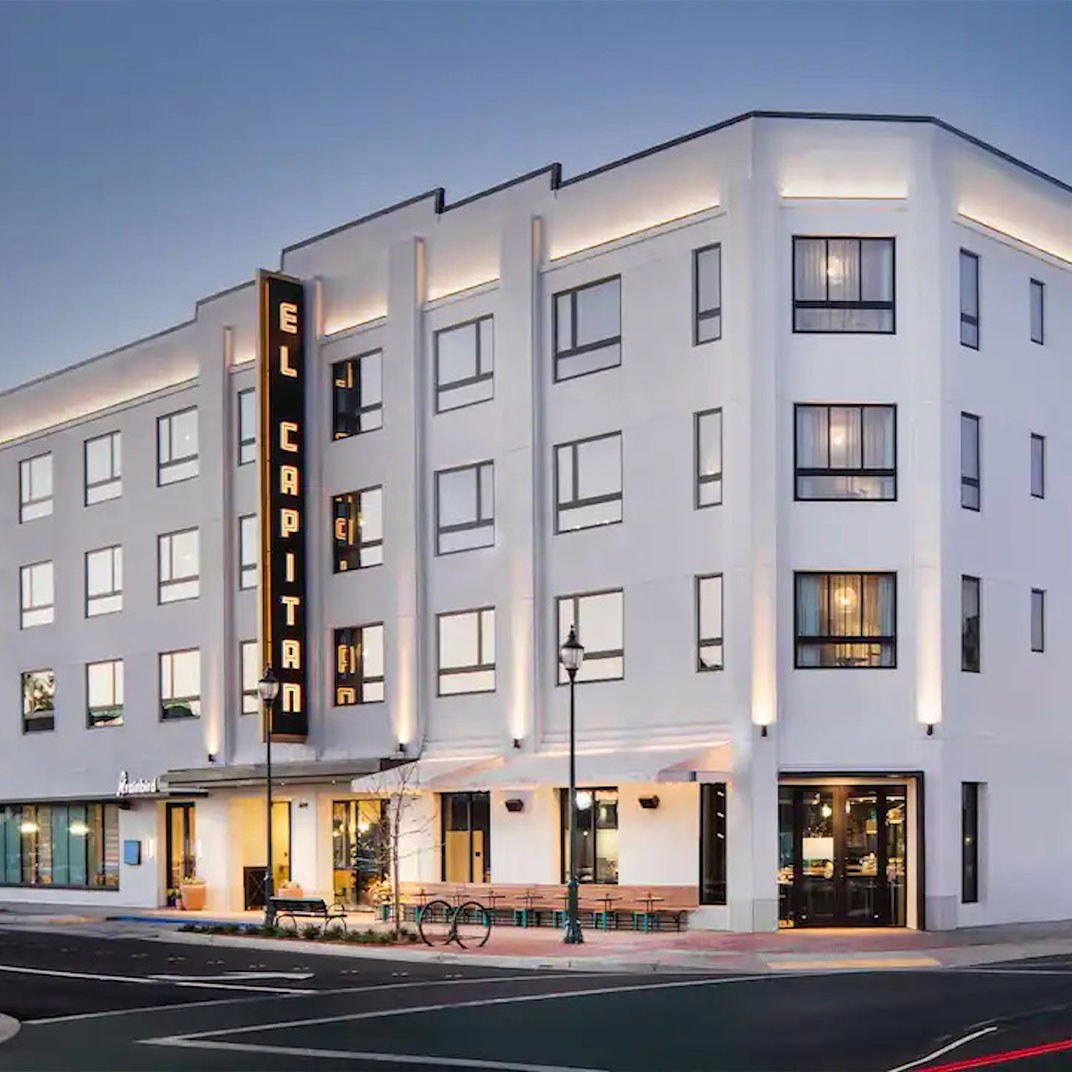
A Historic Address in an Unlikely Place
California's Central Valley is not a region the American hotel industry has historically treated with much imagination. The corridor running through Merced sits between two of the state's most recognizable draws, the Bay Area to the west and Yosemite National Park to the east, yet the town itself has rarely appeared on the itineraries of travelers who spend serious time thinking about where they sleep. El Capitan Hotel, at 609 W Main Street, is one of the reasons that may be changing. Its inclusion in the Michelin Selected Hotels 2025 list places it in a comparable set defined not by room count or amenity breadth but by character, physical presence, and the kind of editorial attention that tends to follow buildings with real architectural substance.
The Michelin Selected designation does not carry the star system applied to restaurants, but in the hotel context it functions as a meaningful signal. For context, properties like Washington School House Hotel in Park City and The Hornibrook Mansion Empress in Little Rock sit in a similar tier.
The Architecture as the Argument
Downtown Merced's Main Street carries the kind of early-twentieth-century commercial fabric that many California cities have lost to successive waves of suburban displacement and redevelopment. El Capitan Hotel is part of that fabric. Historic hotel buildings of this type, broad facades, street-level presence, bones built for permanence rather than modularity, occupy a different architectural register than the mid-range or extended-stay formats that define most Central Valley lodging. The building's position on W Main Street means it operates as a piece of civic architecture as much as a hospitality product, its streetscape contribution inseparable from what it offers guests looking through its windows at the downtown below.
This framing matters because it aligns El Capitan with a broader pattern in American hospitality: the revival of historic downtown hotels as the preferred format for travelers who find resort compounds and airport-adjacent chains equally unappealing. Across the country, properties like the Chicago Athletic Association and Raffles Boston have demonstrated that the appetite for buildings with civic history extends well beyond major metropolitan markets. El Capitan occupies that same instinct in a city that rarely attracts this kind of investment or attention.
The name itself carries a geographic echo worth noting. El Capitan is the sheer granite monolith that defines the southern wall of Yosemite Valley, and naming a Central Valley hotel after it is a signal, whether deliberate or inherited from an earlier era, that the property understands its position as a staging point for one of the American West's most significant natural environments. Travelers driving or taking the Amtrak San Joaquins rail line from the Bay Area pass through Merced before connecting onward to Yosemite by bus or car. The hotel's downtown address sits within reach of the Merced Amtrak station.
Where El Capitan Sits in the California Hotel Conversation
California's hotel market distributes into tiers that rarely overlap. At one end sit the large-footprint, design-forward resorts: properties like Post Ranch Inn in Big Sur or Meadowood Napa Valley, where the landscape is as much a product as the rooms. At the other end, independent properties with architectural histories but limited resources operate largely outside the notice of the national travel press. El Capitan's Michelin Selected status positions it above that second tier without placing it in the same conversation as California's trophy resort properties.
A more accurate comparable set is the category of historically rooted, independently operated small hotels in secondary American cities, places like Troutbeck in Amenia or The Stavrand in Guerneville, where the physical environment and local specificity are the differentiating factors. What each of those properties shares is a resistance to the homogenizing pressure that turns hotels into interchangeable room inventories. El Capitan, in Merced, does the same within a city where the competition for that positioning is considerably thinner.
But the underlying logic is consistent: a building that exists in genuine relationship to its setting, rather than despite it.
Planning a Stay
Merced is accessible by Amtrak's San Joaquins service from both the Bay Area and Sacramento, and by car from San Francisco in roughly two and a half hours via Highway 99. The hotel sits on W Main Street in the downtown core, which keeps it central to what little of Merced rewards walking. For travelers routing toward Yosemite, the park's western entrance via Highway 140 through Mariposa runs east from Merced, the drive to Yosemite Valley from the city takes approximately ninety minutes under normal conditions.
Travelers should confirm availability and pricing directly with the property. Michelin Selected hotels at this scale in secondary markets tend to book more tightly during peak Yosemite season, which runs roughly from May through early October.
The range of properties earning Michelin's hotel recognition in 2025 spans from ultra-resort formats to properties like El Capitan, where the credential rests on built character and local specificity. That breadth is worth noting: it reflects a judgment that quality in hospitality is not synonymous with luxury spend, and that a well-maintained historic building in a working California city can earn the same editorial notice as a private-island compound. For a region that has historically been passed through rather than stayed in, that is a substantive change in the conversation.
A Quick Peer Check
Comparable venues nearby, for context on price, style, and recognition.
| Venue | Cuisine | Price | Notes |
|---|---|---|---|
| El Capitan HotelThis venue — the venue you are viewing | Modern interpretation of Art Deco with historic preservation and contemporary extension | $$ | Not listed |
| Palihotel Westwood Village | Neighborhood boutique hotel with highly-stylized, fun and approachable accommodations. | $$$ | Westwood Village |
| Hotel Sequoia | Independent boutique hotel in a rehabilitated early-20th-century landmark, blending grand historic bones with modern hospitality and community arts programming. | Not listed | Downtown Redwood City |
| Hotel Lucile | Intimate urban boutique hotel set in a preserved 1930s church, positioned as a stylish neighborhood hub in Silver Lake. | $$$ | Silver Lake |
| Cambria Beach Lodge | beach-inspired lifestyle boutique | $$ | Moonstone Beach |
| Yosemite Valley Lodge | mid-century modern lodge architecture integrated with natural surroundings | $$$ | Yosemite Valley |
Recognition history
Dated appearances from independent guides and award organizations, with the underlying list record or original source where available.
Michelin Selected
Michelin

At a Glance
- Modern
- Classic
- Lively
- Elegant
- Business Trip
- Weekend Escape
- Historic Building
- Terrace
- Wi Fi
- Fitness Center
- Room Service
- Concierge
- Street Scene
- Wi Fi
- Fitness Center
- Room Service
- Concierge
Relaxed, elegant, and eclectic with modern playful furnishings, custom wallpaper inspired by Central Valley landscapes, and sophisticated lighting.