← Guides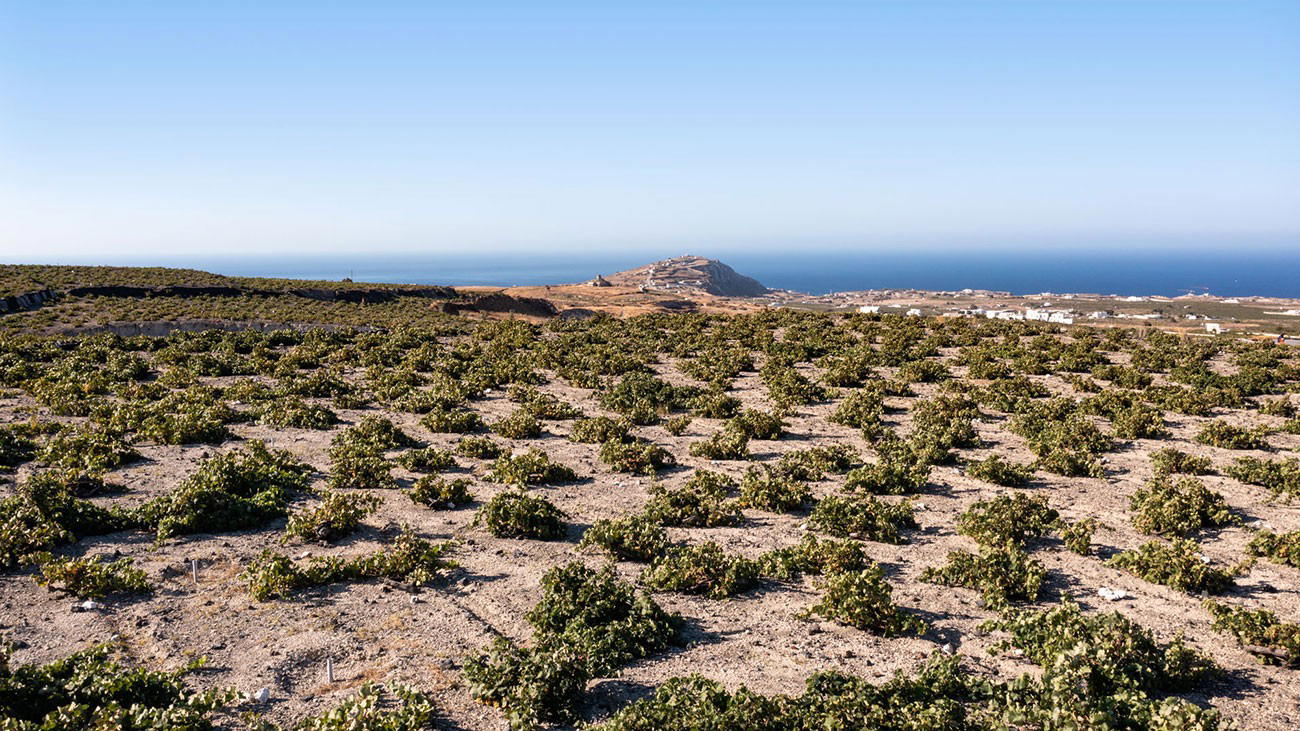
Santorini's 2025 harvest collapsed from 2,500 tons to 500 tons, pushing grape prices to €10/kg and forcing Domaine Sigalas to pilot wastewater irrigation as ancient basket vines die.
Santorini's 2025 harvest collapsed from 2,500 tons to 500 tons, pushing grape prices to €10/kg and forcing Domaine Sigalas to pilot wastewater irrigation as ancient basket vines die.
A 90-year-old kouloura vine, basket-trained to shield grapes from Santorini's summer sun, is dead. Heat and drought killed it. That single vine, standing in a vineyard on the Greek island, marks the end of a tradition and the beginning of a crisis that has forced sixth-generation winemaker Yiannis Boutaris to test wastewater irrigation, abandon dry-farming, and rethink the future of Assyrtiko production.
Production of Santorini's Assyrtiko grape fell from 2,500 metric tons in 2022 to 500 tons in 2025, an 80% collapse. Grape prices reached €10 per kilogram, comparable to Champagne. In northern Greece, where temperatures are cooler, grapes sell for 80 cents per kilo. The island's 2023-2024 growing seasons were the hottest in 60 years, according to Professor Stefanos Koundouras of Aristotle University in Thessaloniki. Low rainfall, searing temperatures, and competition for water between farmers, hotels, and swimming pools have pushed Santorini winemakers to the edge.
Boutaris, who runs Domaine Sigalas, now part of the Kir-Yianni family of wineries, is testing a pilot wastewater irrigation project with local authorities and scientists. Winemaker Yiannis Papaeconomou is planning to use the same system for his 6-year-old vines. Papaeconomou is experimenting with subsurface irrigation to reduce evaporation, while Boutaris is testing atmospheric water harvesting using hydrogels and solar panels. These are not incremental adjustments. They are survival strategies for a region where centuries-old viticulture is collapsing under climate stress.
The 2025 harvest was a breaking point. Production dropped to 500 tons, one-fifth of the 2022 volume, and grape prices spiked to €10 per kilogram. That price level is normally associated with Champagne, not a Greek island where dry-farmed vines have thrived for millennia without irrigation. The economic pressure is acute: growers who once sold grapes for modest returns now face the choice of abandoning vineyards or investing in irrigation infrastructure that contradicts the island's traditional model.
Santorini's volcanic terroir, pumice, ash, and minimal organic matter, has historically allowed vines to survive on dew and sparse winter rainfall. The kouloura training method, which coils canes into low basket shapes, protects fruit from wind and sun while capturing moisture. But sustained drought has overwhelmed that system. Vines that endured for decades are dying. Boutaris gestured to one such vine in his vineyard: 90 years old, basket-trained, now dead from heat and water stress.
The island's water supply is contested. During the tourist season, millions of visitors arrive, and farmers compete with hotel operators and swimming pool owners for dwindling resources. Desalination plants provide some relief, but they are energy-intensive and expensive. Wastewater irrigation, already used in California vineyards, offers a more sustainable alternative, but it requires municipal cooperation, treatment infrastructure, and regulatory approval.
Koundouras, the viticulture professor, said the wine sector could become less sustainable across Europe, particularly around the Mediterranean, if temperatures continue to rise and rainfall becomes more erratic. The 2023-2024 growing seasons in Santorini were the hottest in 60 years. That heat stress has already affected wine quality and the special character of Santorini's Assyrtiko, a grape prized for its mineral tension, citrus acidity, and saline finish.
Boutaris is testing a pilot project with local authorities and scientists to take wastewater from homes and hotels and use it to irrigate vines. The goal is to reduce dependence on desalination and provide a reliable water source during the growing season.
Domaine Sigalas, now part of the Kir-Yianni family of wineries, has its own vineyards and also buys grapes from independent growers. The winery is adapting its vineyard management to accommodate irrigation while preserving the traditional character of Santorini wine. That means testing row-planted vines instead of the scattered, basket-trained kouloura system, which makes efficient irrigation nearly impossible.
Papaeconomou, another Santorini winemaker, is planning to connect his 6-year-old vines to the wastewater project. He has already installed subsurface irrigation to reduce evaporation and is experimenting with trellising to make watering more efficient. The shift from dry-farming to irrigation is not a minor technical adjustment, it is a fundamental change in how Santorini wine is made.
Boutaris is also testing atmospheric water harvesting, a system that captures moisture from the air using hydrogels and extracts it as liquid water with heat generated by solar panels. The technology is experimental, but it represents the kind of innovation that may be necessary if rainfall continues to decline. The alternative is abandoning vineyards entirely, which would erase centuries of viticultural history and eliminate a wine style that cannot be replicated elsewhere.
The kouloura training method is central to Santorini's winemaking identity. Vines are pruned into low, circular baskets that protect fruit from wind and sun while capturing dew. The system evolved over centuries to suit the island's arid climate, volcanic soil, and constant wind. But it was designed for a climate with predictable winter rainfall and moderate summer heat, not the sustained drought and record temperatures of 2023-2024.
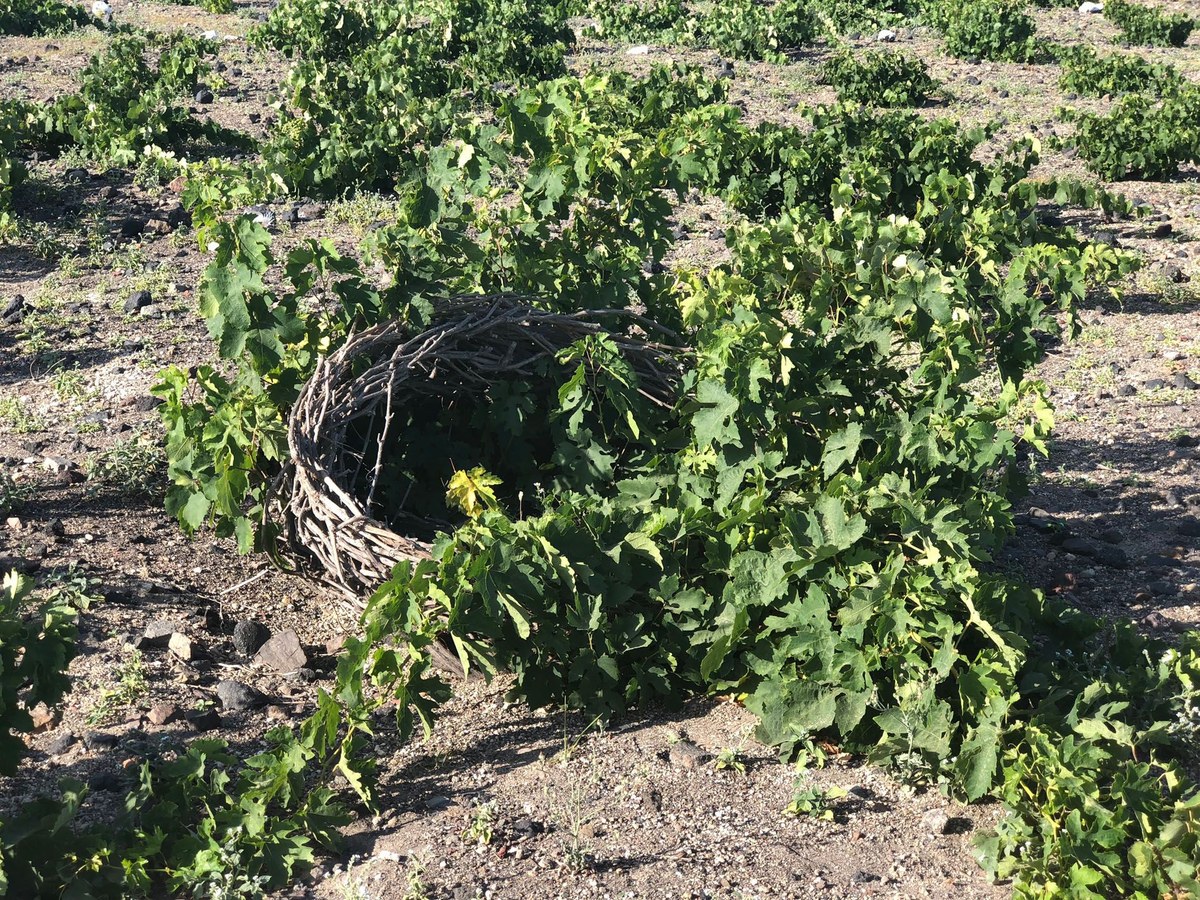
"The lack of rain, in combination with the lack of cultivation, in the last couple of years has led to these old vineyards dying," said Yiannis Boutaris.1 The 90-year-old vine in his vineyard is not an isolated case. Across the island, growers are reporting similar losses. Vines that survived phylloxera, wars, and economic collapse are succumbing to water stress.
The basket shape makes targeted irrigation nearly impossible. Water applied from above evaporates quickly in the heat. Subsurface drip irrigation requires vines to be planted in rows, not scattered across volcanic slopes. That means replanting, a process that takes years and eliminates the old-vine character that defines premium Santorini Assyrtiko.
"We are already seeing problems in the quality and special character of the wines," said Stefanos Koundouras.2 The mineral tension and saline finish that distinguish Santorini Assyrtiko depend on the island's terroir and traditional viticulture. Irrigation, trellising, and row planting may preserve production volumes, but they risk diluting the wine's identity.
Some growers are experimenting with trellising to make irrigation more efficient. Papaeconomou has installed trellis systems for his younger vines and is testing subsurface irrigation to reduce evaporation. The shift from kouloura to trellis is controversial. Traditionalists argue that the basket shape is essential to Santorini's character. Pragmatists counter that without irrigation, there will be no vines left to train.
The 80% production collapse has immediate consequences for collectors and importers. Santorini Assyrtiko is already a niche category, total production in a normal year is modest compared to Chablis or Sancerre. The 2025 harvest of 500 tons will translate to roughly 330,000 bottles, by back-of-envelope math, assuming typical yields and winemaking losses. That volume is insufficient to meet global demand.
Grape prices at €10 per kilogram will push bottle prices higher. Estates that source fruit from independent growers will face margin pressure. Domaine Sigalas, which owns vineyards and buys grapes, will have more control over supply, but even large producers will struggle to maintain inventory levels. Allocation models are likely, collectors who want upper-tier Santorini Assyrtiko may need to join mailing lists or work with négociants who have direct estate relationships.
The secondary market is likely to reflect that scarcity, lifting prices for older vintages from established producers such as Sigalas, Gaia, and Hatzidakis. The 2025 vintage, if it reaches the market in significant volume, will be a collector's item, not a casual purchase. Bulk Assyrtiko, which some importers blend into entry-level Greek white blends, may disappear from export markets entirely.
The long-term outlook depends on whether wastewater irrigation and new vineyard techniques can stabilize production. If the pilot projects succeed, Santorini may establish a new model for Mediterranean viticulture under climate stress. If they fail, the island's wine industry will contract sharply. Some growers will abandon vineyards. Others will replant with heat-tolerant varieties or shift to tourism-focused hospitality rather than wine production.
For travelers, the window to experience traditional Santorini viticulture is closing. The basket-trained vines that define the island's visual identity may not survive another decade of drought. Estates like Domaine Sigalas are adapting, but the wine they produce in 2030 will be different from the wine they made in 2020. That evolution is necessary for survival, but it marks the end of a winemaking tradition that stretches back centuries.
Boutaris framed the challenge plainly: "The main thing for our winery is we are not abandoning tradition... we are adapting the vineyard to the new circumstances." That adaptation, wastewater irrigation, subsurface irrigation, atmospheric water harvesting, trellising, is the future of Santorini wine. Whether it preserves the character that made Assyrtiko one of the Mediterranean's most distinctive whites remains to be seen. The 2025 harvest was a breaking point. The next five years will determine whether Santorini winemakers can rebuild production without losing the identity that made the island's wines worth seeking in the first place.
Tagged
Get the App
Take the shortlist into the En Primeur Club app for concierge access, saved places, and the next step after discovery.
Get Exclusive AccessMore from the editors