


Ranked #79 on Asia's 50 Best Bars 2025 and previously as high as #34, The Bellwood in Shibuya translates the wayō-setchū spirit of Meiji-Taisho Japan into a structured cocktail programme modelled on kaiseki's course logic. A concealed sushi counter at the back extends the experience further, making it one of Shibuya's most considered drinking destinations.
 Discover on Pearl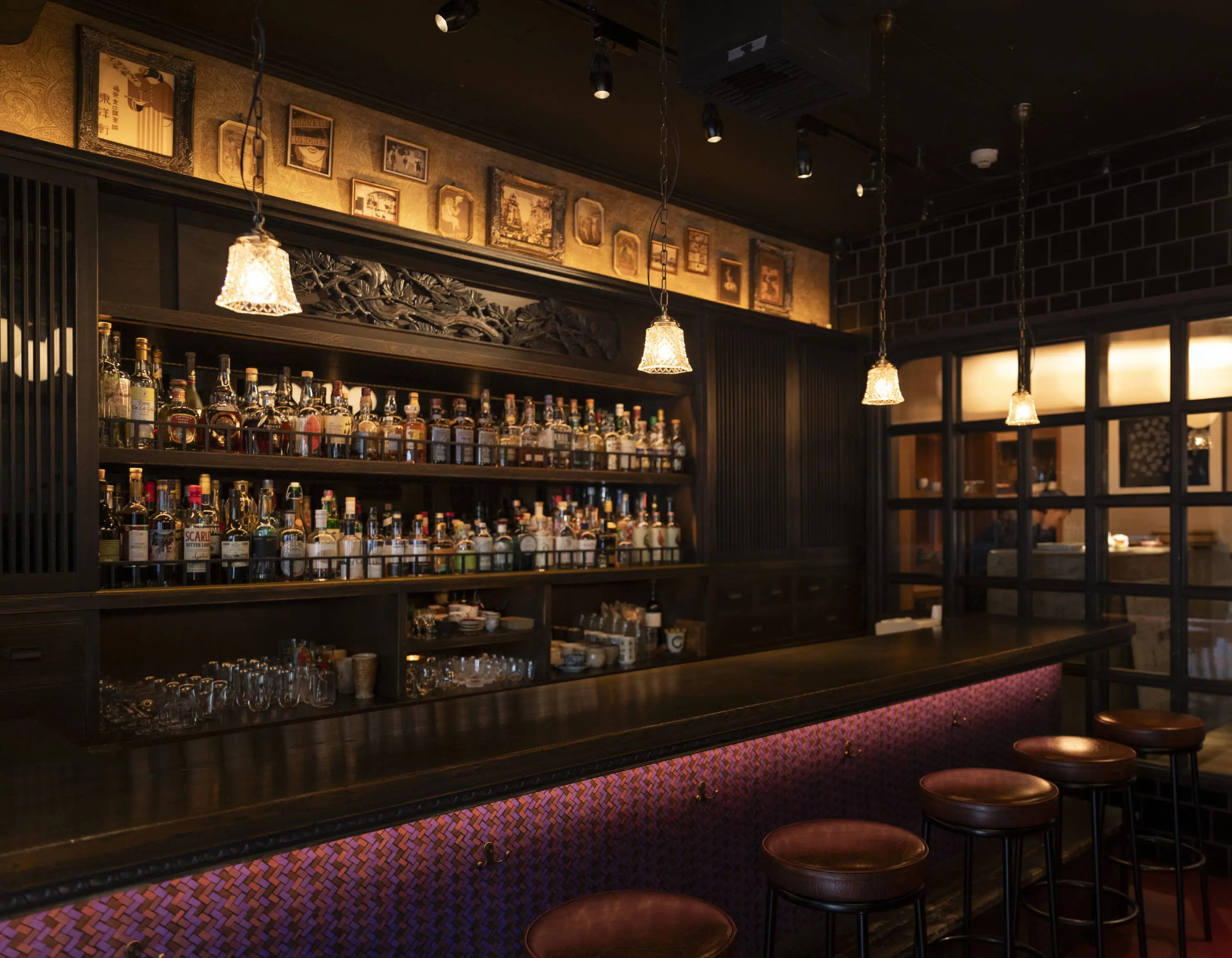
Where Meiji-Era Tokyo Meets the Modern Cocktail Counter
Shibuya rarely rewards stillness. The neighbourhood runs on volume: wide crossings, layered retail, and bars that lean into spectacle. The Bellwood occupies a different register. Set in Udagawachō, the quieter residential-commercial pocket that sits northwest of the station chaos, the space operates closer to the pace of a considered dining room than a destination bar. Approaching from the street, nothing about the exterior signals ambition. That restraint is deliberate, and it frames what follows inside.
Tokyo's cocktail scene has matured in a direction that rewards exactly this kind of discipline. Where Ginza bars like Bar High Five and Bar Orchard Ginza operate in the classical Japanese bartending tradition, with formal precision and a strict hierarchy of technique, Shibuya has developed space for something more hybrid. The Bellwood sits inside that opening, drawing on both Japanese craft culture and a transatlantic bartending vocabulary to produce something that doesn't slot neatly into either camp.
The Cocktail Programme: Kaiseki as Structure, Not Metaphor
The drinks at The Bellwood are organised around the logic of kaiseki, the formal Japanese multi-course meal in which each dish occupies a specific role in a larger progression. The bar's programme reimagines individual courses as cocktails: the sakizuke, a small palate-awakening appetiser, becomes a drink designed to open and orient; the yakimono, typically a grilled course of seasonal produce, translates into something with smoke, char, or roasted character; the gohan, rice served toward the meal's close, anchors the final act. Each cocktail draws on a mix of Japanese and Western spirits chosen to reflect the essence of the course it stands in for.
This isn't merely a naming conceit. The kaiseki framework gives the drinks programme a sequence and internal logic that distinguishes The Bellwood from bars where menus are curated by aesthetic mood alone. A guest moving through the full set of courses is effectively eating a meal in cocktail form, with the same arc of intensity, seasonality, and resolution that a serious kitchen would build into a tasting menu. The approach situates The Bellwood inside a Tokyo bar tradition that has long respected formalism, while extending that tradition into a genuinely new format.
The conceptual reference point is the wayō-setchū period, the late Meiji to Taisho era when Japan was absorbing and reconfiguring Western influence across architecture, food, and social customs. That cultural synthesis, neither purely Western nor purely Japanese, is the actual subject of the drinks programme. Japanese spirits appear alongside European classics; techniques cross; the vocabulary is bilingual. For Tokyo drinkers who have grown up with that hybridity as a baseline assumption, the bar reads as a kind of historical reckoning with how that synthesis came to feel natural.
Bartending Credentials and Programme Authority
The drinks programme at The Bellwood carries the weight of a specific bartending lineage. Atsushi Suzuki, who opened the bar in 2020, worked across New York and Japan before establishing it, building fluency in both the Japanese classical tradition and the more technique-driven American cocktail culture that was reshaping bar programmes internationally during the 2010s. That dual experience produced a bartender capable of treating the kaiseki framework not as decoration but as genuine structural logic, because the discipline behind it is grounded in both culinary and cocktail knowledge.
Bar's recognition trajectory confirms the programme's consistency. Ranked #53 on the World's 50 Best Bars list in 2023, it climbed to #89 in 2024 before settling at #79 in 2025, while the Asia-specific ranking placed it as high as #34 in 2024. The Top 500 Bars list positions it at #190 globally in 2025. Across the cocktail bar circuit that includes peers like Bar Benfiddich in Shinjuku, Bar Libre, and internationally recognised Japanese-influenced bars such as Bee's Knees in Kyoto and Bar Nayuta in Osaka, The Bellwood occupies a specific tier: bars where the drinks programme is built around a defensible creative system, not individual signature cocktails.
Bell Sushi: The Counter Behind the Bar
Tucked at the back of The Bellwood, the unmarked Bell Sushi counter adds a dimension that few cocktail bars anywhere have managed to sustain with any seriousness. The Bell Sushi format is a 12-piece nigiri omakase where traditional sushi technique meets global influence, a deliberate echo of the bar's own wayō-setchū philosophy applied to fish and rice rather than spirits and ice. In Tokyo's sushi culture, omakase counters operate at every price point and philosophical register, from the hyper-traditional to the consciously modern. Bell Sushi sits in the latter group, treating the nigiri sequence with the same course logic that structures the cocktail programme.
The pairing between the two programmes is internally coherent. A guest moving from the kaiseki cocktail sequence into a 12-piece sushi omakase is staying inside the same structural argument: that formal Japanese course logic is a flexible enough framework to absorb Western technique and ingredient without losing its integrity. For those searching specifically for bell sushi Tokyo as a destination, the counter is accessed through the bar itself, operating as a concealed format within a wider drinking experience rather than a standalone restaurant. That integration is part of what makes the format interesting; the sushi is not a separate offer bolted on for revenue, it is a continuation of the same idea.
Shibuya's Quiet Corner and What It Signals
Tokyo's drinking geography rewards attention. Ginza carries the weight of Japanese classical bartending, with venues like Bar High Five and Bar Orchard Ginza representing a formal tradition built over decades. Shinjuku runs a different current, with Bar Benfiddich representing the herbalist-specialist strand. Shibuya, despite its commercial energy, has developed a quieter sub-district in Udagawachō that supports more concept-driven venues. The Bellwood fits the neighbourhood's character: it is not trying to be the loudest signal in the area, but rather the one that sustains the longest conversation.
That positioning matters for how to read the bar against international comparisons. Bar Leather Apron in Honolulu offers another example of a bar in an unexpected geography that uses formal Japanese bartending sensibility as its anchor; The Bellwood's Shibuya location is similarly counterintuitive for anyone expecting Tokyo's most considered cocktail programming to concentrate exclusively in Ginza.
Planning a Visit
The Bellwood opens Monday through Saturday, 11:30 to 20:00, which places it in an unusual operating window for a destination cocktail bar: afternoon hours rather than late-night programming. That schedule suits the kaiseki-inspired format, which reads better as an intentional afternoon or early-evening experience than as a post-dinner stop. The address is 41-31 Udagawachō, Shibuya, Tokyo 150-0042. Google review data across 463 ratings places the bar at 4.5, a consistent score for a venue that polarises no one and satisfies almost everyone who arrives with a clear sense of what the programme is attempting.
For visitors building a broader Tokyo itinerary, our full Tokyo bars guide covers the range of drinking contexts across the city's distinct neighbourhoods. The Tokyo restaurants guide, hotels guide, wineries guide, and experiences guide extend planning across the full trip.
Frequently Asked Questions
- What's the leading thing to order at The Bellwood?
- The most considered way to approach the bar is through the full kaiseki-structured cocktail sequence rather than ordering à la carte. Each drink is designed to function within a progression, and the sakizuke-to-gohan arc gives context to individual flavours that would read differently in isolation. Given the bar's Asia's 50 Best recognition across multiple consecutive years, the programme as a whole is the point, not any single cocktail.
- What's the standout thing about The Bellwood?
- In a city with one of the most technically accomplished cocktail cultures in the world, The Bellwood's differentiation is structural: a drinks programme that applies kaiseki course logic as its organising principle rather than a thematic mood board. Ranked #79 on Asia's 50 Best Bars 2025 and as high as #34 in the Asia ranking in 2024, it has sustained that position across five years of operation, which is the more meaningful signal than any single-year placement.
- Does The Bellwood serve food, and how does Bell Sushi relate to the cocktail experience?
- The Bell Sushi counter is an unmarked 12-piece nigiri omakase located at the back of the bar, accessible through the main space rather than as a separate entrance. It applies the same wayō-setchū philosophy as the cocktail programme, fusing traditional Japanese sushi technique with global influences. The two programmes are conceptually linked rather than operationally separate, making The Bellwood one of very few bars in Tokyo where the food and drink are built around a shared intellectual argument rather than parallel offerings.
In Context: Similar Options
A compact peer snapshot based on similar venues we track.
| Venue | Cuisine | Price | Awards | Notes |
|---|---|---|---|---|
| The Bellwood | (2025) World's 50 Best Asia's Best Bars #79; Opened in 2020 by award-w… | This venue | ||
| Bar Benfiddich | World's 50 Best | |||
| Bulgari Ginza Bar | World's 50 Best | |||
| Star Bar Ginza | World's 50 Best | |||
| Tender Bar | ||||
| Bar High Five | World's 50 Best |
Need a Table?
Our members enjoy priority alerts and concierge-led booking support for the world's most difficult bars and lounges.
Get Exclusive Access