A working bacaro on Calle de la Malvasia in Castello, Osteria Al Portego operates closer to the rhythms of the neighbourhood than the tourist circuit. Locals crowd the narrow bar for cicchetti and wine by the glass through the afternoon, making it a reliable anchor for understanding how Venice actually eats between meals. It sits in a different register from the city's formal osterie, priced and paced accordingly.
 Discover on Pearl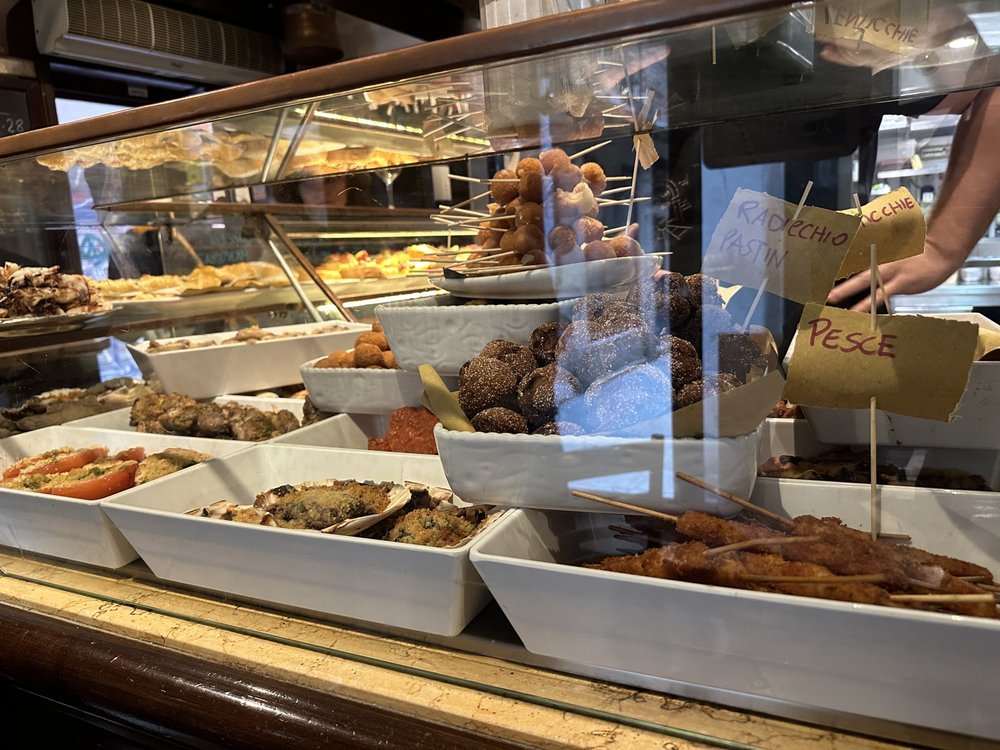
Castello's Counter Culture
Venice's Castello sestiere runs east from the tourist corridors that flood San Marco and Rialto, and the further you walk along its calli, the more the city reasserts its own pace. Osteria Al Portego, on Calle de la Malvasia, occupies exactly that middle ground: close enough to the Rialto market that its cicchetti reflect what arrived that morning, far enough that the clientele skews toward residents running errands rather than visitors consulting maps.
The bacaro format that Al Portego represents is one of Venice's most durable food traditions. These are not restaurants in any formal sense. They are standing bars where small preparations, cicheti, are set out on the counter through the day: folded bread with salt cod, hard-boiled eggs with anchovy, meatballs, fried vegetables, seasonal combinations determined by the market and the kitchen's discretion. The format predates the restaurant as a category in this city, and in the hands of a neighbourhood bacaro, it remains closer to its origins than anything in a guidebook's starred tier.
The shortlist, unlocked.
Hard-to-book tables, cellar releases, and concierge-planned trips.
Get Exclusive Access →What the Location Determines
The address on Calle de la Malvasia is significant in a specific way. The street name itself refers to Malvasia wine, a sweet Greek variety that Venetian merchants imported for centuries through the Republic's trade networks. The naming pattern across Venice's calli reveals how thoroughly the wine trade shaped daily life here, and a bacaro operating on such a street carries that history in its setting, however implicitly.
Castello has historically been the city's working district, home to the Arsenale shipyard workers who built the fleet that made Venice a maritime power. The neighbourhood's food culture reflects that practical inheritance: portions designed for people on short breaks, pricing that assumes regular rather than occasional customers, and a social density at the bar that bears no resemblance to a dining room. Al Portego fits this pattern. The narrow layout of a traditional bacaro forces proximity, and that physical compression is as much a part of the experience as what's on the counter.
For visitors planning their time in Venice, the logistics follow from the format. Cicchetti culture runs primarily through late morning and early evening, the hours when Venetians stop in between other activities. Arriving mid-afternoon between those windows risks finding the counter less fully stocked. The area around Castello offers reasonable access on foot from both the Rialto and the Arsenale vaporetto stop, making Al Portego a natural point on a longer walk through the eastern neighbourhoods rather than a standalone destination requiring separate planning.
Al Portego in Venice's Bar and Bacaro Tier
Venice's drinking and eating establishments have diversified in recent years into a broader range of registers. At one end, hotel bars like Aman Bar operate at a premium international standard, serving guests who have paid for the canal palazzo address. At the other, bacari like Al Portego operate on volume and regularity, with individual spends that remain low by any European capital measure. Between those poles sit wine bars such as Al Covino, which bridges the bacaro standing format with a more considered wine list and longer sitting options, and Rialto-adjacent spots like Al Mercà, where the open-air prosecco crowd operates on a different social tempo entirely. Al Covo represents yet another tier, where the cicchetti tradition extends into a full kitchen with a more formal dining register.
Al Portego's position in this spread is towards the neighbourhood-anchor end: it serves a function for locals that the more curated venues in the same city have stepped away from. That is neither a criticism nor a recommendation in isolation; it is a description of what kind of visit it rewards. Travellers who have spent time in comparable Italian bar cultures, say the ombra-and-cicchetti circuit in the Veneto, or the canal-side bacari that still operate without English menus, will recognise the register immediately.
Across Italy's other major cities, the informal wine bar with a standing counter and rotating food preparation has evolved in different directions. Enoteca Historical Faccioli in Bologna operates as a natural wine specialist with a deep cellar orientation, while operations like 1930 in Milan and Drink Kong in Rome have taken the neighbourhood bar format into cocktail territory with technical ambition. Gucci Giardino in Florence sits at the intersection of luxury retail and aperitivo culture. Against that range, Venice's bacaro tradition represents a distinct and largely unchanged category, one where the format's logic is social and economic rather than driven by menu curation or brand identity.
The Drink to Order
In any Venetian bacaro, the foundational order is an ombra, a small glass of local wine, typically white, poured from whatever the house is running that day. The term refers historically to the shadows cast by the campanile in Piazza San Marco, under which wine sellers reportedly moved their carts to keep bottles cool. That origin story may be apocryphal, but the drink format is not: a short pour, consumed standing, accompanied by a cicchetto or two from the counter, and followed by another or not, depending on how the afternoon is developing. Prosecco by the glass is the other common order in this part of the Veneto, though in a traditional bacaro the ombra remains the more locally grounded choice.
Planning a Visit
Al Portego sits in Castello at Calle de la Malvasia, 6014. It operates as a drop-in venue by nature; the bacaro format does not typically accommodate advance reservations, and the social logic of the space runs on spontaneity rather than scheduling. Whether the counter is crowded depends heavily on the hour: the early evening aperitivo window, roughly 6pm to 8pm in northern Italian convention, tends to bring the highest density. Arriving on the earlier side of that window gives more access to the cicchetti selection before it turns over. See our full Venice restaurants guide for broader coverage of the city's eating and drinking options by neighbourhood and register.
For travellers building itineraries that extend beyond Italy, the standing bar format has parallels in other markets worth noting: L'Antiquario in Naples operates within a different but related southern Italian aperitivo culture, while Lost and Found in Nicosia and Bar Leather Apron in Honolulu demonstrate how the specialist bar format translates across considerably different contexts.
The shortlist, unlocked.
Hard-to-book tables, cellar releases, and concierge-planned trips.
Get Exclusive Access →Frequently Asked Questions
A Tight Comparison
A quick peer check to anchor this venue’s price and recognition.
| Venue | Notes | Price |
|---|---|---|
| Osteria Al Portego | This venue | |
| Aman Bar | ||
| Arts Bar | ||
| Il Mercante | ||
| Vino Vero | ||
| Al Covino |
Need a Table?
Our members enjoy priority alerts and concierge-led booking support for the world's most difficult bars and lounges.
Get Exclusive AccessThe shortlist, unlocked.
Hard-to-book tables, cellar releases, and concierge-planned trips.
Get Exclusive Access →