Mustards Grill
On the St. Helena Highway, Mustards Grill has functioned as a de facto common room for the Napa Valley wine industry for decades — a place where vineyard workers, winemakers, and visitors share the same room without ceremony. The menu tracks California wine-country cooking at its most grounded: straightforward preparations, local sourcing, and a wine list calibrated to match rather than impress.
 Discover on Pearl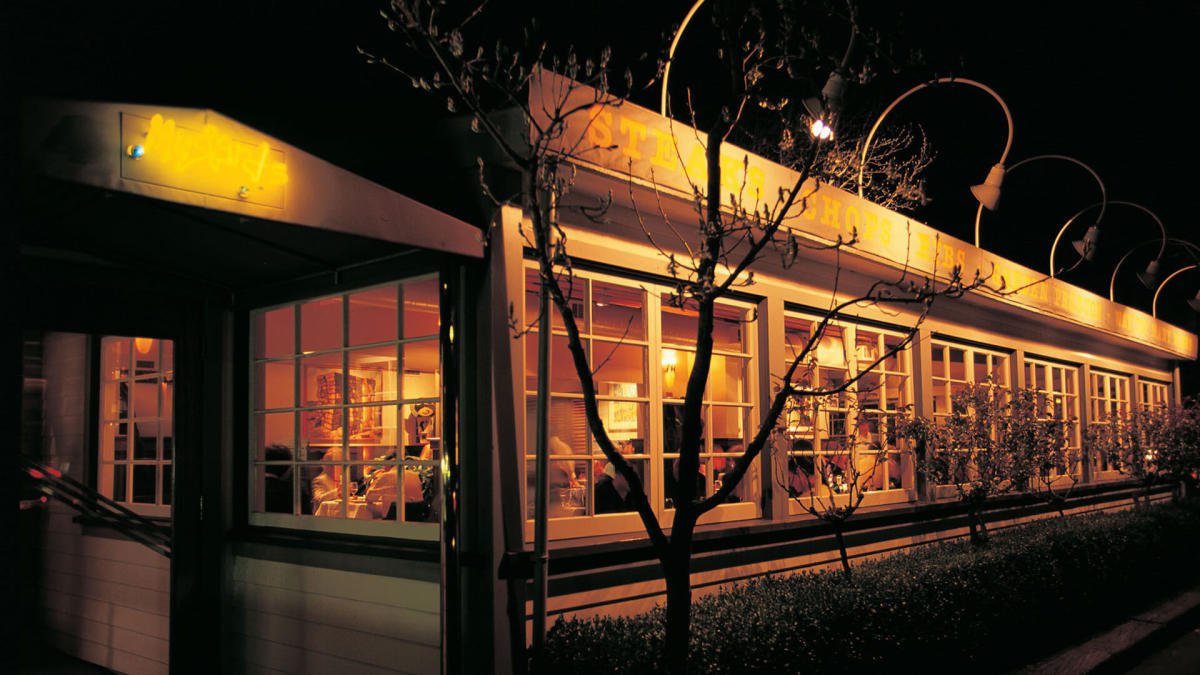
The Room That Napa Built
There is a particular kind of restaurant that a wine region produces not by design but by necessity: a place where the people who actually make the wine can eat a proper meal, drink something cold, and sit across from the people who drove two hours to buy it. On the St. Helena Highway, roughly mid-valley between Napa town and Calistoga, Mustards Grill occupies exactly that role. The building announces itself plainly from the road — a low-slung structure with a parking lot that fills early and a dining room that runs loud from lunch onward. There is no soft launch here, no quiet corner reserved for industry insiders. The noise is the point.
Wine-country restaurants divide, broadly, into two categories. The first trades on the scenery — vineyard views, hushed rooms, tasting-menu formats priced to match the bottles on the list. The second is less interested in performance and more interested in function. Mustards has always belonged to the second category, and that positioning has made it, over the years, something closer to infrastructure than restaurant. For our full Napa County restaurants guide, it registers as a reference point rather than a destination in the conventional sense.
What the Room Tells You About the Valley
California wine-country cooking in its most grounded form is not especially fussy. It borrows from the same European traditions that shaped the vineyards themselves , French technique filtered through decades of California informality , and it tends to prize ingredient quality over compositional complexity. Mustards works inside that tradition. The menu reads as a document of what the valley actually eats rather than what it aspires to plate for visiting critics. That is a meaningful distinction in a corridor that has, in the past two decades, seen a considerable expansion of destination-dining formats.
Proximity to St. Helena places the restaurant inside one of the valley's densest concentrations of serious wine producers. Properties like Clos Pegase Winery and Tasting Room are within easy reach, and the lunch trade at Mustards reflects that geography: the room at midday draws a cross-section that includes tasting-room staff, vineyard managers, and visitors moving between appointments. It is one of the few spaces in the mid-valley where those groups share tables without self-consciousness, which is rarer in Napa than it sounds.
The Bar Counter as Common Ground
The editorial angle that matters here is not what Mustards serves but how the bar functions within the local social architecture. Napa has no shortage of places to drink well , the valley's bar programs at properties like Carneros Resort and Spa and FARM Restaurant and Bar represent the polished, resort-anchored end of the spectrum. Mustards represents the other end: a bar counter where the wine list is genuinely functional and where the default assumption is that most people at the rail know what they are ordering.
That kind of fluency is, in practice, built over years of regulars. The wine list at a place like this is calibrated differently from a destination restaurant's list , it needs to satisfy visitors who are working through the valley's Cabernet producers while also giving the winemaker at the next stool something to drink that does not feel like homework. Getting that balance right is a curatorial skill that does not get discussed much in wine-country criticism, but it is what separates a functioning local watering hole from a restaurant that happens to sell wine.
At the southern end of the county, Boon Fly Café serves a comparable function for the Carneros district , a room where locals and visitors overlap , but the registers differ. Carneros skews younger and more casual; the mid-valley crowd at Mustards carries more institutional memory of the valley's development as a wine region.
California Wine Country Cooking in Context
Wine-country cuisine as a category has expanded considerably since the early years of Napa's premium reputation. The valley now supports everything from hyper-seasonal tasting menus drawing international comparison to direct bistro formats. Mustards occupies the bistro register , preparations that respect the ingredient without requiring the diner to think too hard about the composition. That is not a criticism. In a county where a significant portion of the dining public is already managing a tasting schedule, a menu that rewards attention without demanding it is a considered choice.
For comparison: programs like ABV in San Francisco demonstrate how a bar-forward California venue can develop genuine culinary credibility through focused, technically consistent execution. The mechanics are different in Napa, where the wine always leads, but the underlying logic , substance over spectacle , translates across both rooms.
Planning a Visit
Mustards sits at 7399 St. Helena Highway, positioned along the main artery connecting Napa to Calistoga. The location makes it a natural stop between winery appointments rather than a dedicated drive, though the lunch crowd on weekends suggests plenty of people treat it as a destination in its own right. The mid-valley highway runs busy on Saturday and Sunday, and parking, while available, fills during peak afternoon hours. Booking ahead for lunch on weekends is advisable; the room runs at capacity more often than the highway-diner aesthetic might suggest.
The venue sits within a corridor that includes some of the valley's most visited tasting rooms, meaning visitors combining a Mustards lunch with a Clos Pegase or similar appointment can build a coherent mid-valley afternoon without backtracking. For those building a broader itinerary across the American West Coast bar and restaurant circuit, venues like Bar Leather Apron in Honolulu, Kumiko in Chicago, and Superbueno in New York City represent the kind of technically serious, community-embedded bar programs that share a philosophical register with what Mustards does at the wine-country level, even if the formats differ considerably.
Frequently Asked Questions
- What is the signature drink at Mustards Grill?
- Mustards Grill is primarily oriented around wine rather than cocktails, which reflects its position within the Napa Valley wine corridor. The bar list is calibrated to support the menu and the valley's Cabernet-dominant identity, with selections pitched at visitors working through the region's producers as much as at locals drinking casually. Specific current offerings should be confirmed directly with the venue before visiting.
- What should I know about Mustards Grill before I go?
- Mustards occupies a mid-valley position on the St. Helena Highway that makes it genuinely accessible between winery appointments rather than a detour. The room runs loud and full, particularly at weekend lunches, and the atmosphere is deliberate , this is not a quiet room. It sits closer to the bistro register than the destination-dining format that characterises much of Napa's higher-priced tier, and it prices and operates accordingly. Arriving with a reservation on busy weekends is the practical approach.
- Can I walk in to Mustards Grill?
- Walk-ins are possible, particularly at the bar counter, but the dining room fills quickly on weekends and during peak season, which in Napa runs from late spring through harvest in October. If you are visiting during the busy summer months or planning a weekend lunch, securing a reservation in advance avoids the risk of a wait. The venue's position on the highway means there is no walk-in foot traffic in the conventional urban sense , virtually all arrivals come by car.
- How does Mustards Grill fit into the broader Napa dining scene compared to resort restaurants?
- Mustards operates in a distinct tier from resort-anchored dining programs like those at FARM Restaurant and Bar or Carneros Resort and Spa. Where resort restaurants are built around a controlled environment and a captured guest base, Mustards draws from the valley's working population as much as from its visitors, which gives the room a different social mix and a less curated atmosphere. That distinction has defined its local role for decades.
Reputation Context
A compact peer snapshot based on similar venues we track.
| Venue | Awards | Cuisine | Notes |
|---|---|---|---|
| Mustards Grill | This venue | ||
| Carneros Resort and Spa | |||
| Clos Pegase Winery & Tasting Room | |||
| Boon Fly Café | |||
| FARM Restaurant + Bar | |||
| V. Sattui Winery |
Need a Table?
Our members enjoy priority alerts and concierge-led booking support for the world's most difficult bars and lounges.
Get Exclusive Access