One of northern France's most historically significant addresses, Méert at 25-27 Rue Esquermoise has operated as a confiserie, salon de thé, and purveyor of refined drinks in the heart of Lille for well over two centuries. The ornate interior, with its gilded woodwork and Belle Époque detailing, places it in a tier of French institutions where atmosphere and provenance carry as much weight as what's in the glass.
 Discover on Pearl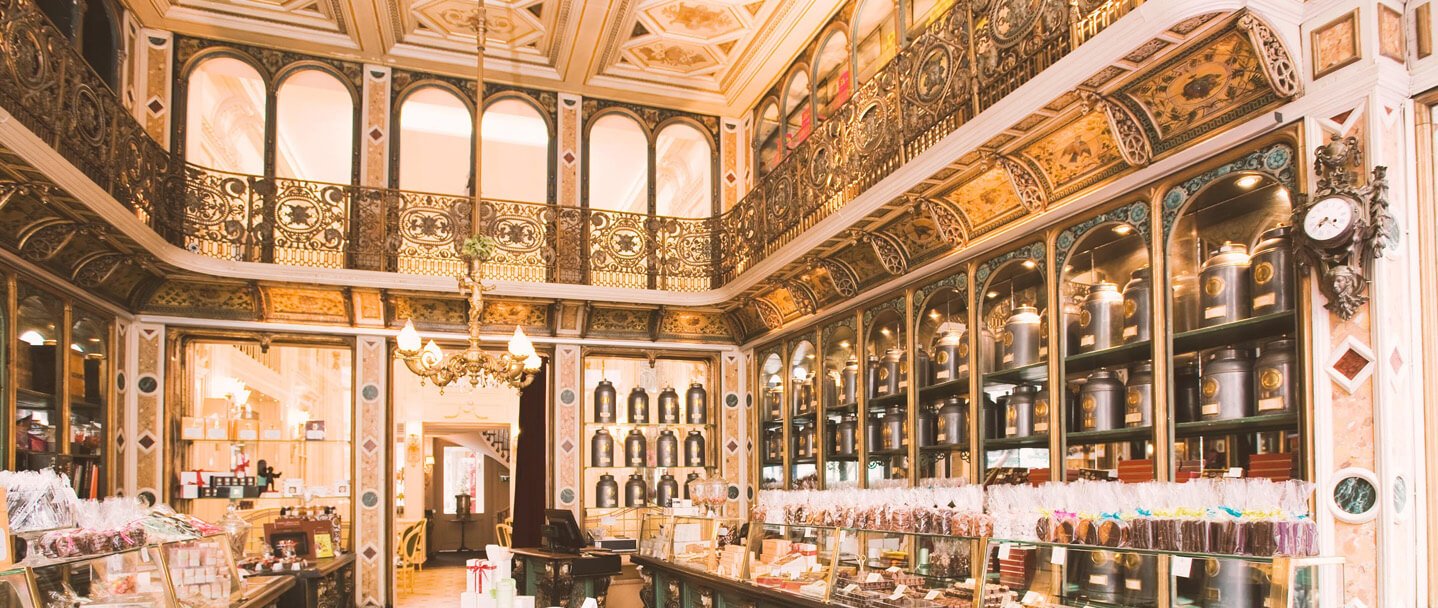
Two Centuries on Rue Esquermoise
Lille's drinking culture sits at a geographic crossroads that few French cities share. Flanked by Belgium to the north and the Channel to the northwest, the city has historically absorbed influences from Flemish brewing traditions, French distilling culture, and a bourgeois café society that peaked in the Belle Époque and never entirely disappeared. Méert, at 25-27 Rue Esquermoise, is one of the clearest expressions of that layered inheritance. The address has been operating since the early eighteenth century, making it not merely old by regional standards but old by the standards of European hospitality in general.
Approaching the façade on Rue Esquermoise, the building announces itself through architecture before anything else. The shopfront is a study in nineteenth-century French commercial design: painted woodwork, arched windows, and a formal symmetry that signals continuity with a pre-industrial retail tradition. Inside, gilded panels, pale walls, and ornate ceiling details place the visitor in a room that reads more like a preserved interior than a working café. That distinction matters. Preserved interiors tend to feel inert. Méert's room functions, which keeps it legible as a place to sit and consume rather than a heritage display.
The shortlist, unlocked.
Hard-to-book tables, cellar releases, and concierge-planned trips.
Get Exclusive Access →What the Address Represents in Lille's Drinks Culture
Lille's premium drinks addresses have diversified considerably over the past decade. The city now has a recognisable cocktail bar scene anchored in the Vieux-Lille neighbourhood, with venues like La Biche & Le Renard representing the contemporary, technique-forward end of the market. Méert occupies a different position in that spectrum: it is not a cocktail bar in the modern sense, and it makes no pretence of being one. Its competitive set is better understood as the category of French salon de thé institutions that also trade in spirits, wines, and fortified drinks, venues where the drink is inseparable from the room and the room from the history.
Across France, this category has produced some of the country's most carefully curated back bars. The logic is consistent: an institution that has been trading for generations accumulates both the relationships and the storage conditions to hold bottles that a newer venue cannot easily source. Whether Méert's current selection reflects that potential fully is a question leading answered on the ground, but the institutional framework for serious curation is present in a way that a venue opened in the last decade cannot replicate.
For context on how similarly positioned French addresses handle their drinks programs, Bar Nouveau in Paris represents the contemporary Parisian equivalent of a heritage-adjacent bar that positions itself through curation rather than novelty. In provincial cities, the model translates differently: La Maison M. in Lyon and Coté vin in Toulouse both demonstrate how French regional bars use provenance and selection depth as the primary differentiators from volume venues.
The Confiserie and the Glass: How Méert's Offer Is Structured
Méert's identity has always been dual: it operates as both a confiserie selling chocolates and gaufres and as a salon where guests sit and are served. The two functions reinforce each other. The confiserie trade requires sourcing discipline, supplier relationships, and an institutional appetite for quality that typically extends to what goes in the glass. French salons de thé that operate at this tier have historically served fortified wines, digestifs, and selected spirits alongside the pastry offer, and Méert's age and positioning suggest it falls within that tradition.
The gaufre de Lille, for which Méert has been noted since the nineteenth century, remains the most documented element of the offer. A vanilla-filled waffle with roots in the regional confiserie tradition, it functions as a kind of anchor product that has made the address legible to successive generations of visitors. Charles de Gaulle's family reportedly purchased them here, a piece of civic history that has been part of Méert's public record for decades. That kind of documented connection to French cultural life gives the address a different weight than a venue whose provenance is merely architectural.
Where Méert Sits in a Broader French Itinerary
For travellers moving through northern France, Méert is one of the addresses that rewards a stop even without a deep interest in Lille's broader scene. The city itself receives fewer international visitors than its size and infrastructure would suggest, which means that addresses like Méert operate in a context where the competition for serious attention is lower than in Paris or Lyon. That asymmetry works in the visitor's favour.
Lille is two hours from Paris by TGV and under forty minutes from Brussels, which positions it as a plausible half-day extension from either city. Rue Esquermoise sits within the Vieux-Lille neighbourhood, walkable from the Gare Lille-Flandres and within a short walk of the city's main architectural cluster. The practical case for including Méert in a Lille visit is therefore logistical as much as editorial: the address is close to everything else worth seeing, and its opening hours as a daytime salon make it a natural anchor for an afternoon in the neighbourhood.
For a fuller account of how Méert sits within Lille's wider food and drink scene, our full Lille restaurants guide maps the city's key addresses by neighbourhood and category.
Comparable Addresses Across France
The category Méert represents, the long-established French salon with a substantive drinks dimension, has equivalents in most major French cities and several smaller ones. Bar Casa Bordeaux in Bordeaux operates in a city where wine heritage and institutional hospitality overlap in a similar way. Au Brasseur in Strasbourg reflects Alsace's distinct tradition where beer culture and French formality coexist within the same room. Papa Doble in Montpellier and Le Café de la Fontaine in La Turbie each demonstrate how the salon format adapts to southern French contexts, where the ambient temperature, the local wine tradition, and the pace of service produce a different register of the same institutional idea.
Beyond France, BOUVET LADUBAY in Saumur shows how a heritage producer can extend its identity into a hospitality offer that is as much about the space and the provenance as the liquid itself. Le Petit Nice Passedat in Marseille operates at the luxury end of the same instinct: that the drink and the room together constitute the experience, not the drink alone. Even Bar Leather Apron in Honolulu reflects an international version of the idea that curation and setting together define a drinks destination more precisely than category or price alone.
Planning a Visit
Méert is located at 25-27 Rue Esquermoise in Vieux-Lille, within easy walking distance of the main stations and the Grand'Place. As a salon de thé rather than an evening bar, visits are typically daytime affairs. Given the address's dual identity as both a retail confiserie and a sit-down salon, it is worth arriving with time to browse the shop as well as to sit. The volume of visitors during peak tourist season in summer means that midweek visits, particularly in the morning, tend to be quieter. No booking information is currently listed in our database, so arriving in person is the most reliable approach for securing a table.
Frequently Asked Questions
- What drink is Méert famous for?
- Méert is most closely associated with its confiserie offer, particularly the gaufre de Lille, a vanilla-filled waffle with a documented history stretching back to the nineteenth century. Within the salon, the drinks offer operates in the tradition of French establishments of this age and type, where fortified wines, selected spirits, and teas sit alongside the pastry offer. The address's awards and critical recognition are tied primarily to its confiserie and heritage status rather than to a specific cocktail or bottle.
- What makes Méert worth visiting?
- In a city that sits between Paris and Brussels on the Eurostar and TGV network, Méert provides something that neither capital offers in quite the same form: an eighteenth-century commercial interior still operating at its original address, with a confiserie and salon offer that has accumulated genuine provenance rather than simulated it. The price of entry is low relative to comparable Parisian institutions, and the neighbourhood context in Vieux-Lille makes it easy to combine with the city's other key addresses.
- What's the leading way to book Méert?
- No booking system or contact details are currently listed in our database for Méert. As a salon de thé rather than a reservation-based restaurant, walk-in is the standard approach. Visitors travelling from Paris or Brussels on a day trip should plan to arrive before the midday rush, particularly on weekends when Vieux-Lille sees higher foot traffic. Confirming current hours directly via the venue before visiting is advisable.
- What's the leading use case for Méert?
- Méert works leading as an afternoon anchor in a Vieux-Lille itinerary rather than as a standalone destination. The combination of the shop and the salon means it absorbs thirty minutes to an hour naturally, and it pairs well with the neighbourhood's broader cluster of independent retailers and historic architecture. For visitors on a tight schedule between Paris and Brussels, it represents the kind of address that makes a Lille stopover feel purposeful rather than incidental.
- Is Méert connected to any documented historical figures or events?
- Yes. Méert's public record includes a documented connection to Charles de Gaulle's family, who reportedly purchased the address's gaufres de Lille during the early twentieth century, when de Gaulle was growing up in the city. That connection has been cited in French cultural press and local historical accounts, giving Méert a layer of civic provenance that goes beyond architectural age. The address at 25-27 Rue Esquermoise has been in continuous operation for well over two centuries, placing it among the oldest functioning commercial hospitality addresses in northern France.
Pricing, Compared
These are the closest comparables we have in our database for quick context.
| Venue | Price | Awards | Notes |
|---|---|---|---|
| Méert | This venue | ||
| Bar Nouveau | World's 50 Best | ||
| Buddha Bar | World's 50 Best | ||
| Candelaria | World's 50 Best | ||
| Danico | World's 50 Best | ||
| Harry's Bar | World's 50 Best |
Need a Table?
Our members enjoy priority alerts and concierge-led booking support for the world's most difficult bars and lounges.
Get Exclusive AccessThe shortlist, unlocked.
Hard-to-book tables, cellar releases, and concierge-planned trips.
Get Exclusive Access →