
La Capilla sits on Hidalgo street in the old town of Tequila, Jalisco, and holds a place in the World's 50 Best Bars record that few cantinas anywhere can match: four consecutive rankings between 2011 and 2014, peaking at number 16. The bar is less a cocktail destination in the contemporary sense and more a living document of how Mexico's national spirit has been served and celebrated in its birthplace for generations.
Pearl is the En Primeur Club membership app — saves, bookings, and concierge access live there. Same editors, same standards.
- Address
- Hidalgo 31, Centro, 46400 Tequila, Jal.
- Website
- theworlds50best.com
- Directions
- Get directions
 Saves & bookings on Pearl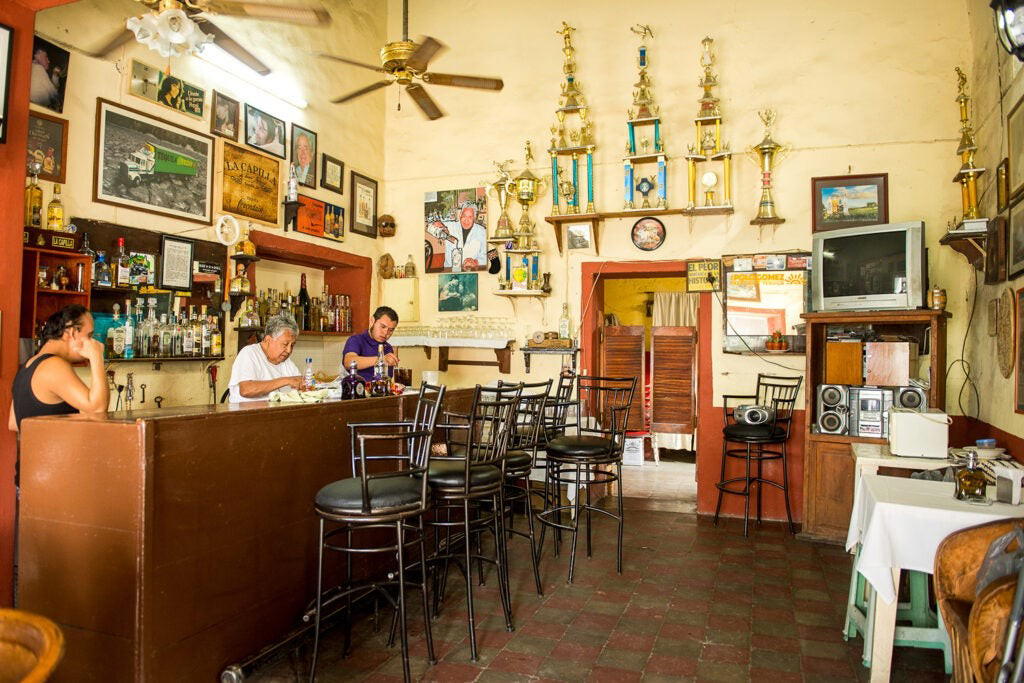
A Cantina in the Capital of Agave
Calle Hidalgo runs through the centro of Tequila, Jalisco, the way most streets run through Mexican towns of its size: unassuming, sun-bleached, dotted with doorways that hold more history than their exteriors suggest. La Capilla occupies one of those doorways at number 31. The physical space does not announce itself with design ambition or mood lighting. What it has instead is continuity: the kind of worn-in permanence that only decades of daily use can produce, and a record on the international bar circuit that places it in company far removed from its modest street address.
The broader context matters here. The town of Tequila is the commercial and cultural nucleus of the Denominación de Origen Tequila, the protected appellation that governs production of the spirit across five Mexican states. Distilleries run along the landscape in every direction. Visitors arrive to tour production facilities and taste through expressions of blue agave. Against that industrial backdrop, La Capilla functions as a counterpoint: a drinking room rather than an education centre, a place where the spirit is consumed rather than explained.
Where the Rankings Place It
Between 2011 and 2014, La Capilla appeared four consecutive times on the World's 50 Best Bars list, reaching number 16 in 2011. That ranking trajectory tells its own story. The bar entered the list at a high position and moved gradually down as the international cocktail circuit expanded and newer programmes absorbed attention. That pattern is common for bars whose authority derives from tradition rather than innovation cycles: they tend to rank on first discovery by the voting community, then slip as novelty wears off and technical programmes in major cities absorb votes.
What the ranking history confirms is that La Capilla was not placed on that list as a novelty or a regional curiosity. At number 16 globally, it sat alongside cocktail programmes in London, New York, and Tokyo that were operating with professional bartending teams, curated spirits collections, and deliberate menu architectures. A cantina in a small Mexican town earning that position suggests the voting community found something in its approach that the era's technical bars were not providing: specificity of place, and a relationship to a single spirit that no imported programme could replicate. For a broader picture of Mexico's bar scene during that period and since, the contrast with city-based programmes like Baltra Bar in Mexico City or El Gallo Altanero in Guadalajara is instructive: those bars operate with menus designed to iterate seasonally and techniques drawn from global bartending. The bar's authority runs in a different direction entirely.
The Drink and the Technique
The bar is associated above all with the Batanga, a drink built from tequila, cola, and fresh lime, stirred with a large knife and served in a salt-rimmed glass. The Batanga is not a sophisticated cocktail by the criteria of contemporary bartending. It does not involve clarification, fat-washing, or tinctures. Its ingredient list is short and its construction is deliberate in its simplicity. What places it in a different category from other simple long drinks is its origin story and its setting: a drink mixed in the town where its base spirit is made, by a bar that has been serving it for long enough that the preparation has become its own ritual.
The knife stir is the detail that matters most for how the drink has been discussed and documented. It is not a technique designed to achieve a particular dilution rate or temperature. It is a gesture that carries association with the bar's history and with the specific person who developed it. In the broader taxonomy of drinks linked to a single place and a single bartender, the Batanga occupies an interesting position: it is simple enough that anyone can reproduce it, but the version served at the bar carries a provenance that reproduction cannot transfer. That gap between recipe and origin is precisely what the World's 50 Best community was recognising when it placed the bar in its upper rankings.
Mexico's broader cocktail evolution has moved significantly since 2011. Programmes like Bekeb in San Miguel de Allende, Sabina Sabe in Oaxaca, and Boulenc in Oaxaca City represent a new generation of Mexican bar culture that draws on indigenous ingredients, local fermentation traditions, and technique-led bartending. Arca in Tulum and Zapote Bar in Playa del Carmen bring that sensibility to resort markets. Against that movement, the bar does not compete on the same terms. It predates the movement and sits outside it. Its reputation rests on something the newer programmes are still building: duration.
Arriving and Drinking There
The town of Tequila is roughly an hour northwest of Guadalajara by road, and a dedicated tourist train, the Jose Cuervo Express, runs weekend departures from Guadalajara's historic station with distillery visits built into the itinerary. That infrastructure brings a steady stream of visitors to the town, many of whom pass through the bar as part of the circuit.
The bar operates as a walk-in cantina. It operates as a walk-in cantina. The address, Hidalgo 31, Centro, places it within the walkable historic centre, close to the main plaza. Pricing is about $10 per person. The drink itself, in other words, is not priced against its ranking history.
For travellers building a wider itinerary around Mexico's bar culture, the bar works well as a specific stop on a route that includes Guadalajara's cocktail scene. Aruba Day Drink in Tijuana and Cafe Liquor in Todos Los Santos represent the kind of regional bar culture that rewards detour; the bar sits in that same tier of destination-with-purpose. For those building a Pacific-facing bar itinerary further afield, Bar Leather Apron in Honolulu offers a useful point of contrast in how a bar builds lasting reputation through programme discipline rather than historical provenance. Coco Bongo in Cancun represents the opposite end of the spectrum entirely: high-volume spectacle over craft or provenance.
What the Bar Represents in the Broader Story
The bar's place in the World's 50 Best Bars history is significant not because it competed with London's technical programmes on their own terms, but because it demonstrated that a bar's authority does not have to derive from innovation. The 2011 to 2014 era of the list was a period when the bar world was beginning to take Mexican spirits seriously as a category, and placing a small cantina in Tequila at number 16 was partly a statement about that shift. The mezcal wave that followed, which drove interest in Oaxacan producers and pushed agave spirits into the premium tier globally, had not yet peaked. In that context, the bar functioned as an early signal.
What the bar offers a visitor today is not what it offered a voter in 2011. The international context has changed, the agave category has matured, and the Mexico bar scene has produced new programmes with serious technical ambitions. What remains consistent is the drink, the address, and the fact that the Batanga was invented and is still served where the tequila is made. That combination of origin and continuity is not reproducible elsewhere, and it is the basis on which the bar continues to attract visitors who have done their research before arriving on Calle Hidalgo.
Side-by-Side Snapshot
Comparable venues nearby, for context on price, style, and recognition.
| Venue | Cuisine | Price | Awards | Notes |
|---|---|---|---|---|
| La CapillaThis venue — the venue you are viewing | dive_bar | $$ | World's 50 Best #16 | Not listed |
| El Gallo Altanero | cocktail_bar | $$ | World's 50 Best #8 | 140390001158A |
| Bekeb | rooftop_bar | $$$ | World's 50 Best #27 | Zona Centro |
| Bar Mauro | cocktail_bar | $$$ | World's 50 Best #14 | Roma Norte |
| Café de Nadie | cocktail_bar | $$ | World's 50 Best #15 | Roma Norte |
| Sabina Sabe | mezcaleria | $$ | World's 50 Best #20 | 2006700010204 |
Recognition history
Dated appearances from independent guides and award organizations, with the underlying list record or original source where available.
World's 50 Best Best Bars #46
World's 50 Best
World's 50 Best Best Bars #37
World's 50 Best
World's 50 Best Best Bars #20
World's 50 Best
World's 50 Best Best Bars #16
World's 50 Best
Continue exploring
More in Tequila
Bars in Tequila
Browse all →
Restaurants in Tequila
Browse all →
Hotels in Tequila
Browse all →
At a Glance
- Rustic
- Well Known
- Cozy
- Casual Hangout
- Historic Building
- Seated Bar
- Counter Only
- Tequila
No-frills, authentic old-school cantina with plywood bar, plastic chairs, and a lively local atmosphere that feels like stepping back in time.