Guavate
Guavate is Cayey's celebrated roadside strip along PR-52, where lechoneras line the mountain highway and slow-roasted pork has defined weekend ritual for generations. The scene runs on charcoal smoke, cold Medalla, and communal tables that fill well before noon on Saturdays. For anyone tracing Puerto Rico's food traditions beyond San Juan, it is the clearest possible argument for the island's vernacular cooking.

Pearl is the En Primeur Club membership app, where members save venues, book tables and use the concierge.
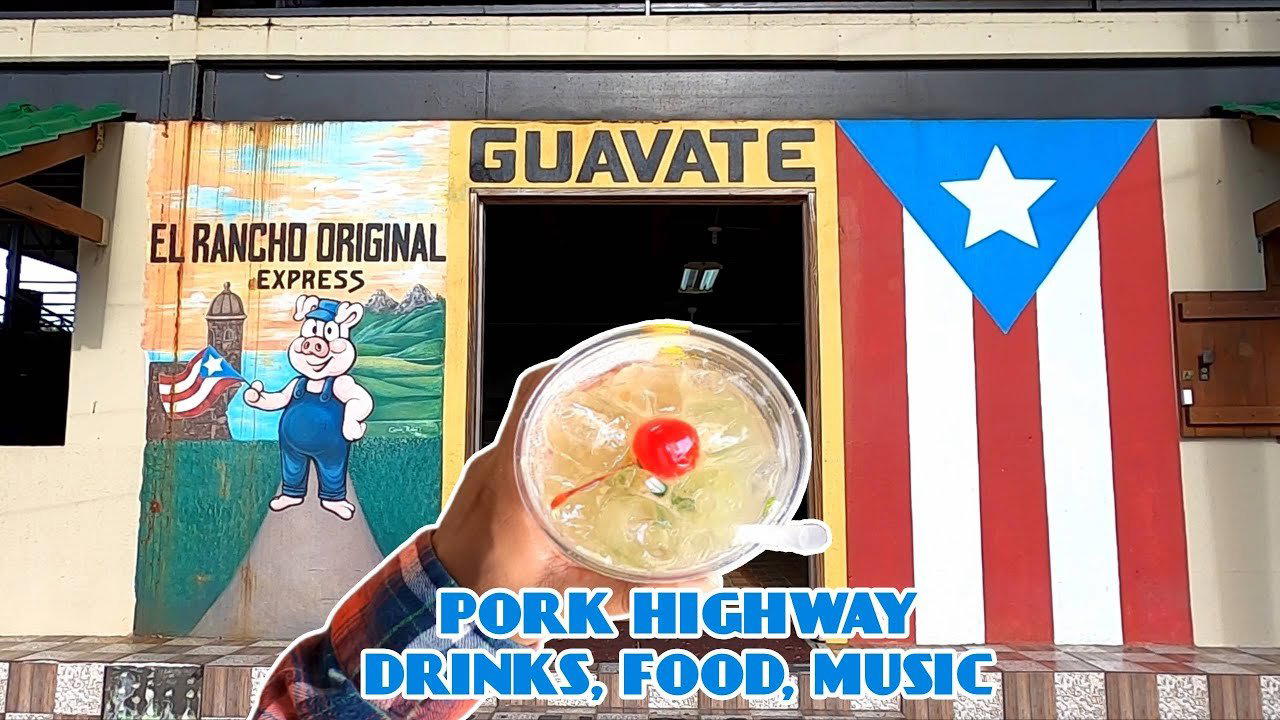
The Road Into the Mountains
Approaching Cayey from the north on PR-52, the air changes before the exit. Charcoal smoke drifts across the highway somewhere around kilometer 32, and by the time drivers pull onto the service road, the scene is already in motion: families carrying styrofoam trays, vendors calling from open-fronted stalls, and whole pigs turning on spits behind wire mesh. Guavate is not a restaurant in the conventional sense. It is a corridor of lechoneras, a collective food tradition that runs along the mountain road and operates on a weekend calendar that has remained largely unchanged for decades. The individual stalls vary in size and menu depth, but the organizing principle is the same across all of them: whole-roasted pork, served by weight or portion, accompanied by rice, beans, and fried starches.
For context on Puerto Rico's broader bar and drinking scene, our full Cayey restaurants guide covers the surrounding area in detail.
What Lechonera Culture Actually Means
Lechón asado, roasted over wood or charcoal, is one of the defining practices of Puerto Rican communal eating. The tradition draws from Spanish colonial technique and African cooking practice, and the mountain municipalities around Cayey have developed it into something closer to a regional institution than a street food category. The Guavate strip concentrates this tradition in a way that makes the cooking legible as a system: the same base ingredients, the same achiote-rubbed pigs, the same crackled skin, but each lechonera applying its own balance of seasoning, fire management, and side dish repertoire. Weekend throughput at the busiest stalls can run to hundreds of kilos of pork by early afternoon, which gives some indication of the scale this tradition operates at.
The drinking culture here runs parallel to the food: cold beer, typically Medalla Light, the island's dominant domestic lager, and occasionally rum mixed simply. This is not a cocktail environment. The beverage program, if it can be called that, is calibrated to match food cooked over direct heat in open air. Visitors expecting the kind of considered cocktail work found at La Factoría in San Juan or the refined tropical approaches at Jewel of the South in New Orleans will find a different register entirely here, and that difference is the point.
Drinking in Context: What the Mountain Strip Offers
Across Puerto Rico, the gap between the craft cocktail scene concentrated in San Juan's Santurce district and the vernacular drinking culture of the interior municipalities is significant. The island's cocktail infrastructure has grown considerably in recent years, with San Juan bars developing programs that reference classic Caribbean rum tradition through a contemporary technical lens. Guavate sits outside that conversation. The drinking here is functional and social: the Medalla stays cold, the rum comes in plastic cups, and the transaction takes about fifteen seconds. That economy of service is part of the experience's coherence rather than a limitation of it.
For comparison, operations like Campamento Piñones in Loiza and La Parguera in La Parguera occupy a similar register: outdoor, community-oriented, food-led, with drinking as a social lubricant rather than an independent program. The contrast with venues like PR-116 in Lajas or El Bohio in Rincon is instructive for anyone mapping Puerto Rico's hospitality range. And for those whose reference points extend beyond the island, the discipline and transparency-focused programs at Bar Leather Apron in Honolulu, Julep in Houston, or Kumiko in Chicago represent what happens when the same communal spirit is filtered through a technically demanding cocktail framework. Guavate makes no claim in that direction, and is better understood for it.
Rum's presence here connects to the island's production heritage. Casa BACARDÍ in Catano and Da Bowls in Aguadilla represent different expressions of how Puerto Rico's rum identity is packaged for visitors; Guavate offers the least packaged version of all.
The Energy and the Timing
The strip runs at full capacity on Saturday and Sunday mornings, with many stalls selling out of pork by early afternoon. This is not a Friday night destination or an evening scene. The energy is daytime, familial, and loud in the way that outdoor communal eating spaces tend to be: generators, speakers, conversation competing with cooking sounds. By mid-afternoon on a Sunday, the stalls that started at dawn begin to wind down, and the road empties with notable speed. The practical implication is simple: arrive before noon on a weekend to find full selection. Arriving after 2pm on a Sunday typically means reduced options and depleted trays.
There are no reservations, no dress considerations, and no website to check. The entire system operates on cash, physical presence, and timing awareness. For anyone accustomed to booking-required dining in San Juan or the controlled environments of upscale Caribbean hospitality, the Guavate model requires a recalibration of expectations that most visitors find more liberating than inconvenient.
What to Order and How to Eat
The organizing principle of any order here is the lechón itself: slow-roasted pork sold by portion or weight, with crackling skin that is assessed as seriously as any preparation in the repertoire. Standard accompaniments include arroz con gandules (rice with pigeon peas), tostones (twice-fried green plantain), and morcilla (blood sausage), which varies stall to stall in spice balance and fat ratio. The morcilla at Guavate is generally cited as among the island's better expressions of the preparation, though quality varies by vendor and production day.
The sequence is counter service: choose a stall, point at what you want, receive a tray, find a table or a wall to lean against. The communal tables fill fast on peak days. Cold beer is the expected pairing, and the logic holds: carbonation and mild bitterness cut pork fat cleanly, and the low alcohol content of Medalla means the drinking can run for hours without displacing the food as the afternoon's main subject.
Planning a Visit
Guavate is accessible by car from San Juan in approximately 45 minutes via PR-52 south, making it a reasonable day trip from the capital. Public transport options are limited, and the strip is not walkable from Cayey's town center in any practical sense. Weekend mornings between 10am and 1pm represent the highest-activity window. Cash is essential; card payment is not standard practice across the stalls. The experience requires no advance planning beyond arriving early and knowing that the supply of roasted pork is finite and time-bound.
Side-by-Side Snapshot
| Venue | Price | Awards |
|---|---|---|
| GuavateThis venue (the venue you are viewing) | $10–20 | Not listed |
| La Factoría | $20–30 | World's 50 Best #26 · Food & Wine Top 10 US Bars #6 |
Continue exploring
More in Cayey
Bars in Cayey
All bars in Cayey →
Restaurants in Cayey
All restaurants in Cayey →

Details
- Lively
- Group Outing
- Casual Hangout
- Live Music
- Standing Room
- Rum
- Mountain
Lively and festive with nonstop music like merengue, bachata, and salsa, creating a party vibe amid the mountain setting.