Bourbon St
Bourbon Street is New Orleans' most recognized strip of bars, live music venues, and late-night drinking culture — a study in excess, tradition, and the city's unusual relationship with public consumption. Positioned against the quieter craft programs at spots like Jewel of the South and Cure, it represents a different axis of the city's drinking identity: high-volume, street-level, and unapologetically performative.
 Discover on Pearl
Pearl is the En Primeur Club membership app — saves, bookings, and concierge access live there. Same editors, same standards.
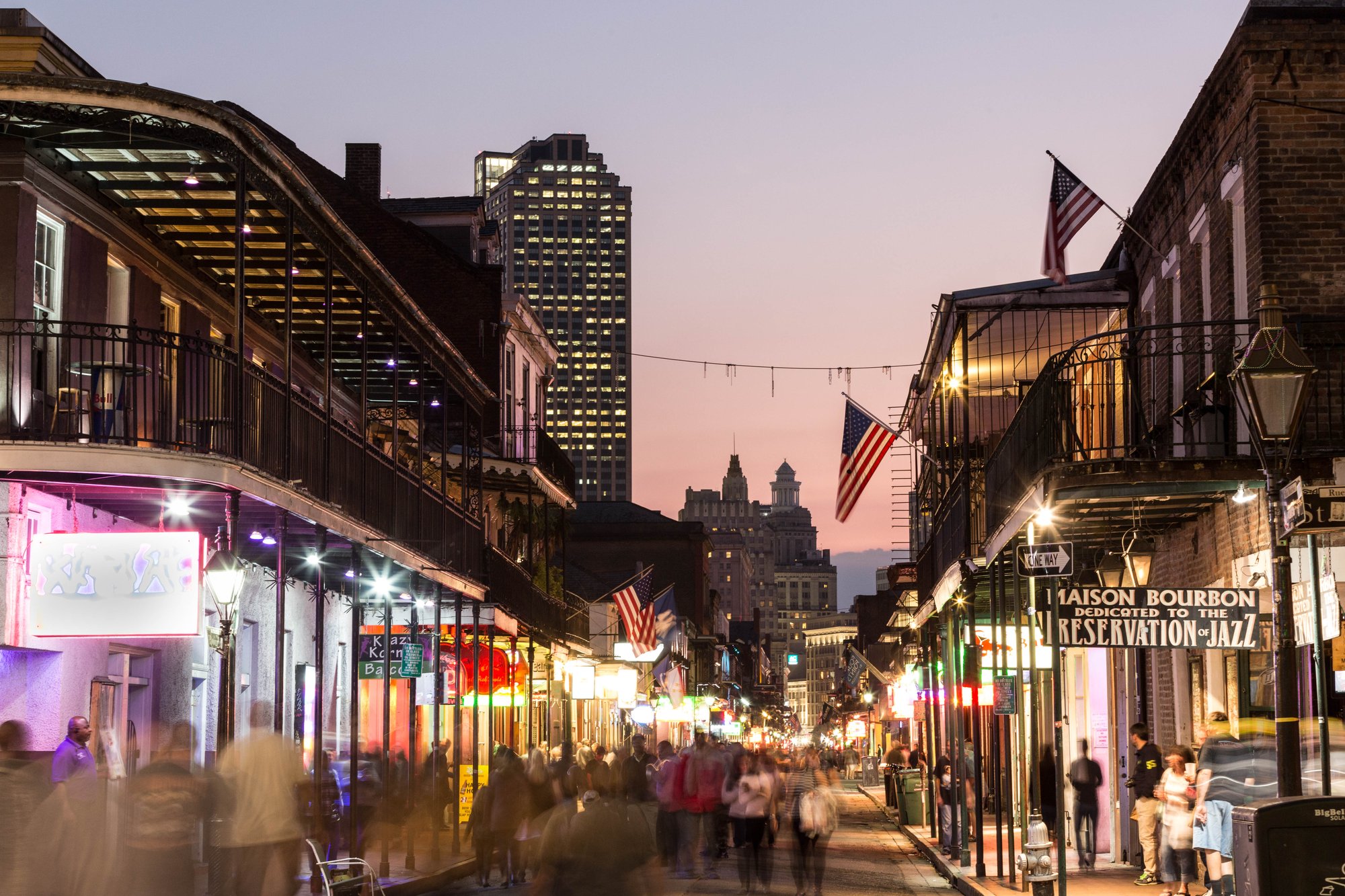
The Street Before the Drink
Before you reach the first plastic cup of frozen daiquiri, Bourbon Street announces itself through sound. The competing bass lines from open-fronted bars, the brass-band spillover from adjacent blocks, and the particular ambient roar of several thousand people drinking outdoors simultaneously — this is the sensory grammar of the strip before a single sip is taken. The French Quarter's grid was laid out in the 18th century, and Bourbon Street has been the corridor of public spectacle for much of that history. The neon, the balconies, the beads, the go-cups: none of it is accidental. It is a sustained civic permission for behavior the rest of American cities generally prohibit.
That permission — New Orleans' open container ordinance, which allows alcohol consumption on public streets within designated areas , is the structural fact that explains everything about Bourbon Street's character. It transforms the sidewalk into a de facto bar, and the bar itself into a staging point rather than a destination. The drink is purchased to be carried, not lingered over. This distinguishes the strip sharply from the seated, service-led programs at places like Jewel of the South or the technically rigorous counter at Cure, which operate on the opposite premise: that the room is the point, and the drink deserves your full attention.
What Bourbon Street Actually Serves
The signature drink of Bourbon Street is the Hurricane, a rum-forward, fruit-juice-based cocktail originally associated with Pat O'Brien's, which has operated on St. Peter Street, just off the main strip, since the 1940s. The drink itself , dark rum, passion fruit syrup, citrus , was reportedly developed in part to move excess rum inventory during World War II whiskey shortages, which makes its survival into the present as a tourist touchstone an interesting piece of supply-chain history. Whether the version served in a plastic to-go cup from a walk-up window bears much resemblance to the original formulation is a question worth asking.
Beyond the Hurricane, the Bourbon Street economy runs on volume formats: the Hand Grenade (a melon-and-grain-spirit blend sold by Tropical Isle), frozen daiquiris in flavors that prioritize sweetness and alcoholic payload over any particular craft, and yard-long plastic vessels designed for maximum visibility rather than optimal drinking temperature. The drinks are not the point in the way they are at Beachbum Berry's Latitude 29, where tiki's archival tradition gets serious scholarly treatment, or at 2 Phat Vegans, where a different set of values entirely governs what goes into a glass. On Bourbon Street, the drink is a prop in a larger social performance.
Sustainability and Scale: The Environmental Weight of a Perpetual Party
The editorial angle that tends to get skipped in any Bourbon Street write-up is the environmental one, and it is substantial. A street that operates at high volume, seven days a week, 365 days a year, generating single-use plastic cups, straws, beads, and food packaging at the scale that Bourbon Street does, represents one of the more concentrated waste-generation zones in American urban hospitality. The plastic go-cup, while culturally central, is also the defining sustainability problem of the strip. New Orleans has piloted various recycling and waste-diversion initiatives in the French Quarter, with variable success; the volume of foot traffic and the transient nature of the visitor base make behavioral change difficult to enforce or incentivize.
This contrasts directly with the direction that the city's more considered drinking establishments have taken. Bars like Jewel of the South and Cure operate with house-made ingredients, reduced-waste bar programs, and an emphasis on local sourcing that aligns them with a broader national shift in how premium bars think about their environmental footprint. The same shift is visible at programs like Kumiko in Chicago, ABV in San Francisco, and Allegory in Washington, D.C., where zero-waste ambitions and ethical sourcing have become part of the bar's identity, not an afterthought. Even internationally, venues like The Parlour in Frankfurt on the Main demonstrate that sustainability-conscious programming is now a credentialed bar category in its own right.
Bourbon Street sits at the opposite end of that spectrum, not by design but by the structural logic of its format. A walk-up daiquiri window selling frozen drinks to a crowd of thousands has no practical mechanism for the sourcing conversations happening at Julep in Houston or Superbueno in New York City. The gap is not purely one of ambition; it is one of operating model.
Reading the Strip Against the City
The most useful framing for Bourbon Street is not as a bar destination but as a district-level phenomenon that happens to involve alcohol. The city's serious drinking culture exists in parallel, largely insulated from the strip. The French Quarter itself contains some of New Orleans' most historically significant bar programs, but they cluster away from Bourbon's central blocks. The craft cocktail infrastructure that has developed in the Marigny, Mid-City, and Uptown neighborhoods over the past fifteen years represents a different hospitality economy entirely, one measured in James Beard nominations and internationally benchmarked programs rather than yard-long drink volume.
For anyone mapping a New Orleans drinking itinerary, the question is not whether to include Bourbon Street but what role to assign it. As a piece of the city's cultural architecture, it is worth an hour of observation. As a place to drink seriously, the alternatives catalogued in our full New Orleans restaurants and bars guide present a substantially different proposition.
Planning a Visit
Bourbon Street requires no booking, no dress code, and no particular planning , which is either its primary appeal or its central limitation, depending on what you are looking for. The strip operates continuously, but the experience changes significantly by time of day. Late afternoon, before the main crowd builds, offers something closer to a navigable street; after 10pm on weekends, the density becomes its own logistical challenge. The French Quarter is walkable from most downtown hotels, and the street itself is a short walk from the St. Charles streetcar line. For visitors combining Bourbon Street with the city's more considered bar programs, the sequencing matters: the craft bars first, then Bourbon Street as a nightcap and cultural data point, tends to serve the evening better than the reverse.
At a Glance
A compact peer snapshot based on similar venues we track.
| Venue | Notes | Price |
|---|---|---|
| Bourbon St | This venue | |
| Jewel of the South | ||
| Beachbum Berry's Latitude 29 | ||
| Cure | ||
| Cane & Table | ||
| The Carousel Bar |
Continue exploring
More in New Orleans
Bars in New Orleans
Browse all →
Restaurants in New Orleans
Browse all →
At a Glance
- Lively
- Energetic
- Iconic
- Late Night
- Group Outing
- Casual Hangout
- Live Music
- Historic Building
- Standing Room
- Classic Cocktails
Vibrant and chaotic with neon lights, crowds, and constant entertainment from street performers and bar activities.