On the leafy Rathenauplatz in Cologne's Südstadt, Biergarten Rathenauplatz Veedelstreff operates as a neighbourhood fixture rather than a destination venue. The name itself signals its role: Veedelstreff translates roughly as neighbourhood meeting point, and the open-air format draws locals from the surrounding residential streets for Kölsch on tap and straightforward food in a setting that prioritises community over spectacle.

Pearl is the En Primeur Club membership app, where members save venues, book tables and use the concierge.
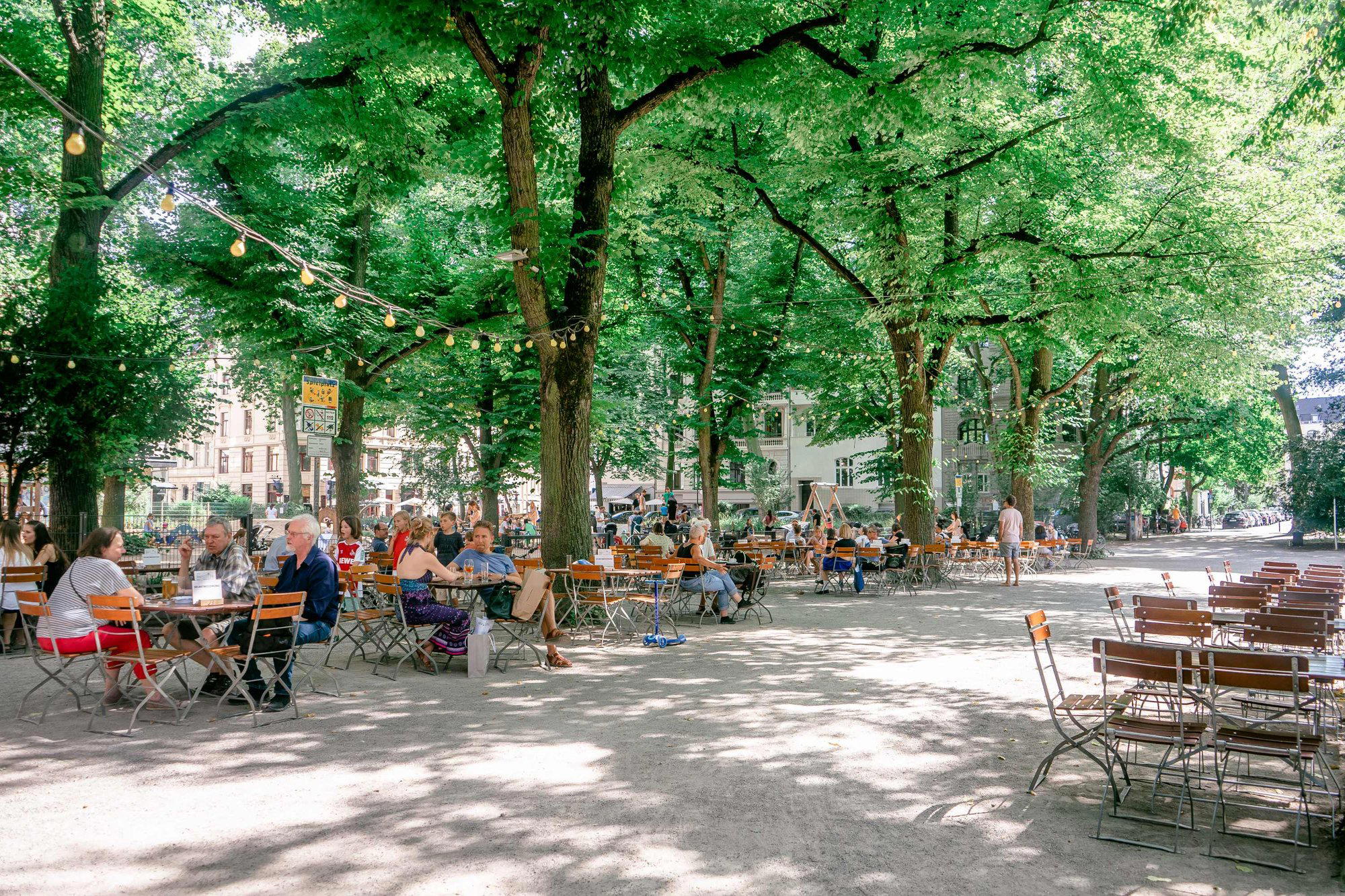
A Square, a Beer, a Neighbourhood
Rathenauplatz sits in the Südstadt, one of Cologne's denser residential quarters, where Wilhelmine apartment blocks line streets that run south from the Ring. The square itself has the character of a place that belongs to the people who live around it rather than to visitors passing through. On warm evenings, the outdoor tables fill with residents from the surrounding Veedel, the Cologne term for the small-scale neighbourhood unit that gives this biergarten its subtitle. That dynamic, familiar across German cities wherever a local square has room for outdoor seating and a beer tap, is what Biergarten Rathenauplatz Veedelstreff runs on.
Germany's biergarten tradition is older than modern hospitality categories. Bavarian in origin, spreading north and west over the nineteenth century, the format settled into a consistent grammar: outdoor seating, communal tables, draught beer, and food that supports drinking rather than competing with it. Cologne adapted the format to fit its own beer culture, which centres on Kölsch, the pale, top-fermented ale served in the city's characteristic cylindrical 0.2-litre glasses called Stangen. A Cologne biergarten operates differently from its Munich counterpart. The portions are smaller, the glasses are smaller, and the Köbes, the traditional waiter, keeps refilling automatically until you signal otherwise. That rhythm defines the experience as much as the beer itself.
The Sequence of a Biergarten Evening
The editorial angle on a biergarten is not the menu but the arc of the evening, and Veedelstreff follows the structure that open-air Cologne drinking venues have used for generations. Arrival is casual: there is no threshold moment, no host station, no reservation to honour. You find a seat, often sharing a table with strangers, and the first Stange arrives quickly. That immediacy, the absence of preamble, is the point. The biergarten format strips out the approach sequence that a restaurant uses to manage expectations.
The middle phase is sustained by the Kölsch refill cycle. Unlike beer formats that require active ordering, the Stange model keeps the drinking continuous and the glass always fresh and cold. Food, where it features in this format, functions as ballast: pretzels, Flammkuchen, or simple meat dishes that extend the session without redirecting attention toward the plate. The social logic is different from a restaurant meal, where courses provide structure. Here, conversation provides structure, and the food anchors it without dominating.
Late phase of a biergarten evening in a residential Cologne square is governed by the neighbourhood itself. As the hour moves later, the crowd thins toward regulars, the pace slows, and the setting becomes more intimate. The surrounding apartment buildings and the tree cover of the square create an enclosure that distinguishes this format from a bar interior: you are outside, but contained.
Where Veedelstreff Sits in Cologne's Drinking Scene
Cologne's bar and drinking venues span a wide range of formats. The city has cocktail bars with considered programs, such as Bar Rix and Barracuda Bar, alongside neighbourhood spots like Bei Oma Kleinmann and the Italian-inflected Bar Trattoria Celentano. Veedelstreff belongs to a different tier entirely: the community-anchored outdoor venue that serves as a social commons for a specific Veedel rather than a destination for the city at large. Its competition is not cocktail bars but other squares, other biergartens, and the simple option of drinking at home with a Kölsch from the corner shop.
That positioning is not a limitation. Across German cities, the venues that carry the most durable local significance tend to be the ones that serve a neighbourhood function without ambition beyond it. The Uerige brewpub in Düsseldorf, reachable via our Uerige guide, runs on a similar logic for its own city's Altbier tradition. The comparison across German beer cities is instructive: each city protects its own style and serves it through venues that prioritise regulars over tourists.
For visitors who want the full range of German bar culture, the contrast is worth making explicit. A technically ambitious cocktail bar like Buck and Breck in Berlin, the wine-focused programming at Goldene Bar in Munich, or the spirit-led approach at Le Lion Bar de Paris in Hamburg all sit at a different point on the spectrum from a neighbourhood biergarten in Cologne's Südstadt. Neither end of that spectrum is superior; they serve different purposes at different moments of a trip. Similarly, comparing across greater geographic distances, a venue like Bar Leather Apron in Honolulu operates in a cocktail-precision register that has almost nothing in common with the Veedelstreff format, which illustrates how diverse the category of drinking venue actually is.
Within Germany's beer-specific culture, the Kieler Brauerei am Alten Markt in Kiel offers another reference point: a brewery-anchored venue where regional beer identity and place are inseparable. Veedelstreff operates on that same principle, substituting Kölsch and the Südstadt square for whatever the northern equivalent might be. Across all these cases, the drink is the vehicle; the neighbourhood is the subject.
Getting There and Practical Orientation
Rathenauplatz is in the Neustadt-Süd district, south of the city centre and accessible from Cologne's inner ring by tram. The square is a standard residential address rather than a tourist landmark, so walking from the Altstadt takes roughly fifteen to twenty minutes through the grid of the Südstadt. The biergarten's open-air format means it operates seasonally; outdoor venues in this format in Cologne typically run from late spring through early autumn, with weather determining both opening and atmosphere on any given evening. No booking infrastructure is documented, which aligns with the format: you arrive, you find a seat, and the Kölsch cycle begins. For the fuller picture of what Cologne's eating and drinking scene offers across formats and price points, the full Cologne guide maps the city's venues by neighbourhood and type.
The Frankfurt equivalent for a more cocktail-focused session would be The Parlour in Frankfurt, which illustrates how different the bar cultures of Germany's major cities have become even as they share a common foundation in serious beer and spirits traditions.
Credentials Lens
Comparable venues nearby, for context on price, style, and recognition.
| Venue | Cuisine | Price | Awards | Notes |
|---|---|---|---|---|
| Biergarten Rathenauplatz VeedelstreffThis venue (the venue you are viewing) | beer_bar | $10–20 | Not listed | Not listed |
| Venloer Str. 437 | cocktail_bar | $20–30 | Not listed | Ehrenfeld |
| Barracuda Bar - Köln | cocktail_bar | $20–30 | Not listed | Neustadt/Nord |
| Café Storch | cocktail_bar | Not listed | Not listed | Neustadt/Süd |
| Bar Rix | wine_bar | Not listed | Star Wine List | Altstadt/Nord |
| Le Moissonnier | Bar | Not listed | Not listed | Neustadt/Nord |
Continue exploring
More in Cologne
Bars in Cologne
All bars in Cologne →
Restaurants in Cologne
All restaurants in Cologne →

Details
- Lively
- Casual
- Rustic
- Scenic
- Casual Hangout
- Group Outing
- Beer Garden
- Garden
- Outdoor Terrace
- Communal Tables
- Standing Room
- Craft Beer
- Garden
Current opening hours
- Monday
- Closed
- Tuesday
- 3–11 PM
- Wednesday
- 3–11 PM
- Thursday
- 3–11 PM
- Friday
- 3–11 PM
- Saturday
- 3–11 PM
- Sunday
- 3–11 PM
Hours can change for holidays and private events. Hours as of .
Relaxed outdoor atmosphere with natural lighting from trees and open sky, lively on weekends with casual communal seating and a festive community vibe.