Tokara Winery


On Helshoogte Road with Simonsberg mountain as its backdrop, Tokara occupies a position at the architectural and viticultural edge of Stellenbosch. The contemporary stone winery holds a Pearl 3 Star Prestige rating (2025), placing it among the Winelands' more formally recognised estates. The site combines serious wine production with a considered visitor experience in one of the Cape's most photographed settings.
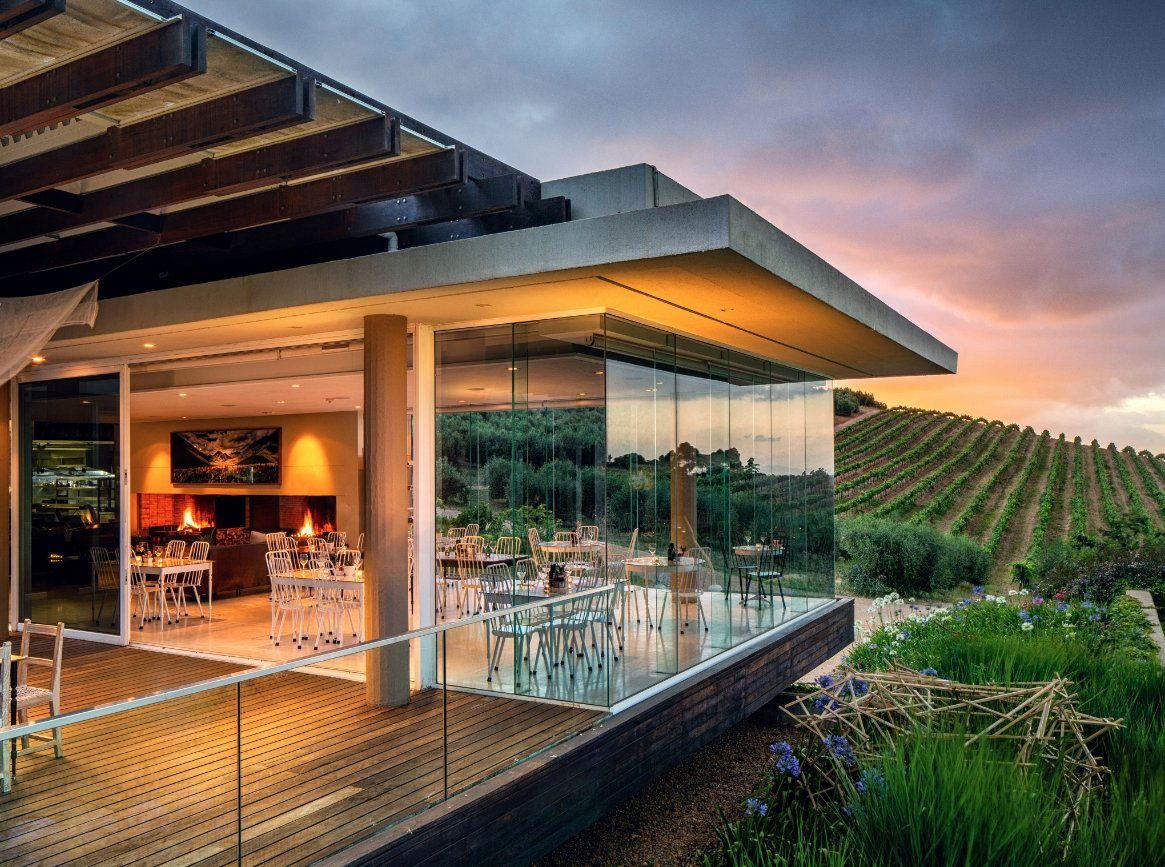
Where Granite Slopes Meet Contemporary Design
The approach along Helshoogte Road sets up the visit before you arrive. The Simonsberg mountain dominates the eastern skyline, its granite and shale formations running downhill into the vineyards below, and by the time the winery building comes into view, the landscape has already made an argument about terroir. Tokara's stone architecture works with that argument rather than against it, its contemporary lines reading as a deliberate response to the rocky surroundings rather than an imposition on them. This is a design language that several of Stellenbosch's more considered estates have adopted, where the building functions as an extension of the site's geology.
The Helshoogte Pass corridor sits at an elevation that matters in Cape winemaking terms. Higher altitude means cooler temperatures during the growing season, longer hang time for fruit, and the kind of diurnal temperature variation that tends to produce wines with structural tension rather than soft generosity. Estates along this stretch operate in a different thermal register than the valley floor, and that distinction shows up in the glass. Tokara's position on this corridor places it within a peer set defined by altitude and mountain-facing exposure rather than the flatter, warmer sites closer to the Stellenbosch town centre.
Terroir at Altitude: What the Helshoogte Corridor Delivers
Stellenbosch's winemaking reputation has historically leaned on Cabernet Sauvignon as its flagship variety, a legacy tied to the deep granitic soils and warm summers of the broader appellation. But within that story, the higher-altitude sub-zones have always produced fruit with a different profile: tighter structure, higher acidity, and a cooler-climate character that makes them better suited to varieties that struggle in warmer sites. The Simonsberg-Stellenbosch ward, which Tokara's vineyards border, carries its own geographical indication for this reason, signalling a recognised distinction from lower-elevation parcels.
That elevation advantage connects directly to how estates in this sub-zone position their wine programmes. Where valley-floor producers typically lean into riper, more textured expressions of Cabernet and Syrah, the mountain-influenced sites tend toward restraint and longevity. The soils on these slopes, combining decomposed granite with clay subsoils, drain efficiently but retain enough moisture to avoid the vine stress that produces flat, overripe fruit in dry vintages. For visitors comparing notes across multiple Stellenbosch estates, the altitude difference is worth tracking through tastings. It is one of the clearest terroir signals in the Winelands.
Tokara holds a Pearl 3 Star Prestige rating for 2025, a recognition that sits it in the more formally assessed tier of South African estates. In a regional context where the Pearl rating system functions as one of the more consistent local benchmarks alongside international competition results, a three-star prestige designation indicates a wine programme operating at a level where consistency and quality across the range are both factors in the assessment, not merely one standout bottling.
Stellenbosch's Design-Led Estates: A Smaller Subset
The Western Cape wine route hosts estates across a wide spectrum of hospitality investment, from farm-gate tasting rooms with folding tables to purpose-built visitor centres with galleries, restaurants, and curated programming. Tokara belongs to the latter group, where contemporary architecture and a considered physical environment are as deliberate as the winemaking. Delaire Graff Estate sits at the extreme luxury end of this design-led cohort, with significant art collection investment and a hotel component that makes it a destination in its own right. Tokara operates in that same broad category of architecturally intentional estates without the same level of hospitality infrastructure, which positions it as a serious winery visit rather than a full resort stay.
The distinction matters for planning. Estates that have invested heavily in architecture and design tend to attract visitors for the full sensory experience of the site, not just the wine. That broadens the appeal beyond pure wine tourism but also shapes the visit format: you are as likely to spend time engaging with the building and its relationship to the mountain as you are standing at a tasting counter. For first-time visitors to the Helshoogte corridor, this is a useful frame. Neethlingshof Estate and Spier Wine Farm offer different versions of the Stellenbosch estate visit, both with longer historical footprints and more expansive grounds. Alto Wine Estate and Asara Wine Estate represent other points on the Stellenbosch spectrum, and comparing them across a multi-day Winelands programme helps clarify what makes the Helshoogte altitude sites distinctive.
The Winelands in Wider Context
Stellenbosch sits within a broader Cape Winelands circuit that includes Franschhoek and the Hemel-en-Aarde ridge near Hermanus. Each zone has developed its own dominant variety identity over the past two decades: Franschhoek with its Semillon heritage and growing Chardonnay reputation, the Hemel-en-Aarde with cool-climate Pinot Noir that draws direct comparisons to Burgundy, and Stellenbosch maintaining the fullest range but anchored by its Cabernet and red-blend tradition. Babylonstoren in Franschhoek represents the farm-estate model taken to its most fully realised form, with garden, accommodation and wine all operating under a single integrated proposition. Creation Wines in Hermanus shows what the cooler coastal sites deliver when the focus is on food-and-wine pairing as an explicit hospitality format.
For visitors constructing a longer Cape itinerary, the contrast between Stellenbosch's mountain-influenced reds and the coastal zones' cool-climate whites and Pinots is the most instructive route through the region's geography. Constantia Glen in Cape Town adds a third terroir type to that comparison, with the cool south-facing Constantia valley producing Bordeaux-style blends with a notably different structure to Stellenbosch counterparts. Planning a visit to Tokara alongside estates from two or three of these sub-zones gives the most complete read of what Western Cape winemaking is doing across its climatic range.
Planning Your Visit
Tokara is located on Helshoogte Road, placing it roughly midway between Stellenbosch town and Franschhoek, which makes it a practical stop on a day that covers both valleys. The address (Helshoogte Rd, Stellenbosch, Cape Town, 7600) is on the main pass road, accessible by car from Stellenbosch town in under fifteen minutes. Because specific tasting hours, pricing, and booking requirements are not confirmed in our current data, contacting the estate directly before arriving is advisable, particularly during peak summer season from December through February when Winelands traffic is at its highest. The estate's Pearl 3 Star Prestige recognition suggests a visit format with some structure rather than a simple walk-in farm-gate tasting, though the exact format should be verified ahead of travel.
For broader Stellenbosch planning, our full Stellenbosch wineries guide maps the valley's estates by style and sub-zone. The Stellenbosch restaurants guide covers the town's dining options for evenings after estate visits, and our Stellenbosch hotels guide covers accommodation across the valley's price range. If the wider circuit appeals, our Stellenbosch experiences guide and bars guide fill in the rest of a multi-day programme.
For international context, the design-led winery estate model that Tokara exemplifies has parallels in other premium wine regions: Abadía Retuerta in Sardón de Duero takes the architecture-meets-viticulture proposition to its furthest expression in Castile, while Aberlour in Aberlour shows how a different kind of production heritage can anchor a visitor experience with equal seriousness.
Frequently Asked Questions
- What do visitors recommend trying at Tokara Winery?
- Given Tokara's position on the Helshoogte corridor at the foot of Simonsberg, the altitude-influenced red wines are the most instructive place to focus. The Pearl 3 Star Prestige rating (2025) applies to the estate's overall programme, which suggests the tasting range across varieties is worth working through rather than selecting a single bottling. Confirming the current tasting format directly with the winery will clarify which wines are available on the day of your visit.
- What is the defining thing about Tokara Winery?
- The combination of mountain-facing elevation on Helshoogte Road, contemporary stone architecture set against Simonsberg, and a Pearl 3 Star Prestige rating (2025) positions Tokara within a small subset of Stellenbosch estates where serious viticulture and considered design coexist. It is a property where the site's physical geography is as deliberate a part of the visit as the wine programme.
- Can I walk in to Tokara Winery?
- Specific booking requirements are not confirmed in our current data. Given the estate's Pearl 3 Star Prestige standing and its location on Helshoogte Road (Stellenbosch, Cape Town, 7600), contacting the estate before visiting is the safest approach, particularly during summer peak season. Walk-in availability at estates of this calibre in Stellenbosch varies by day and season.
- Is Tokara Winery better for first-timers or repeat visitors to Stellenbosch?
- Both profiles will get value from the visit for different reasons. First-time visitors to the Winelands will find Tokara's architecture and Helshoogte Pass setting a strong introduction to how mountain-influenced terroir shapes Cape wine. Repeat visitors who have already covered the valley-floor estates will appreciate the altitude contrast and the more focused winery format. The Pearl 3 Star Prestige recognition gives both audiences a reliable quality baseline.
- How does Tokara's Helshoogte location affect the style of its wines compared to other Stellenbosch estates?
- The Helshoogte Pass sits at an elevation where cooler growing temperatures and diurnal variation produce wines with tighter structure and higher acidity than those from Stellenbosch's valley floor. This makes Tokara's site climatically closer to the Simonsberg-Stellenbosch ward's mountain-influenced character than to warmer, flatter parcels near town. For visitors who have tasted across multiple Stellenbosch estates, this altitude distinction is one of the clearest terroir differences the appellation offers, and the Pearl 3 Star Prestige rating (2025) suggests the winemaking is translating that site advantage consistently into the bottle.
Cuisine Context
A quick context table based on similar venues in our dataset.
| Venue | Cuisine | Awards | Notes |
|---|---|---|---|
| Tokara Winery | Pearl 3 Star Prestige (2025); Here in the winemaking hub of Stellenbosch, contemporary South African design offsets the rocky shadows of Simonsberg mountain. Tokara’s sleek stone winery boas; Here in the winemaking hub of Stellenbosch, contemporary South African design offsets the rocky shadows of Simonsberg mountain. Tokara’s sleek stone winery boas | This venue | |
| Delaire Graff Estate | |||
| Neethlingshof Estate | |||
| Spier Wine Farm | |||
| Alto Wine Estate | |||
| Asara Wine Estate |
Access the Cellar?
Our members enjoy exclusive access to private tastings and priority allocations from the world's most sought-after producers.
Access the Concierge