Schloss Gobelsburg (Weingut)


Occupying a sixteenth-century Habsburg Renaissance castle in the Kamptal wine region, Schloss Gobelsburg is among Austria's most historically grounded estates. The property earned a Pearl 3 Star Prestige rating in 2025, placing it at the upper tier of Langenlois producers. For visitors tracing the expression of Grüner Veltliner and Riesling through one of Austria's defining vineyard landscapes, it represents a compelling anchor point.
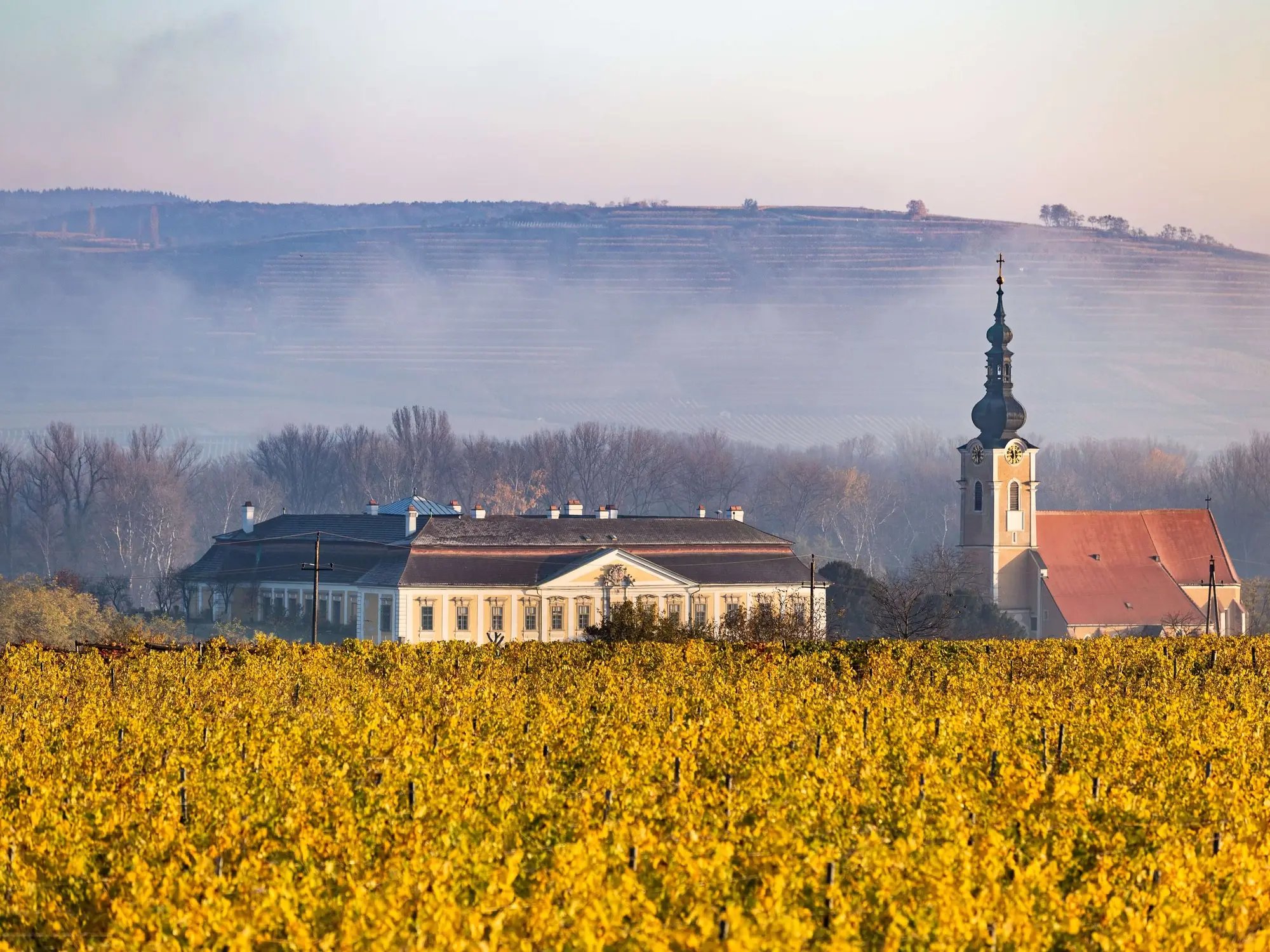
Where History and Terroir Converge
The approach to Gobelsburg village, a few kilometres outside Langenlois in Lower Austria's Kamptal region, gives little warning of what lies ahead. The sixteenth-century castle materialises at the end of a drive through vineyard rows: a full Renaissance manor house commissioned under Habsburg patronage, its proportions belonging to another century's ambitions entirely. Architecture of this scale in a wine-producing context is not unusual in Central Europe, but the combination of historical weight and active winemaking operation gives Schloss Gobelsburg a positioning that sits apart from most Kamptal estates.
The Kamptal is one of Austria's most rigorously studied wine regions, defined by the Kamp River's moderating influence and the dramatic interplay between warm Pannonian air pushing up from the east and cool northern winds funnelling through the valley. That thermal tension is the engine behind the region's reputation for Grüner Veltliner and Riesling with pronounced acidity and length. Loess terraces, crystalline gneiss, and volcanic rock all appear within short distances of one another, giving individual vineyard sites distinct mineral signatures that show clearly in the glass when production is careful enough to let them. Schloss Gobelsburg holds parcels across several of the Kamptal's classified Ried sites, meaning the estate's range functions as a practical map of how soil type and aspect translate into flavour.
A Prestige Tier Rating in Context
In 2025, Schloss Gobelsburg received a Pearl 3 Star Prestige designation, EP Club's upper-tier recognition for estates demonstrating sustained quality and site coherence. Within Langenlois, that places the estate in a competitive group alongside producers like Weingut Bründlmayer and Weingut Jurtschitsch, both of which have built international followings from the same Kamptal foundation. The distinction at Gobelsburg is the estate's scale of historical documentation: where most Austrian wineries measure their continuity in decades, Gobelsburg's records extend centuries further, with the Cistercian monks of Zwettl Abbey having farmed the surrounding vineyards long before the Habsburg building programme reshaped the site.
That longer arc matters for how the estate reads its terroir. Producers with multi-century presence in a region accumulate observational knowledge about vineyard behaviour that newer operations simply cannot replicate from reference books. Harvest records, site performance across variable vintages, and the gradual understanding of which parcels perform under stress all contribute to a winemaking perspective calibrated over generations rather than decades. Among Langenlois's peer group, Weingut Fred Loimer and Weingut Hiedler bring their own distinct approaches to Kamptal viticulture, but neither operates from a site with this depth of agricultural history.
Terroir Expression as the Defining Ambition
Austria's DAC (Districtus Austriae Controllatus) classification system, which came into clearer focus through the 2000s and 2010s, formalised what Kamptal producers had long argued informally: that individual Ried sites in the valley produce wines with identifiable and repeatable characteristics distinct from surrounding regions. Kamptal DAC rules require either Grüner Veltliner or Riesling, with Ried-designated wines sitting at the leading of a tiered hierarchy that moves from regional through village to single-vineyard. Schloss Gobelsburg's position in this structure places its top-tier bottlings in direct conversation with the most scrutinised single-vineyard expressions from producers like Weingut Emmerich Knoll in Dürnstein, whose Wachau Rieslings are measured by a comparable site-specificity logic.
The Grüner Veltliner question is central to any assessment of Kamptal quality. The variety is harder to read than Riesling precisely because it lacks Riesling's near-universal reference points: GV's spice characteristic, its white pepper edge, and its capacity for both early drinkability and extended cellar development are all terroir-dependent in ways that shift substantially between sandy loess and rocky gneiss. Estates that hold parcels across both soil types, as Gobelsburg does, face a production decision at each vintage about whether to blend for consistency or bottle separately for contrast. That decision reveals a great deal about how a producer understands its own land.
The Castle as Context, Not Set Dressing
It would be easy to treat the Renaissance architecture as atmosphere rather than substance, the kind of backdrop that wine tourism operations deploy without it meaning anything about the wine. At Gobelsburg, the relationship is more substantive. The estate's monastic origins meant the land was selected and maintained under agricultural principles that predated modern viticultural science by centuries, but which arrived at some of the same conclusions about site selection: south-facing slopes, adequate drainage, and protection from frost pockets. The castle's construction under Habsburg commission absorbed an already-functioning agricultural system rather than displacing one.
That continuity is what gives the estate's terroir narrative its credibility. Wine regions that market historical provenance as a quality signal are common enough, but the claim is stronger when the land itself has been under continuous cultivation rather than simply adjacent to surviving architecture. Visitors arriving at the property are effectively standing inside the evidence for the estate's argument about site knowledge.
Planning a Visit to Langenlois and Gobelsburg
Langenlois sits roughly 70 kilometres northwest of Vienna, making it accessible as a day trip from the capital, though the concentration of serious producers in the area rewards at least one overnight stay. The town itself operates as the practical centre for Kamptal wine exploration, with accommodation and restaurants oriented around the visiting wine traveller. For a fuller picture of what's available locally, the Langenlois restaurants guide, hotels guide, and bars guide cover the options in detail.
Schloss Gobelsburg itself is located at Schloss Strasse 16, 3550 Langenlois. As with many Austrian estate wineries at this tier, visits and tastings are typically arranged in advance rather than walk-in, though specific booking arrangements should be confirmed directly with the estate. Autumn, from September through November, aligns with harvest activity and tends to be the most atmospheric period for cellar visits across the Kamptal; spring tastings, once the new vintage has settled, give a cleaner comparative read across the range. The wider Langenlois winery circuit, detailed in the full Langenlois wineries guide, maps the other major estates and helps structure a coherent itinerary across the valley.
For travellers building a broader Austrian wine itinerary, the Kamptal visit pairs naturally with the Wachau to the south and, for contrast, with Burgenland producers like Weingut Kracher in Illmitz or Weingut Pittnauer in Gols, where the focus shifts from cool-climate white varieties to red wine production and sweet wine under very different climatic conditions. The Langenlois experiences guide covers structured tours and tastings across the region for visitors who prefer a curated route. Those extending beyond Austria entirely might consider how the estate-winery format at Gobelsburg compares to historic estate operations in other European regions, from Abadía Retuerta in Sardón de Duero to non-wine properties like Aberlour in Aberlour, where heritage and production site occupy a similarly inseparable relationship.
Frequently Asked Questions
- What's the leading wine to try at Schloss Gobelsburg (Weingut)?
- The Kamptal's most persuasive case for terroir expression runs through single-vineyard Grüner Veltliner and Riesling from classified Ried sites. At Schloss Gobelsburg, the estate's access to multiple Kamptal Ried parcels means the top-tier Ried bottlings offer the clearest read on how soil type and aspect shape the wine. For a comparative tasting across the range, those single-vineyard designations give the strongest editorial argument for the estate's 2025 Pearl 3 Star Prestige recognition. Within the Langenlois peer group, tasting across several producers, including Weingut Bründlmayer and Weingut Jurtschitsch, gives the most useful frame of reference for understanding what Gobelsburg does differently.
- What's the standout thing about Schloss Gobelsburg (Weingut)?
- The combination of a fully operational estate winery inside a sixteenth-century Habsburg Renaissance castle, in the centre of one of Austria's most seriously regarded wine regions, gives Gobelsburg a layering of context that most Kamptal producers cannot replicate. The 2025 Pearl 3 Star Prestige rating confirms its position at the upper tier of Langenlois producers. Unlike many historic properties that function primarily as tourism venues, the estate's winemaking operation and multi-century site history give the visit substantive wine content rather than architectural spectacle alone. That combination is what separates it from the broader Langenlois circuit, even among strong competitors like Weingut Fred Loimer and Weingut Hiedler.
Standing Among Peers
A small peer set for context; details vary by what’s recorded in our database.
| Venue | Classification | Awards | First Vintage | Notes |
|---|---|---|---|---|
| Schloss Gobelsburg (Weingut) | World's 50 Best | This venue | ||
| Weingut Bründlmayer | 1 awards | |||
| Weingut Jurtschitsch | 1 awards | |||
| Weingut Fred Loimer | 1 awards | |||
| Weingut Hiedler | 1 awards |
Access the Cellar?
Our members enjoy exclusive access to private tastings and priority allocations from the world's most sought-after producers.
Access the Concierge