
Among Uruguay's wine-country lodges, Narbona stands apart for the weight it carries in a small place: a Pearl 2 Star Prestige (2025) recognition anchors a property where vineyard terrain, cellar tradition, and table-side produce work as an integrated whole. Carmelo's riverside wine belt rarely produces properties that function convincingly at every register, but Narbona comes close.
Where the Rio de la Plata Wine Belt Concentrates
Carmelo sits at the western edge of Uruguay's Colonia department, where the Rio de la Plata widens into something closer to a sea than a river. The terrain here is rolling and clay-heavy, and the estancias that once dominated it have, over the past three decades, given way to a patchwork of boutique wineries and vineyard lodges that have quietly repositioned the region as one of South America's more considered wine destinations. Narbona Wine Lodge occupies a significant place within that shift, carrying a Pearl 2 Star Prestige (2025) recognition that places it among the more formally assessed properties in the country.
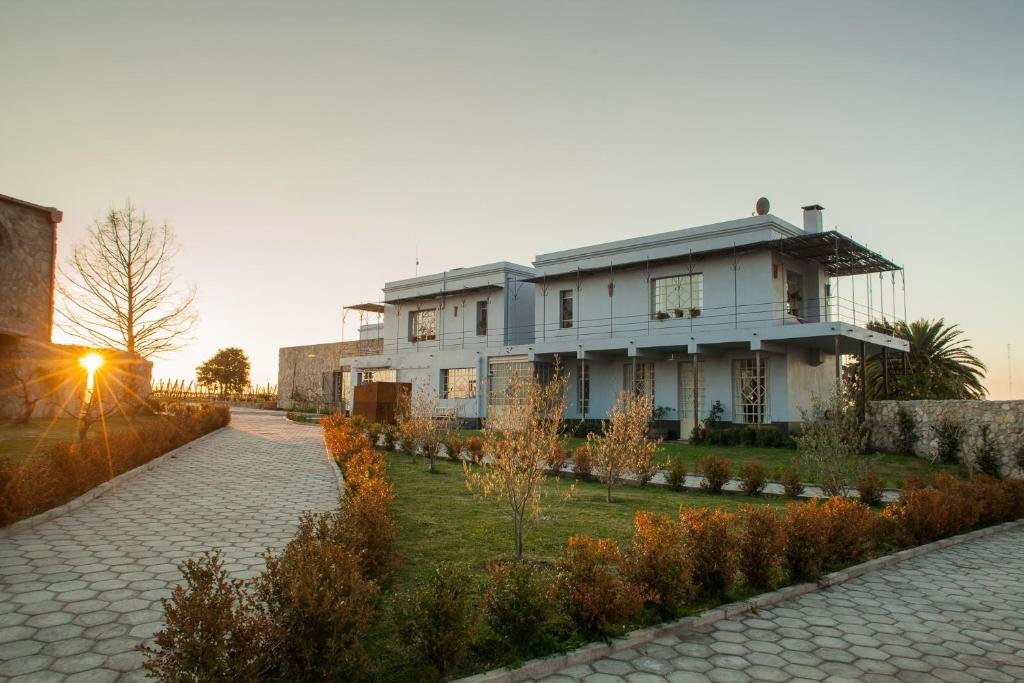
The approach to the lodge already communicates something about the property's register. Vineyards frame the access road, and the colonial-era architecture — low, whitewashed, and built to trap shade rather than announce itself — reads as a working estancia before it reads as a hospitality property. That ordering is deliberate. In a region where Carmelo's winery scene runs from industrial cooperatives to design-forward boutique operations, Narbona positions itself as authentically agricultural first and experiential second.
Vineyard and Terrain as the Operating Logic
Uruguay's wine identity has historically been built on Tannat, the thick-skinned Basque grape that arrived with 19th-century immigrants and proved, improbably, to thrive in the humid, estuary-influenced climate. Colonia and its surrounds have developed a particular version of that identity , slightly cooler than the Atlantic-facing regions to the east, with soils that tend toward clay loam and produce wines with a bit more structural density than those from the lighter, sandy soils further north. Narbona's vineyards reflect that terroir argument directly.
What distinguishes the lodge's physical presence from comparable properties elsewhere in Uruguay is the integration between where the grapes grow and where the guests stay. Terraces and open corridors face into the vineyard rows rather than away from them, and the rhythms of the agricultural calendar , pruning through winter, canopy work through summer, harvest running roughly from late February into April , are visible from the property rather than hidden behind a designed façade. This is not incidental to the experience. The Rio de la Plata wine belt rewards properties that make their agricultural seriousness legible, and at Narbona, the visual argument is made without much editorial overlay.
For context on how Narbona sits within its immediate competitive set in Carmelo, neighboring operations like Campotinto, El Legado, and Familia Irurtia represent the range of the region's winemaking ambitions. What the Pearl 2 Star Prestige award signals, alongside Narbona's lodge format, is a step up in integrated-experience terms: this is a property where accommodation, food, and wine exist in a coordinated editorial voice rather than as separate offerings operating in parallel.
The Table as an Extension of the Cellar
Carmelo's restaurant culture, covered in our full Carmelo restaurants guide, generally reflects the town's agricultural roots: estancia cooking, grilled meats, and produce sourced from the surrounding Colonia farmland dominate the mid-range register. At lodge properties like Narbona, the table operates closer to the wine-pairing tradition than the parrilla tradition, though the two are not mutually exclusive in Uruguay. The country's beef culture and its Tannat program have a natural affinity , both are built on structure, density, and a certain directness that resists ornament.
Without confirmed menu specifics from the venue record, what can be said with confidence is that lodge-format properties holding Prestige-tier recognition in this region typically anchor their dining program to estate produce, cellar-driven wine lists featuring older vintages, and a meal structure that extends across several hours. That pace is itself a function of location: Carmelo is not a day-trip destination for most international visitors, and properties of this tier design their food offering to reward the decision to stay rather than pass through.
Getting to Carmelo, and Timing the Visit
Reaching Narbona from Buenos Aires is more practical than the distance suggests. A Buquebus or Seacat ferry service connects Buenos Aires to Colonia del Sacramento in roughly an hour, and Carmelo sits approximately 70 kilometres west along the RN1 , a direct drive through Colonia's rolling countryside. Alternatively, direct ferries to Carmelo from Buenos Aires operate seasonally. From Montevideo, the drive runs west along the coast road through the Colonia department, passing the wine estates and river-facing estancias that define the belt's character. Visitors coming from Montevideo might also consider stops at Bodega Bouza in Montevideo, Varela Zarranz in Canelones, or Bodega Carrau in Las Piedras to build a broader picture of Uruguay's wine geography before arriving in the Colonia belt.
Seasonally, the lodge operates at different registers. Harvest season , late February through early April , puts the vineyard at its most active, with picking crews, sorting tables, and cellar activity running alongside the hospitality program. This is the period that rewards those with wine-production interest. The shoulder months of November through January bring longer daylight hours and the full canopy in leaf, which changes the visual quality of the property considerably. Winter visits (June through August) are quieter, the vines dormant and the landscape stripped back, but the estuary light at this latitude has a particular quality that low-season visitors tend to value. Booking ahead is advisable regardless of season, given the lodge's limited-capacity format and its award-tier recognition drawing attention beyond the local market. Consult our full Carmelo hotels guide for alternative accommodation options in the region, and our full Carmelo experiences guide for activities that complement a vineyard stay.
Narbona in Uruguay's Wider Wine Conversation
Uruguay's wine scene has gradually assembled a peer set that competes credibly in South American premium terms, even as it remains less exported than Argentina's or Chile's programs. The country's producers have increasingly differentiated on terroir argument rather than varietal novelty, and the lodge-format properties in Carmelo are part of that broader repositioning. Bodega Cerro del Toro in Piriápolis and Bodega Los Cerros de San Juan in Colonia del Sacramento represent adjacent points on that same map. Further afield, properties like Abadía Retuerta in Sardón de Duero demonstrate the European lodge-winery model that some Uruguayan producers have studied and adapted for the Southern Cone context. The ambition at Narbona, signalled by its 2025 Prestige-tier recognition, sits within that trajectory.
For those building a wider Carmelo itinerary, our full Carmelo bars guide covers the town's informal drinking culture, which operates at a different register than the lodge properties but completes the picture of a destination that rewards slower travel. Narbona anchors the upper tier of that picture.
Frequently Asked Questions
What wines should I try at Narbona Wine Lodge?
Carmelo's clay-dominant soils produce a particular expression of Tannat , the grape variety most closely associated with Uruguayan wine identity , that tends toward structural density and age-worthiness. At a Prestige-tier lodge like Narbona, the cellar list typically spans current and older vintages of estate reds, alongside Albariño and other white varieties that have found increasing traction in the region's cooler micro-zones. Asking the team specifically about reserve-category Tannats from the estate will give you the clearest read on the property's winemaking seriousness. For a broader regional comparison, our full Carmelo wineries guide maps the variety of styles produced in the belt.
What is Narbona Wine Lodge known for?
Within Carmelo's wine-lodge tier, Narbona holds Pearl 2 Star Prestige recognition (2025), which places it among the more formally assessed hospitality properties in Uruguay. Its distinction within the local competitive set comes from the integration of vineyard, cellar, accommodation, and dining into a coherent whole, rather than from any single element operating independently. For travelers arriving from Buenos Aires or Montevideo, it functions as the most complete articulation of the Colonia wine-country proposition currently on offer in the region.
Should I book Narbona Wine Lodge in advance?
Yes. Lodge-format properties of this award tier in Carmelo operate at limited capacity by design, and Narbona's Pearl 2 Star Prestige (2025) recognition draws attention from the Argentine market in particular, given Buenos Aires's proximity via the Rio de la Plata ferry connections. Harvest season (late February to early April) and the summer shoulder months (November to January) fill earliest. Contact the property directly through the address at 70100 Carmelo, Departamento de Colonia, for current availability and rate information, as no online booking portal is listed in available records.
Is Narbona Wine Lodge suitable for a multi-day stay rather than a single visit?
The lodge format at Narbona is structured for overnight and multi-night stays rather than day visits, which reflects a broader pattern among Prestige-tier wine lodges in the Colonia department. The agricultural calendar, cellar access, and table-side dining program require time to appreciate in sequence, and the property's location outside Carmelo's town center makes the self-contained lodge experience the more logical frame. Visitors pairing Narbona with other Colonia-belt wineries will find that two to three nights gives sufficient depth without exhausting the property's programming.
Cuisine and Awards Snapshot
A short peer table to compare basics side-by-side.
| Venue | Classification | Awards | First Vintage | Notes |
|---|---|---|---|---|
| Narbona Wine Lodge | 1 awards | This venue | ||
| Campotinto | 1 awards | |||
| El Legado | 1 awards | |||
| Familia Irurtia | 1 awards |
Access the Cellar?
Our members enjoy exclusive access to private tastings and priority allocations from the world's most sought-after producers.
Access the Concierge