
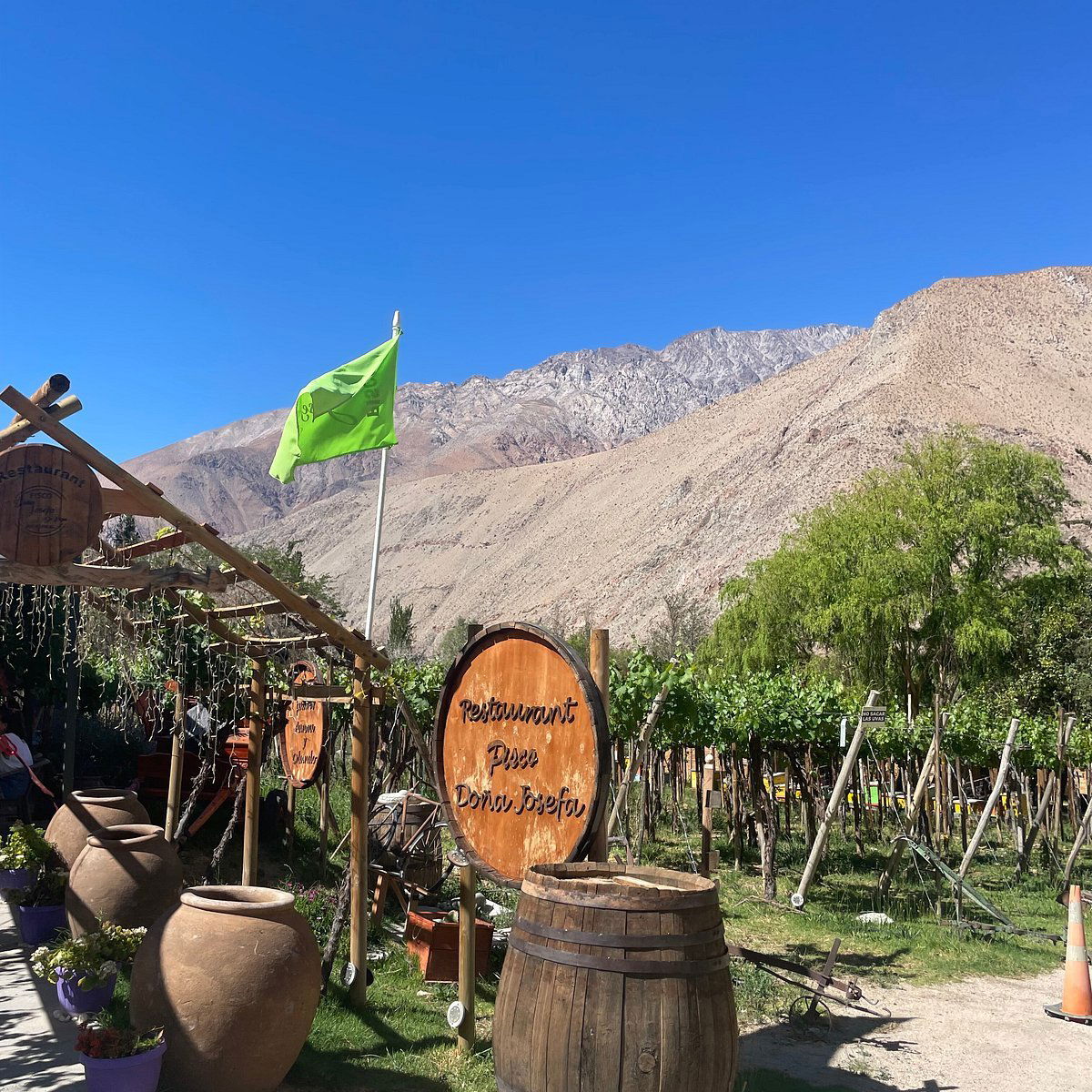
Doña Josefa de Elqui sits in Pisco Elqui, the village at the spiritual heart of Chile's pisco-producing Elqui Valley, and holds a Pearl 2 Star Prestige rating from EP Club for 2025. The address places it in Paihuano commune, deep in the Andean foothills of Coquimbo Region, where high altitude and extreme sun define the terroir of the Muscat grapes that drive the valley's distilling tradition.
Pisco Elqui and the Geography of a Spirit
The Elqui Valley cuts east from the Pacific coast into the Andes at a latitude — roughly 30 degrees south — that places it in a band of semi-arid high desert where grape sugar accumulates fast and aromatic intensity runs high. The village of Pisco Elqui, formerly known as La Unión and renamed in 1939 as part of Chile's ongoing territorial claim to the pisco denomination, sits at the upper end of that valley at an elevation where nights are cold enough to preserve acidity in the Muscat-family grapes that define the appellation. This is not wine country in the Napa or Burgundy sense: the fruit here is grown to be distilled, and the distilling tradition is old, localized, and still shaped by small family operations alongside industrial cooperatives.
Doña Josefa de Elqui holds a Pearl 2 Star Prestige rating from EP Club in 2025, a signal that places it in the recognized upper tier of producers in the region. Its address on D-485 in Pisco Elqui, within the Paihuano commune, positions it at the geographic and cultural core of Chilean pisco production , not on the valley floor near Vicuña, where larger infrastructure tends to cluster, but in the higher, quieter reaches where smaller producers have long operated. For context on the broader Vicuña-area pisco scene, our full Vicuña wineries guide maps the range of producers from cooperative-scale to boutique.
The Distilling Tradition Doña Josefa Represents
Chilean pisco occupies a distinct regulatory and cultural space from its Peruvian counterpart, and within Chile the Elqui Valley carries more prestige than the parallel Limarí appellation to the south. The Denomination of Origin for Chilean pisco covers both, but Elqui , with its narrower canyon, more extreme diurnal temperature swings, and longer distilling heritage , has historically commanded more attention from producers aiming at the premium segment. The region's Muscat variants (Moscatel de Alejandría, Moscatel Rosada, Pedro Jiménez, and a handful of others) produce a base wine of pronounced floral and stone-fruit character that carries through distillation when handled carefully.
The production philosophy that separates smaller Elqui Valley operations from the cooperative giants is largely one of scale and attention at each stage: lower yields per hectare, slower distillation in smaller copper pot stills, and more deliberate decisions about aging format and duration. This approach is not unique to any single producer in the valley, but it characterizes the tier in which Doña Josefa operates , the tier of producers whose identity is tied to a specific address and family name rather than a brand built for supermarket shelf presence. For comparison, the scale and infrastructure visible at Capel Pisco Plant in Vicuña represents the cooperative model at its largest regional expression, while Pisquera ABA and Pisco Mal Paso occupy different positions across the independent-producer spectrum.
What the Pearl 2 Star Prestige Signal Means in This Context
EP Club's Pearl 2 Star Prestige rating for 2025 places Doña Josefa de Elqui in recognized company within the region, alongside operations like Viña Falernia and Viña Mayu, which have built reputations bridging Chilean wine and pisco. In a valley where the volume producers dominate distribution and visibility, a prestige signal like this tends to indicate a producer whose output is more likely evaluated on sensory merit and provenance specificity than on price-point or shelf availability.
The distinction matters for visitors planning a tasting itinerary in the Elqui Valley. Prestige-rated producers in this appellation typically operate at a smaller scale, may not have walk-in hours, and often offer a more structured or appointment-based engagement than the cooperative operations designed to handle tourist buses. The visitor experience at this tier is less about spectacle and more about direct access to the production environment and the people who run it. This pattern holds across Chilean spirits and wine production more broadly: at Pisco Alto del Carmen Distillery in Huasco and at estate wine producers like Viña Casa Silva in San Fernando, the prestige tier correlates with a more deliberate, lower-volume hospitality format.
Approaching Pisco Elqui: Logistics and Timing
Getting to Pisco Elqui requires committing to the valley. The nearest city with reliable transport connections is La Serena, roughly 120 kilometres to the west on the coast. From La Serena, the road follows the Elqui River east through Vicuña , the administrative centre of the valley and the better base for visitors covering multiple producers , before climbing into the narrowing canyon toward Paihuano and then Pisco Elqui itself. The drive is scenic and the road is paved, but the distances between points in the upper valley require either a rental car or pre-arranged local transport.
Seasonally, the valley operates differently from coastal Chilean tourism zones. Summers (December through March) bring intense heat in the lower valley but remain more manageable at the altitude of Pisco Elqui, and this period coincides with harvest activity that can make visits to smaller producers particularly informative. The clearest skies in the valley tend to occur in the April-to-September window, which is when the area's astronomical tourism peaks given the Elqui Valley's reputation as one of Chile's prime stargazing corridors. Visitors combining a producer visit to Doña Josefa with an evening at one of the valley's observatories are making a logical itinerary out of what the geography offers naturally. For accommodation options across the valley's range, our full Vicuña hotels guide covers the available choices from Vicuña town to the upper valley.
The Elqui Valley in the Wider Chilean Spirits and Wine Context
Chilean pisco sits in an interesting moment globally. The category has long been overshadowed by Peruvian pisco in international markets , partly a question of marketing investment, partly a difference in production style (Chilean pisco is typically aged, while Peruvian pisco is generally unaged, creating different flavour profiles and different cocktail applications). Within Chile, however, there is a growing movement of small producers in the Elqui Valley who are working to articulate a premium, terroir-driven identity for the category that can compete on its own terms with aged spirits internationally.
This positions the Elqui Valley's prestige producers in a conversation that extends beyond Chile: to the aged-spirit tradition at operations like Aberlour in Aberlour, where wood aging and provenance are central to value, and to estate-led wine producers in Spain such as Abadía Retuerta in Sardón de Duero or El Gobernador (Miguel Torres Chile) in Curicó, where a single estate's identity anchors a premium price and distribution strategy. The analogy is structural: in each case, a specific address and production philosophy do the work that a large brand budget would do for a cooperative or multinational.
For visitors building a complete picture of what the Elqui Valley offers beyond pisco production, our full Vicuña restaurants guide, our full Vicuña bars guide, and our full Vicuña experiences guide provide coverage of the supporting scene that makes a multi-day stay in this part of Coquimbo Region worthwhile.
Planning a Visit to Doña Josefa de Elqui
Specific booking methods, opening hours, and pricing for Doña Josefa de Elqui are not confirmed in current EP Club data, which is consistent with smaller producers in this region that often operate by appointment or through local coordination rather than online reservation systems. The practical advice for visiting any prestige-rated producer in the upper Elqui Valley is to make contact well in advance of arrival, particularly during peak season (January and February) when the valley attracts both Chilean domestic tourists and international visitors combining the region with La Serena and the Atacama. Arriving without a confirmed arrangement at a small family operation is a reliable way to find a closed gate.
The address , D-485, Pisco Elqui, Paihuano , is locatable via standard mapping applications, and the village itself is small enough that local knowledge will fill gaps that online systems may not. Visitors staying in Vicuña will find the drive to Pisco Elqui manageable as a half-day excursion, leaving time to combine a visit here with one or more stops at other valley producers on the return journey.
Compact Comparison
A quick comparison pulled from similar venues we track in the same category.
| Venue | Classification | Awards | First Vintage | Notes |
|---|---|---|---|---|
| Doña Josefa de Elqui (Pisco) | 1 awards | This venue | ||
| Viña Falernia | 1 awards | |||
| Capel Pisco Plant | 1 awards | |||
| Pisquera ABA | 1 awards | |||
| Viña Mayu | 1 awards | |||
| Pisco Mal Paso | 1 awards |
Access the Cellar?
Our members enjoy exclusive access to private tastings and priority allocations from the world's most sought-after producers.
Access the Concierge