Clos Apalta (Casa Lapostolle)


Clos Apalta earns its EP Club Pearl 4 Star Prestige rating through gravitational winemaking and an architectural statement that makes the property as compelling as the wine. Set in the Apalta Valley outside Santa Cruz, the winery integrates Old World technique with Chilean terroir in a structure designed around the slope itself — no pumps, no shortcuts, just gravity and time.
Where Architecture and Elevation Become Part of the Wine
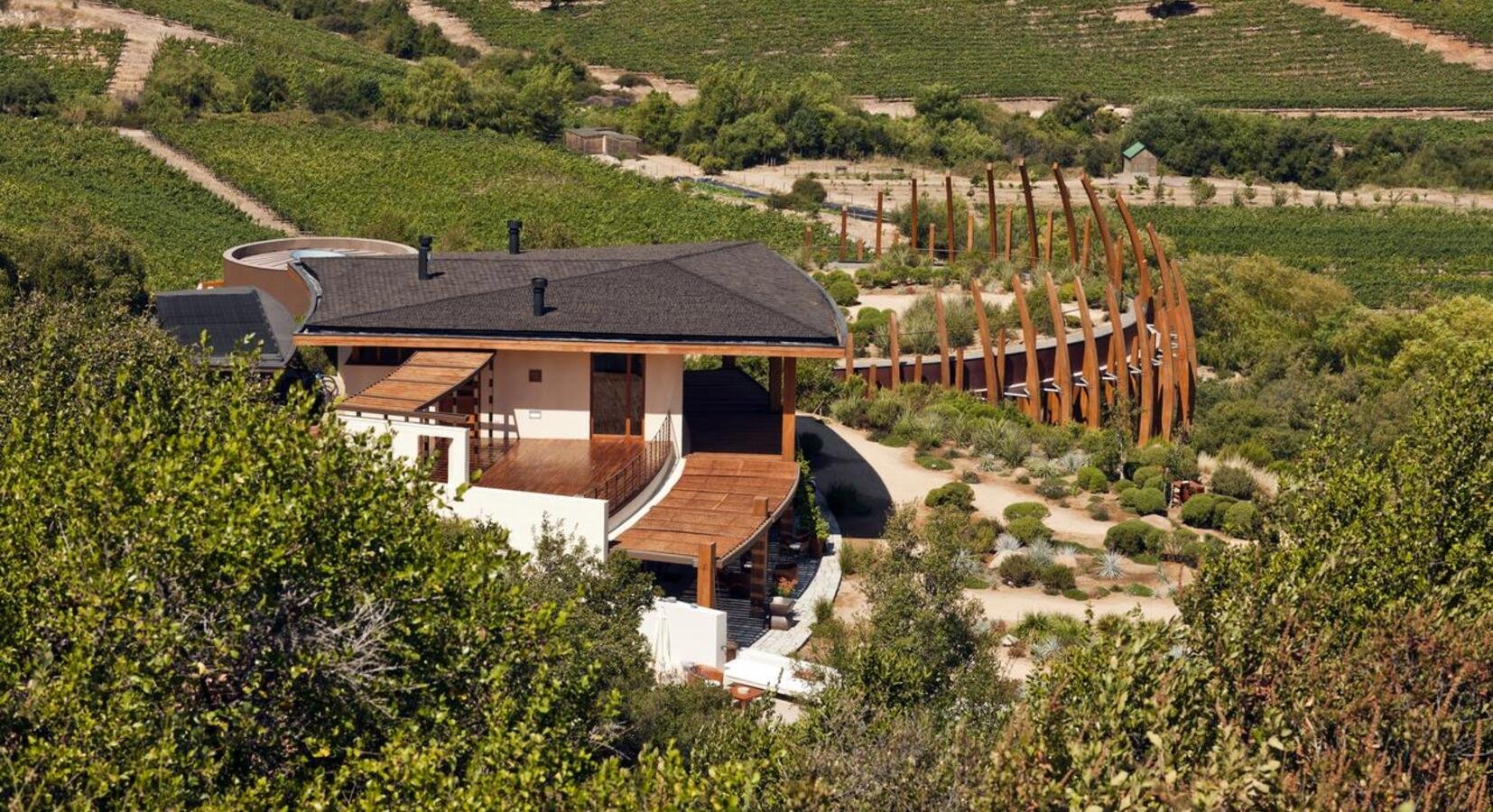
Approaching Clos Apalta, the first thing that registers is structural: wooden staves rise from the hillside like the ribs of a half-buried barrel, embedded in native forest and surrounded by the kind of quiet that only comes with altitude and deliberate siting. The building does not sit on the land so much as grow from it. That integration is not incidental — it reflects the same logic that governs what happens inside. Gravity replaces mechanical intervention at every stage of production. Fruit moves downward through the facility by its own weight, from sorting through fermentation to ageing below ground. In a region where large-volume operations still dominate, that commitment to process over efficiency places Clos Apalta in a narrower, more demanding tier.
The Apalta Valley, roughly ten kilometres from Santa Cruz in Chile's O'Higgins Region, has emerged over the past two decades as one of the Colchagua sub-zones most closely associated with premium Carménère and red blends. The valley's particular combination of granitic soils, steep hillside gradients, and the temperature modulation provided by surrounding forests produces fruit with concentration and structure that the flatter Colchagua floor cannot replicate. Several of the region's most discussed producers — including Viña Viu Manent and Viña Montes , operate within the broader Santa Cruz orbit, but Apalta's hillside sites carry a separate identity that the market has begun to price and discuss accordingly.
Gravitational Winemaking as a Design Principle
Gravitational wineries are not new. The concept traces back to traditional European producers, particularly in Burgundy and the Douro, where building into a hillside allowed fruit to descend naturally through each stage of production without pump-induced agitation. What Clos Apalta represents is the application of that Old World logic to a New World site with New World scale ambitions. The circular, multi-level structure works with the existing topography rather than flattening it, creating distinct zones for reception, fermentation, and barrel ageing that stack vertically rather than spread horizontally.
That choice has direct consequences for the wine. Gentle handling preserves the integrity of the grape skins, which matters particularly for Carménère , a variety that, under rough treatment, can tip toward harsh tannin and green pyrazine character. Chilean Carménère spent decades being dismissed as misidentified Merlot before producers in Colchagua demonstrated that careful viticulture and restrained extraction could produce something structurally closer to a serious Pomerol than the extracted, over-oaked versions that defined the 1990s. Clos Apalta sits within that corrective tradition, producing wines that the international press has tracked closely since the early 2000s.
The Casa Lapostolle connection anchors the property in a specific European winemaking lineage. The family behind the project brings a background in French spirits and wine that shaped the initial approach: intervention-light, terroir-focused, aimed at a market that was beginning to take Chilean premium wine seriously. That positioning has proven durable. The EP Club Pearl 4 Star Prestige rating for 2025 reflects accumulated critical regard rather than a single vintage anomaly.
Colchagua's Premium Tier: Where Clos Apalta Sits
Chile's wine export market has long been defined by volume-driven value, which makes the emergence of a genuine prestige segment within Colchagua notable. The region's leading producers now compete directly with Argentinian Malbec flagships and mid-tier Napa Cabernets for shelf space and critical attention in the same price brackets. Viña Apaltagua operates within the same geographical zone, while producers such as Viña Casa Silva in San Fernando and Viña De Martino in Isla de Maipo represent other nodes in Chile's expanding premium map.
What separates the Apalta hillside properties from the broader Colchagua field is specificity of site. When a region's premium identity depends on terroir differentiation rather than brand-building alone, properties with demonstrably distinct geography have a structural advantage in the conversation. The barrel-stave architecture at Clos Apalta functions partly as a visual argument for that specificity: the building announces, before a single bottle is opened, that this is a site-driven project rather than a brand deployed across purchased fruit.
For comparison across Chile's wider wine geography, El Gobernador (Miguel Torres Chile) in Curicó represents the northern Maule approach to premium production, while international benchmark operations such as Abadía Retuerta in Sardón de Duero illustrate how Old World estate logic translates into contemporary winery design , a parallel that helps frame what Clos Apalta is attempting within a South American context.
The Experience on the Ground
Winery visits to properties at this level in Colchagua have shifted from casual walk-in tastings toward structured, appointment-only formats that reflect the seriousness of the wine program. The physical experience at Clos Apalta is shaped heavily by the architecture: moving through the barrel rooms underground, with light filtering through the forest canopy above, connects the visitor directly to the gravitational logic of the facility in a way that a conventional warehouse winery cannot replicate. The site is located at Fundo San José de Apalta, roughly within reach of Santa Cruz town for those using the region as a base.
Santa Cruz itself functions as the practical hub for Colchagua wine tourism, with accommodation, restaurants, and the Museo de Colchagua all within the town. For broader planning across the region, EP Club maintains guides to Santa Cruz restaurants, Santa Cruz hotels, Santa Cruz bars, and a full Santa Cruz wineries guide covering the complete range of producers in the area. The Santa Cruz experiences guide covers additional activities in the O'Higgins Region for those building a longer itinerary.
Visits to properties at this prestige level in Colchagua typically require advance booking. Given the gravitational facility's architectural complexity and the site's hillside position, group sizes are likely constrained compared to flatter, more accessible wineries in the valley. Contacting the estate directly in advance of any visit is strongly advised, particularly during harvest season (March to April) when operational priorities shift and access may be limited.
Within the Wider Context of Premium Estate Wineries
The gravitational winery model , and the estate-grown, single-origin positioning that accompanies it , has become a meaningful differentiator across the global premium wine market. Properties as varied as Aberlour in Scotland and Pisco Alto del Carmen Distillery in Huasco illustrate how place-specific production logic can anchor a brand's identity across very different spirit and wine categories. At Clos Apalta, the architectural investment in gravitational infrastructure functions as the clearest public statement of that positioning: the building is the argument.
For those tracking the development of Chilean fine wine specifically, Apalta's hillside producers occupy the sharpest end of a regional quality story that has taken thirty years to establish credibility in international markets. The Pearl 4 Star Prestige recognition from EP Club in 2025 situates Clos Apalta at the upper tier of that story , not as a novelty but as a property with accumulated evidence behind its reputation.
Frequently Asked Questions
- Is Clos Apalta (Casa Lapostolle) more formal or casual?
- The experience sits firmly in the formal, appointment-driven tier of Colchagua wine tourism. This is not a drop-in tasting room. The site's architecture, gravitational production facility, and EP Club Pearl 4 Star Prestige rating (2025) all signal a structured, considered visit rather than a casual afternoon stop. Dress accordingly , smart casual is appropriate, and arriving prepared with questions about the production process will make the most of a facility that rewards attentive visitors.
- What's the leading wine to try at Clos Apalta (Casa Lapostolle)?
- The Clos Apalta flagship blend is the wine most closely associated with the property's reputation and has received the most sustained international critical attention since the early 2000s. It is a Carménère-led blend that reflects the gravitational, intervention-light production philosophy of the facility. Given the site's positioning in the Apalta Valley and its Old World winemaking lineage, the flagship is the clearest expression of what distinguishes this property from the broader Colchagua field.
- What's the defining thing about Clos Apalta (Casa Lapostolle)?
- The gravitational winery architecture is the most immediately distinctive feature , a circular, hillside-integrated facility where fruit descends by gravity through each production stage without pump intervention. That design choice is not cosmetic; it reflects a production philosophy rooted in minimal handling and site specificity. The EP Club Pearl 4 Star Prestige rating in 2025 confirms that the wines support the architectural ambition. Among Santa Cruz's premium wine producers, this is the property most explicitly built around a single production argument.
- How hard is it to get in to Clos Apalta (Casa Lapostolle)?
- Access requires advance booking and is not available as a walk-in visit. The site's hillside position, limited footprint, and prestige positioning all suggest constrained capacity compared to larger valley-floor wineries. During harvest (March to April), availability is likely tighter. No public booking portal or phone number is available through EP Club's database, so direct contact with the estate , or engagement through a specialist travel operator covering Colchagua , is the most reliable approach for securing a visit.
Reputation Context
A quick peer check to anchor this venue’s price and recognition.
| Venue | Classification | Awards | First Vintage | Notes |
|---|---|---|---|---|
| Clos Apalta (Casa Lapostolle) | World's 50 Best | This venue | ||
| Viña Viu Manent | World's 50 Best | |||
| Appleton Estate | 1 awards | |||
| Viña Montes | World's 50 Best | |||
| Viña Apaltagua | 1 awards |
Access the Cellar?
Our members enjoy exclusive access to private tastings and priority allocations from the world's most sought-after producers.
Access the Concierge