
One of Montalcino's older-established estates, Altesino sits north of the town centre in a position that has long been read as a benchmark for the appellation's more structured, age-worthy style. The property holds a Pearl 2 Star Prestige rating for 2025. For visitors pursuing serious Brunello di Montalcino, Altesino represents the kind of estate where terroir argument and cellar discipline converge.
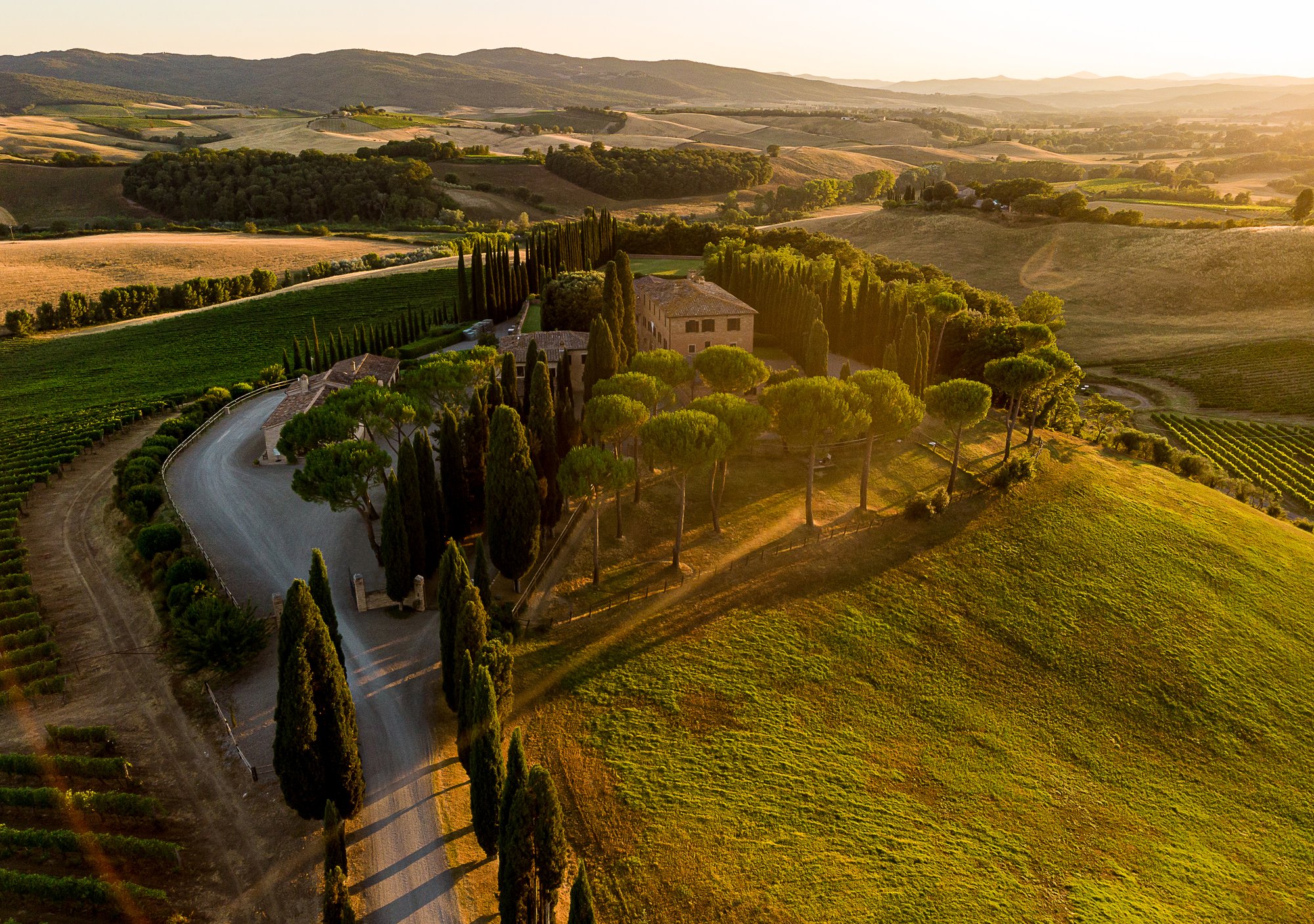
North of Town, Long in the Barrel
The road north out of Montalcino drops quickly from the hilltop town into a range of pale clay and galestro schist, the soil combination that defines the cooler, more austere side of the appellation. Altesino's address at Località Altesino, 54 places it in this northern arc, a position that carries real meaning for anyone who follows Brunello di Montalcino closely. In a denomination where the compass direction of a vineyard can shift a wine from plush and approachable to tight and architecturally demanding, north-facing and higher-altitude sites consistently produce wines that need time before they open fully. That is the physical context before you taste a single glass.
Estates on this side of the denomination tend to attract a particular type of visitor: one who comes with a cellar notebook rather than a holiday itinerary. The comparison is instructive. Biondi-Santi Tenuta Greppo, the estate most associated with Brunello's founding identity, also operates from the northern reaches of the appellation and has long set the standard for wines built around structure and longevity over early fruit expression. Altesino sits in the same broad tradition, and a visit here works leading understood against that backdrop.
What the Terroir Actually Argues
Montalcino's denomination covers roughly 3,500 hectares of potential vineyard land across a range of altitudes, aspects, and soil compositions that no other Italian appellation quite replicates. The hill itself acts as a geographic fulcrum: the southern slopes, warmer and drier, produce Sangiovese Grosso (the local clone, officially Brunello) with more concentrated colour and forward tannin. The northern and eastern slopes, subject to greater diurnal temperature swings and influenced by cooler air from the Orcia valley, slow ripening and preserve the acidity that makes structured Brunello capable of ageing for two to three decades.
Galestro, the schistous limestone-clay that fractures into small plates and drains rapidly, dominates much of the northern zone. Vines under stress in lean, well-drained soil produce smaller berries with higher skin-to-juice ratios, which in turn pushes tannin and aromatic concentration rather than volume. The argument for terroir expression here is direct in geological terms: the soil profile is not simply a backdrop, it is a direct variable in the wine's structure. This is the kind of site-specific logic that separates Brunello from many other Italian reds, and it is why estates like Altesino are read through the lens of location before anything else.
For a broader map of how different estates interpret Montalcino's diverse geology, the comparison set is rich. Azienda Agricola Casanova di Neri di Giacomo Neri works vineyards across multiple zones and has built a reputation for wines that balance structural ambition with earlier accessibility. Il Poggione, operating from the warmer southern slopes near Sant'Angelo in Colle, consistently produces a richer, rounder house style. Valdicava Az Agr brings a different altitude argument from its northern position. Placing Altesino against these peers clarifies what you are choosing when you come here: a specific point on the appellation's spectrum rather than a generic Brunello experience.
Recognition and Positioning
Altesino holds a Pearl 2 Star Prestige rating for 2025, a designation that places it in a tier of consistent, serious producers within the EP Club assessment framework. In a denomination with over 200 licensed producers ranging from small family plots to corporate-scale operations, positioning matters for practical planning. The Pearl 2 Star level signals an estate operating above baseline appellation quality and meriting considered attention from collectors and serious wine travellers.
The comparison context at this level includes estates like L'Enoteca Banfi, which represents the larger, more visitor-infrastructure-heavy end of Montalcino's producer range, and the tighter, production-focused operations that receive less walk-in traffic but reward direct visits with access to older library vintages and more concentrated conversation about cellar philosophy. Altesino belongs to the middle of that range in terms of scale, with the kind of operation that maintains quality discipline across both its Brunello di Montalcino DOCG and its Rosso di Montalcino DOC, the latter offering an earlier-drinking introduction to the same terroir at a lower price point and with significantly less cellar time required before opening.
The Wider Montalcino Context
Arriving in Montalcino itself is worth the approach. The fortified hilltop town, visible from the surrounding valleys at over 550 metres, has been a wine-trade centre since at least the nineteenth century, and its enotecas and specialist wine bars carry a depth of back-vintage stock rare outside of auction houses. The town's main piazza anchors several restaurants where Brunello pairings are taken seriously; for a full orientation to eating and drinking options in the area, our full Montalcino restaurants guide maps the options with the same critical framework applied here.
The broader Italian fine wine comparison is also useful for placing Montalcino's ambitions in national context. Antinori nel Chianti Classico in Tuscany operates as the region's most commercially visible estate, with a visitor centre scaled for volume that Montalcino producers rarely match. In Piedmont, the parallel for structured, long-ageing reds built from a single variety and a specific appellation plays out through estates like Aldo Conterno in Monforte d'Alba and Bruno Giacosa in Neive, where Barolo carries similar age-worthiness arguments from Nebbiolo. Internationally, Abadía Retuerta in Sardón de Duero represents a Spanish estate making analogous claims about terroir discipline and cellar patience in a warmer continental context. These comparisons help calibrate expectations: Brunello's demand for cellaring is not an Italian peculiarity but a specific expression of what cool-climate, high-acid viticulture with a structured grape variety reliably produces.
Planning a Visit
Montalcino is accessible from Siena in under an hour by car, and Florence in around ninety minutes, making it a workable day visit though a stay of at least one night allows time to cover multiple estates without rushing tasting appointments. Altesino's address at Località Altesino, 54 sits north of the town on roads that require a car; public transport connections to the estates outside the town centre are limited. Visits to serious producers in Montalcino generally run by appointment, and contacting estates directly in advance is the standard approach across the appellation. For accommodation options in the zone, our full Montalcino hotels guide covers the range from town-centre options to agriturismo properties within the vineyard area.
For anyone building a fuller programme across Montalcino's producers, our full Montalcino wineries guide provides the comprehensive view. Our full Montalcino bars guide and our full Montalcino experiences guide cover the wider context for spending time in the area beyond winery visits. For those whose interest extends to other premium production regions, Aberlour in Aberlour represents a useful parallel for how a single-origin, terroir-argued production tradition functions in a completely different category and climate.
Frequently Asked Questions
What wines should I try at Altesino?
The Brunello di Montalcino DOCG is the primary reference point. Given the estate's northern terroir position, this is a wine built for patience: expect firm tannin structure, higher natural acidity, and an aromatic profile that opens slowly with bottle age rather than arriving in full expression on release. The Rosso di Montalcino DOC, made from younger vines or earlier-selected fruit from the same appellation, provides access to the same site character with a shorter required ageing window and typically at a lower price. Both sit within Montalcino's Sangiovese Grosso tradition, and comparing Altesino's interpretation against peers like Biondi-Santi Tenuta Greppo or Il Poggione teaches you the most about how radically one grape variety and one denomination can vary by site.
What's Altesino leading at?
The estate's consistent recognition, including a Pearl 2 Star Prestige rating for 2025, points to reliable quality in a denomination that can vary considerably between producers. Altesino's strength is the clarity of its terroir argument: the northern position and galestro-dominant soils produce a structurally defined house style that reads as distinctly Montalcino rather than generically Tuscan. For collectors looking for age-worthy Brunello from a geographically coherent position within the appellation, this is where Altesino makes its case most convincingly.
How hard is it to get in to Altesino?
Montalcino's serious estates generally operate on an appointment basis rather than open-door walk-in access. If you are planning to visit Altesino, contacting the estate in advance is advisable and is standard practice across the appellation's better producers. The broader area around Montalcino sees meaningful visitor traffic during the Tuscan harvest season (late September through October) and in the spring months when the landscape is at its most accessible. Mid-week visits and shoulder-season timing reduce competition for appointment slots. As a Pearl 2 Star Prestige-rated estate, Altesino draws a considered visitor profile rather than high-volume casual tourism, which typically means more substantive tasting experiences than you would get at the appellation's larger, more commercially oriented operations.
Same-City Peers
A fast peer set for context, pulled from similar venues in our database.
| Venue | Classification | Awards | First Vintage | Notes |
|---|---|---|---|---|
| Altesino | 1 awards | This venue | ||
| Biondi-Santi Tenuta Greppo | 2 awards | 1888 | ||
| L'Enoteca Banfi | 1 awards | 1978 | ||
| Valdicava Az Agr | 2 awards | 1987 | ||
| Argiano | 1 awards | 1888 | ||
| Cerbaiona | 1 awards | 1981 |
Access the Cellar?
Our members enjoy exclusive access to private tastings and priority allocations from the world's most sought-after producers.
Access the Concierge