Zeret Kitchen
Our verdict
Zeret Kitchen on Camberwell Road brings Ethiopian communal dining to south London, where shared injera platters and slow-cooked wats define the format. The room operates on a different rhythm from the city's formal dining rooms, with daytime service leaning casual and evenings drawing a fuller, more sociable crowd. For those exploring London's African dining scene beyond the tourist-facing centre, this is a serious address.

Pearl is the En Primeur Club membership app, where members save venues, book tables and use the concierge.
Ethiopian Dining in South London: The Communal Table Tradition
London's African restaurant scene has long been concentrated in specific postal pockets, with Ethiopian and Eritrean kitchens clustering in areas where diaspora communities put down roots decades ago. Camberwell, in southeast London, holds a small but established node of that tradition, and Zeret Kitchen at 216-218 Camberwell Road sits within it. To understand what makes this address worth attention, it helps to understand what Ethiopian communal dining actually demands of a room: the format is inherently social, built around a shared injera base on which multiple dishes arrive simultaneously, and the leading practitioners of it in London treat the logistics of that format as seriously as any tasting-menu kitchen treats plating sequence.
Ethiopian cuisine divides broadly into two eating registers. Daytime service in Ethiopian restaurants, whether in Addis Ababa or Camberwell, tends toward single-dish simplicity: a tibs of fast-sauteed meat, a bowl of ful, or a modest fasting plate of lentils and greens. Evening service is where the communal platter comes into its own, with a spread of wats (slow-cooked stews), kitfo (spiced minced beef, often served raw or lightly warmed), and an array of vegetable preparations that in Orthodox fasting tradition can be remarkably varied. The lunch-versus-dinner divide here is not merely a question of price or portion; it reflects two different social contracts with the food.
The Lunch vs. Dinner Divide at Zeret Kitchen
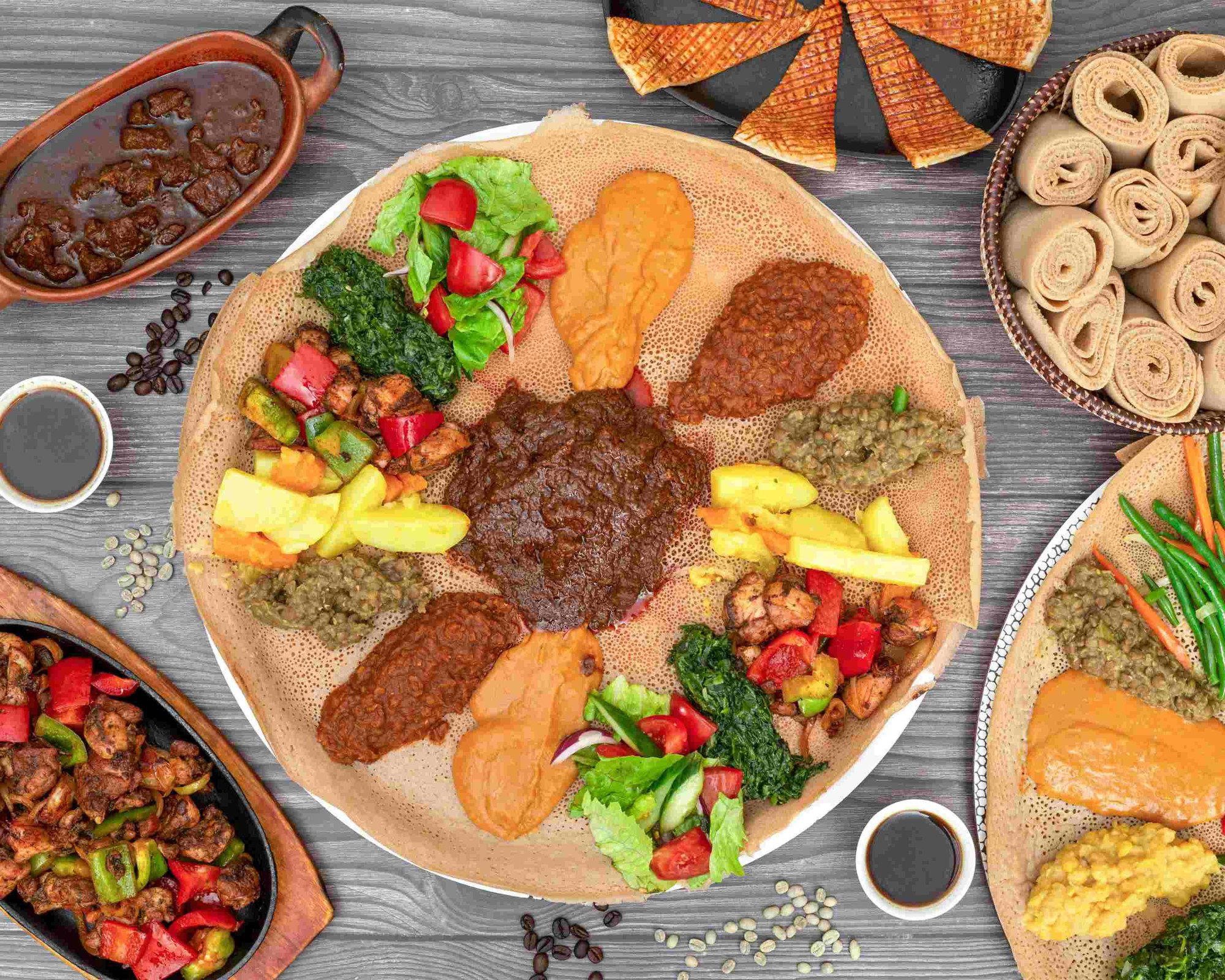
Evening service shifts register. The room fills with groups, and the format expands: combination platters arrive on wide shared trays, with a selection of meat and vegetable wats arranged around a central mound of injera. The social architecture of this format is worth noting. Ethiopian communal eating involves tearing and sharing from a single surface, which changes the dynamic of a table in ways that no Western sharing-plates format quite replicates. It is a format with genuine communal logic built into it, not a retrofitted trend. London's broader wave of sharing-format restaurants, from the contemporary European rooms to the modern British kitchens like Dinner by Heston Blumenthal and CORE by Clare Smyth, has made communal eating fashionable, but Ethiopian cuisine arrived at it through a different and older cultural logic entirely.
What to Order: Reading the Menu by Time of Day
For a lunchtime visit, the most revealing order is a single meat wat with injera on the side. Doro wat, chicken slow-cooked in berbere and clarified niter kibbeh butter with a whole hard-boiled egg, is the reference dish of Ethiopian festive cooking, and how a kitchen handles it at midday when the pot may be fresher from morning prep tells you a great deal. For vegetarians, a yetsom beyaynetu (fasting platter) at lunch is the more instructive order than a single dish: it arrives as a spread of lentil, split pea, greens, and salad preparations that shows the kitchen's range across plant-based cooking, which in Ethiopian Orthodox tradition is a serious discipline rather than an afterthought.
In the evening, the combination platter logic takes over. Groups of four or more get the fullest expression of the format. The meat combinations will typically include a beef tibs, a lamb or goat preparation, and the doro wat, while the vegetable side brings alicha (mild turmeric-based stew), gomen (collard greens), and misir (spiced red lentils). Kitfo, if available, is worth ordering separately: it is a dish that demands kitchen confidence because it is eaten raw or very lightly cooked, seasoned with mitmita and niter kibbeh, and the quality gap between a kitchen that respects it and one that doesn't is immediately obvious.
Camberwell Road in Context
Zeret Kitchen operates in a part of London that sits at a distance from the zones where press attention tends to cluster. The Michelin-starred rooms that define London's formal upper tier, addresses like Restaurant Gordon Ramsay, Sketch, The Lecture Room and Library, and The Ledbury, operate in a different economy and a different geography. Camberwell SE5 is a neighbourhood of independent businesses, a scrappy high street, and a significant African-Caribbean community that has shaped the area's food character over decades. Ethiopian restaurants in this context are not curated imports; they are community infrastructure.
That positioning matters to how Zeret Kitchen should be read. It is not competing with the tasting-menu rooms of Mayfair and Notting Hill, any more than a Sichuan family restaurant in Chengdu competes with a hotel dining room. The comparison set is other Ethiopian and East African kitchens in London, and in that comparison, a restaurant that maintains consistent injera fermentation, sources its berbere correctly, and handles kitfo with care is operating at a high level for its category. Readers who want wider reference points for serious London dining, including the high-formal rooms in the city centre, will find our full London restaurants guide useful, alongside UK-wide addresses such as Le Manoir aux Quat'Saisons in Oxford, L'Enclume in Cartmel, or Moor Hall in Aughton. But the frame for Zeret Kitchen is a different one.
Know Before You Go
- Address: 216-218 Camberwell Road, London SE5 0ED
- Format: Communal injera platters; combination platters work leading for groups of two or more
- Daytime vs. Evening: Lunch suits solo diners or quick visits; evenings suit groups and fuller platter orders
- Vegetarian suitability: Ethiopian fasting-plate tradition makes this a genuinely strong option for plant-based diners; yetsom beyaynetu covers a wide spread of preparations
- Getting there: Camberwell Road is served by multiple bus routes from Elephant and Castle (Northern and Bakerloo lines)
Frequently asked questions
What part of town is Zeret Kitchen in?
Zeret Kitchen is located at 216-218 Camberwell Rd, London SE5 0ED, United Kingdom, London.
Is Zeret Kitchen suitable for a group dinner in South London?
The communal eating format at Zeret Kitchen, centred on a shared injera base with multiple wats placed around it, makes it structurally well-suited to groups. The Camberwell Road address in SE5 places it in southeast London, accessible from Peckham and Brixton, which broadens its practical range for groups assembling from across South London.
What's the best thing to order at Zeret Kitchen?
The answer shifts by time of day. At lunch, a single doro wat with injera is the clearest test of the kitchen's fundamentals: slow-cooked chicken in berbere and clarified niter kibbeh served on fermented flatbread. For dinner, the fuller spread of shared wats gives a more complete picture of what the kitchen on Camberwell Road does across the menu.
How far ahead should I plan for Zeret Kitchen?
Zeret Kitchen on Camberwell Road operates as a neighbourhood restaurant rather than a high-demand booking destination. Lunch walk-ins are generally straightforward, while dinner on weekends warrants a call ahead. It sits well outside the zones where reservation pressure tends to cluster in London.
What has Zeret Kitchen built its reputation on?
Zeret Kitchen's standing in London's Ethiopian dining scene rests on the consistency of its foundational techniques: injera fermentation, berbere-based slow-cooking, and the communal table format that defines Ethiopian hospitality. Located at 216–218 Camberwell Road in SE5, it holds that position by staying close to the cooking traditions rather than adapting them for a broader audience.
Can Zeret Kitchen handle vegetarian requests?
Ethiopian Orthodox fasting practice, which excludes meat and dairy on specific days of the religious calendar, has produced one of the most developed plant-based traditions in any cuisine. Zeret Kitchen's menu reflects that: lentil-based misr wat, gomen, and other fasting dishes are kitchen staples rather than afterthoughts, making Camberwell Road a practical choice for vegetarians approaching Ethiopian food for the first time.
Booking and Cost Snapshot
Comparable venues nearby, for context on price, style, and recognition.
| Venue | Cuisine | Price | Notes |
|---|---|---|---|
| Zeret KitchenThis venue (the venue you are viewing) | Authentic Ethiopian | $20–30 | Not listed |
| Drip London | Modern West African Fusion | $50–100 | Clerkenwell, Modern West African Fusion |
| Gourmet Pizza | Authentic Italian Pizza | $20–30 | River Thames, Authentic Italian Pizza |
| Malibu Kitchen | Californian Health-Conscious | $30–50 | Cheapside, Californian Health-Conscious |
| Beijing Dumpling | Authentic Chinese Dumplings | $30–50 | Chinatown, Authentic Chinese Dumplings |
| Monmouth Kitchen | Contemporary Peruvian & Italian Small Plates | $50–100 | St Giles, Contemporary Peruvian & Italian Small Plates |