
Yamada Seimensho puts Osaka’s everyday udon culture into a small, low-cost format with serious recognition behind it. Selected for Tabelog 100 Udon WEST 2024, it belongs to the city’s practical noodle tier rather than the tasting-menu economy, with sake, oden, counter seating, take-out, and a neighborhood rhythm in Shimizu, Asahi-ku.
Pearl is the En Primeur Club membership app — saves, bookings, and concierge access live there. Same editors, same standards.
- Address
- 大阪府大阪市旭区清水2-12-4
- Phone
- +81669583955
- Website
- kamaageudon.jp
 Saves & bookings on Pearl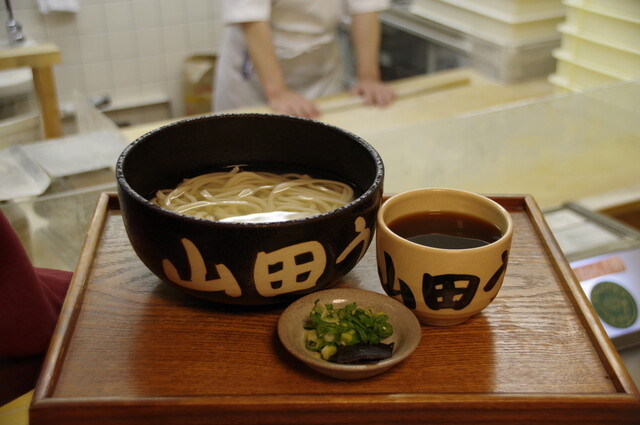
Approaching a small udon shop in residential Osaka is a different proposition from chasing a counter in Ginza or a chef’s-menu room in Kita. The cues are quieter: a short frontage, a room built for quick turnover, and the expectation that the noodles matter more than ceremony. Yamada Seimensho belongs to that Osaka category where value is not a discount strategy but the form itself: wheat noodles, oden, sake, and a room compact enough to make lunch feel local rather than staged.
Osaka’s casual food reputation often gets flattened into takoyaki and okonomiyaki shorthand, but its noodle culture is just as revealing. Udon here tends to reward texture, broth clarity, and portion logic over luxury signaling. That is why a shop selected for Tabelog 100 Udon WEST 2024 carries a useful signal: it has been pulled from the crowded field of western Japan udon specialists, not from a broad restaurant popularity contest. A Tabelog score of 3.65 places it in a serious everyday category, the kind where repeat local use and specialist attention overlap.
Osaka value is clearest when the format stays narrow
The strongest argument for this type of meal is focus. In a city where casual dining can run from pork-cutlet specialists such as Tonkatsu Fujii to sub-¥1,000 udon counters like Odoru Udon Takii honten and Teuchi Udon Beniy, the meaningful comparison is not luxury versus budget. It is whether a narrow format gives enough reason to cross town. Yamada Seimensho’s answer sits in the combination of udon, Japanese sake, and oden, a trio that reads as practical rather than decorative.
That matters because low prices in Japan can be misleading to visitors. A cheap bowl is common; a cheap bowl attached to a recognized specialist list is less common. The value proposition is not abundance for its own sake. It is the chance to eat inside a category that locals treat with real discrimination, while spending at the level of an everyday lunch. For travelers used to equating reservation difficulty with quality, Osaka’s noodle shops are a useful correction.
The room reinforces that point. Counter seating and table seating create a mixed-use rhythm: solo diners, families, and friends can all fit the format without turning it into an occasion restaurant. The absence of private rooms keeps the experience public and functional. This is not the kind of place that needs a long narrative arc around a chef. Its authority comes from category discipline, Tabelog recognition, and a format that lets noodles carry the meal.
Udon, oden, and sake make a compact Osaka meal
Udon shops with side dishes and sake occupy an appealing middle ground in Japan: quicker and less formal than an izakaya, more complete than a single-purpose noodle stop. Oden gives the meal a slower, warmer register, while sake signals that the shop is not treating noodles as a purely rushed lunch product. The result is a compact Osaka meal, especially for diners who want one address to cover texture, broth, and a drink without moving into a multi-course setting.
That compactness is also what separates it from the broader casual field. Mensho Jikon sits in Osaka’s noodle economy at a similar everyday spend, while Bird COFFEE operates in a café register and Tonkatsu Fujii in a fried-pork lane. Yamada Seimensho is more specific: udon first, with enough supporting structure to make the visit feel complete. For a traveler building a day around neighborhoods rather than reservations, that specificity is the point.
Asahi-ku also changes the expectation. This is not Dotonbori performance dining or Umeda convenience dining. Shimizu places the meal in a quieter north-eastern pocket of Osaka, where the reward is a local cadence rather than a landmark backdrop. The nearest station context keeps it accessible, but the surrounding feeling is residential. In Osaka, that often produces better casual eating than the visitor-heavy core, because the room has to work for regulars as much as for destination diners.
How to fit it into an Osaka food day
The smartest use of the restaurant is as a focused noodle stop rather than the centerpiece of an entire day. Pair it with a broader Osaka plan that leaves room for contrast: a bakery morning, a pork bun detour, an Italian dinner, or a bar crawl later in the evening. For broader planning, Our full Osaka restaurants guide maps the city’s dining range, while Our full Osaka hotels guide, Our full Osaka bars guide, Our full Osaka wineries guide, and Our full Osaka experiences guide help frame the rest of the trip.
Within Osaka’s casual circuit, the useful contrasts are close at hand..cafe and 52CHO-ME BAKERY point toward the city’s lighter daytime side; 551 Horai (551蓬莱) anchors a different kind of mass-loved Osaka comfort; 99 Pizza Napoletana Gourmet and a canto (Italian) show how the city absorbs European formats without losing its appetite for everyday value.
For readers comparing Japanese regional casual dining beyond Osaka, the contrasts are just as useful. -Grilled beef Sukiyaki- KAMAKURA TANUKIAN 鎌倉 たぬき庵 in Kamakura sits in a different comfort-food tradition. 鮪と炭火焼き うお炭 秋葉原店 in Tokyo moves toward tuna and charcoal, and.know in Kumamoto gives a regional counterpoint. (Shoku) Vietnam in Kawasaki, [Curry Senmon Ten] Maruyama Kyoju. in Sapporo, and [ki:] in Kyoto underline how varied Japan’s low-to-mid-price specialist rooms can be. Further afield, Jōdo Saké Bar in Los Angeles and Onigiri Time in Pasadena show how Japanese formats shift when transplanted abroad.
The critical read is simple: the restaurant is not trying to imitate a luxury noodle counter. Its appeal lies in the opposite direction, a recognized udon shop that keeps the spend low, the format tight, and the neighborhood setting intact. In Osaka, where value and seriousness often share the same stool, that is the stronger story.
Peers You’d Cross-Shop
Nearby venues at a similar price tier for orientation.
| Venue | Cuisine | Price | Notes |
|---|---|---|---|
| Yamada SeimenshoThis venue — the venue you are viewing | Kama-age udon & oden shop | $ | Not listed |
| Chiikawa Bakery | Chiikawa-themed Japanese bakery café | $ | Umeda |
| Human beings everybody noodles (人類みな麺類) | Traditional Shoyu Ramen | $ | Nishinakajima, Yodogawa-ku |
| Teuchi Udon Beniy | Handmade Udon & Curry Udon | $ | Moriguchi |
| Takeuchi Udon Ten | Sanuki-style udon and tempura shop | $ | Kita |
| Zeroku Honmachi ten | Traditional Japanese kissaten with coffee and monaka ice cream | $ | Chūō |
Recognition history
Dated appearances from independent guides and award organizations, with the underlying list record or original source where available.
Tabelog 100 #31 · No. 31
Tabelog · Tabelog 100 - Udon - WEST - 2024
Continue exploring
More in Osaka
Restaurants in Osaka
Browse all →



Bars in Osaka
Browse all →

Hotels in Osaka
Browse all →



Wineries in Osaka
Browse all →
At a Glance
- Cozy
- Classic
- Solo
- Family
- Casual Hangout
- After Work
- Group Dining
- Standalone
- Local Sourcing
Simple and homey neighborhood udon shop with a classic feel, counter-style casual dining, non-smoking interior, and a relaxed atmosphere suited to everyday meals rather than formal occasions.