Waterside Restaurant
Waterside Restaurant sits on Lakeview Drive in Stone Mountain, Georgia, where the setting along the water shapes the dining experience as much as what arrives on the plate. The kitchen's sourcing approach connects it to a broader regional conversation about where ingredients come from and what that means for a meal. For Stone Mountain dining, it occupies a distinct position worth understanding before you book.
Pearl is the En Primeur Club membership app — saves, bookings, and concierge access live there. Same editors, same standards.
- Address
- 4021 Lakeview Dr, Stone Mountain, GA 30083
- Phone
- +17704653240
- Website
- atlantaevergreen.com
- Directions
- Get directions
 Saves & bookings on Pearl
Water as Context: Dining Along Stone Mountain's Lakeshore
Stone Mountain's restaurant scene is compact, defined largely by its proximity to the park and the residential corridors that ring it. Most visitors eating in the area move between a short list of casual to mid-range options: Italian-American at Fresca Trattoria, Tex-Mex at Frontera Mex-Mex Grill, or the more generalist comfort of The Commons Restaurant. Waterside Restaurant, at 4021 Lakeview Drive, is a restaurant serving American Comfort Food in Stone Mountain, Georgia; the water is not incidental. A lakeside setting in suburban Atlanta carries specific dining associations, a slower pace, a certain expectation that the view will carry some weight in the room, and, ideally, that the kitchen has thought about what that setting demands of the food.
In American dining, waterfront restaurants have historically fallen into two camps: those that rely on the view as the primary draw while the kitchen coasts, and those that treat the geography as an ingredient in itself, sourcing fish and produce with the same intentionality that the setting implies. The better examples of the latter category are found across the country: Le Bernardin in New York City built its identity around seafood sourced with near-obsessive specificity; Providence in Los Angeles turned California coastal sourcing into a critical framework. Waterside Restaurant operates at a different scale and in a different market, but the question the setting raises is the same: does the kitchen take its cues from the water?
The Sourcing Question in the Georgia Piedmont
Georgia's food geography is more varied than its national reputation suggests. The Piedmont region, where Stone Mountain sits, has access to produce from a network of farms that has expanded steadily since the mid-2000s growth of farmers markets in the Atlanta metro. Georgia shrimp from the coast, catfish and bass from inland waterways, peaches and pecans from the central belt, and a widening range of specialty vegetables from small-scale growers in the north Georgia mountains, this is the pantry that any ingredient-aware kitchen in the region can draw from.
The broader American farm-to-table conversation, which venues like Blue Hill at Stone Barns in Tarrytown and Single Thread Farm in Healdsburg have pushed to its logical extreme, trickled into Southern dining through restaurants in Atlanta proper before reaching the suburbs. Bacchanalia in Atlanta has long anchored this approach in the metro, treating sourcing as a structural pillar rather than a marketing line. For a restaurant in Stone Mountain to participate meaningfully in that conversation, the kitchen needs to be making specific decisions about where ingredients originate, not just noting locality in general terms on a menu.
What the address and setting do is frame a reasonable expectation: a lakeside restaurant in this part of Georgia has proximity to both Southern coastal supply chains and Piedmont farm networks. Whether the kitchen acts on that proximity is the variable that separates a destination dining experience from a scenic one.
What Stone Mountain Dining Lacks, and What That Creates
Stone Mountain as a dining destination sits in a curious position relative to Atlanta. The city's restaurant culture, which includes serious kitchens drawing national attention, is accessible within 30 to 40 minutes. That proximity raises the bar for what a suburban restaurant needs to offer to justify the trip, or, more accurately, to justify staying local rather than driving into the city. The restaurants that hold their own in this context tend to do so either by offering something the city does not replicate easily (a specific setting, a neighborhood scale, a cuisine category underrepresented in Atlanta) or by meeting city-level execution standards at a different price point.
Across the American dining scene, this urban-suburban tension has produced some interesting results. The Inn at Little Washington is one cited example of a non-urban restaurant that exceeded the standards of its nearest major market. At a more modest scale, restaurants in suburban corridors around cities like Denver, where Brutø has helped define what serious suburban dining can look like, or San Francisco, where Lazy Bear helped redraw what a casual-feeling room could serve, show that geography outside a city center is not inherently limiting.
For Waterside Restaurant, the lakeside location is the clearest differentiator from what the city offers. A meal with that kind of physical setting, if the kitchen supports it, is a different proposition from eating at a similarly priced restaurant on a city block. The question for anyone planning a visit is whether the room and the food work together as a coherent argument for making the drive.
Planning a Visit: What to Know Before You Go
Waterside Restaurant's address at 4021 Lakeview Drive places it in a residential stretch of Stone Mountain, accessible by car from central Atlanta in under an hour depending on traffic conditions on I-285 and US-78. Reservations are recommended, and the restaurant is open daily from 7:30 AM to 9:30 PM. Checking directly with the restaurant before visiting is advisable.
Stone Mountain as a dining area benefits from comparison with what surrounds it. The park draws visitors who often eat before or after their time at the mountain, which means the local restaurant market includes a tourist-facing layer alongside a neighborhood-serving one. Waterside, given its address, likely draws more from the latter, people who know the area and return regularly, than from the former. That distinction matters for what kind of experience to expect: a room calibrated to local regulars tends to operate differently from one calibrated to first-time visitors.
For reference points on what waterfront or ingredient-driven dining can look like at various levels of ambition and formality, the spectrum runs from technically precise programs at places like Alinea in Chicago and Atomix in New York City to more produce-forward formats at Addison in San Diego or the seafood sourcing rigor of Emeril's in New Orleans. Internationally, venues like 8 1/2 Otto e Mezzo Bombana in Hong Kong demonstrate how a dining room's physical setting can be mobilized as a deliberate part of the guest experience. These reference points clarify what the category's ceiling looks like and what questions are worth asking of any restaurant that leads with its location. One useful question for Waterside remains the simplest: does the kitchen do justice to the setting?
Fast Comparison
Comparable venues nearby, for context on price, style, and recognition.
| Venue | Cuisine | Price | Notes |
|---|---|---|---|
| Waterside RestaurantThis venue — the venue you are viewing | American Comfort Food | $$ | Not listed |
| Frontera Mex-Mex Grill | Mex-Mex Grill | $$ | Stone Mountain |
| The Commons Restaurant | Southern American Pub Fare | $$ | Stone Mountain Park |
| Fresca Trattoria | Italian Trattoria | $$ | Stone Mountain |
| f2o Fresh to Order | Healthy American Fast-Casual | $$ | Johns Creek |
| Chicken Salad Chick | Southern Chicken Salad | $$ | Vinings |
Continue exploring
More in Stone Mountain
Restaurants in Stone Mountain
Browse all →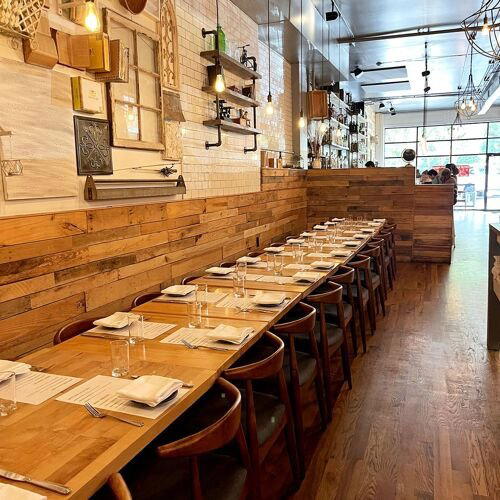
Bars in Stone Mountain
Browse all →
At a Glance
- Scenic
- Casual
- Romantic
- Family
- Waterfront
- Waterfront
- Mountain
Current opening hours
- Monday
- 7:30 AM–9:30 PM
- Tuesday
- 7:30 AM–9:30 PM
- Wednesday
- 7:30 AM–9:30 PM
- Thursday
- 7:30 AM–9:30 PM
- Friday
- 7:30 AM–9:30 PM
- Saturday
- 7:30 AM–9:30 PM
- Sunday
- 7:30 AM–9:30 PM
Hours can change for holidays and private events. Last verified .
Casual and inviting atmosphere with natural light from large windows overlooking the lake and mountain.