
Osaka’s noodle culture is often judged by speed, price, and broth discipline rather than ceremony. Usami Tei Matsubaya belongs to the old Minamisenba register: founded in 1893, selected for Tabelog 100 Udon WEST 2024, and priced in the sub-¥1,000 bracket, with udon, soba, oyako-don, and sake forming a compact everyday repertoire.
Pearl is the En Primeur Club membership app — saves, bookings, and concierge access live there. Same editors, same standards.
- Address
- 3 Chome-8-1 Minamisenba, Chuo Ward, Osaka, 542-0081, Japan
- Phone
- +81 6-6251-3339
- Website
- tabelog.com
 Saves & bookings on Pearl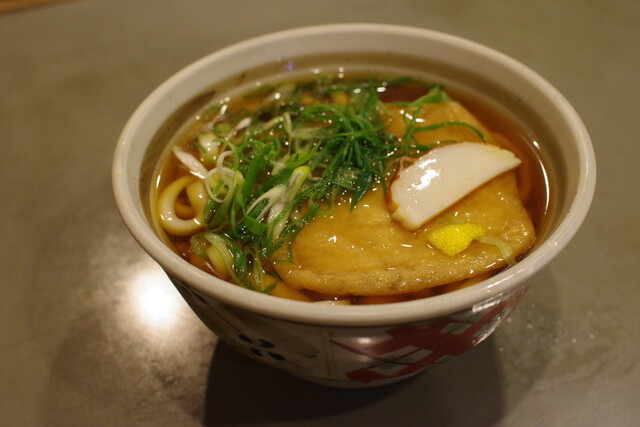
Minamisenba gives Osaka a quieter appetite. From Shinsaibashi, the route leaves department-store glare for offices, small shops, and lunch counters, where noodle houses are judged less by theatre than by feeding regulars cleanly, quickly, and at the right price. Here, Usami Tei Matsubaya reads as old Osaka rather than retro Osaka: a working noodle address with a Meiji-era founding date, a 50-seat room, and a menu centred on udon, with soba, oyako-don, and sake sitting naturally beside it.
That matters because Osaka’s everyday dining identity is not only takoyaki queues and late-night neon. The city also has a practical daytime culture of noodle shops, curry counters, bakeries, and casual rice-bowl rooms, where value and repetition carry more authority than spectacle. For that wider register, Our full Osaka restaurants guide places noodle shops alongside addresses such as 551 Horai (551蓬莱), 52CHO-ME BAKERY, .cafe, and 99 Pizza Napoletana Gourmet. The comparison is useful: Osaka’s casual strength is not one genre, but a density of formats that fit into a normal day.
Udon in Osaka is a discipline of restraint, not display
Kansai udon rewards clarity. Compared with heavier, darker broth traditions elsewhere in Japan, Osaka’s noodle culture often privileges lighter dashi, softer regional expectations around texture, and repeat eating over culinary theatre. Not every bowl follows one template, but the grammar values balance and speed. A sub-¥1,000 average price places Usami Tei Matsubaya in the everyday bracket, not the special-occasion tier of restaurants such as Oimatsu Hisano or Restaurant Tsujikawa. That signal shapes the meal before ordering: this category is built for frequency.
The Tabelog 100 Udon WEST 2024 selection gives the address a clearer benchmark. It does not make a noodle shop into a tasting-menu restaurant; it places it among Western Japan’s recognized udon specialists for that year. The distinction matters because udon quality in Japan is hyper-local and hard to judge by price alone. A 3.66 score and category-specific selection point to a shop that has earned attention in a crowded genre, while soba and oyako-don keep it grounded in the multipurpose Japanese dining room rather than a single-product counter.
The menu is best read through that everyday breadth. Udon is the centre of gravity, soba offers a second noodle route, and oyako-don anchors the rice-bowl side. Sake is listed, less as a promise of cellar depth than as a sign of traditional compatibility. This is not a sake-bar destination like Jōdo Saké Bar in Los Angeles, but a supporting choice for a compact Japanese meal. In a dining era that often overstates beverage programs, the curation here appears functional: nihonshu with noodles and donburi, not a sommelier-led cellar narrative.
Old Minamisenba, priced for regulars
1893 founding date gives the room a different weight from Osaka’s newer casual wave. Longevity in this category usually means adapting without losing the core proposition: affordable noodles, family-friendly usability, and a format that can absorb office workers, shoppers, and neighborhood regulars. The 50-seat capacity also separates it from counter-only ramen or curry rooms where the queue is part of the ritual. This is a conventional dining-room model, useful for groups and children, with private rooms unavailable and non-smoking status noted.
Minamisenba’s geography explains the audience. Shinsaibashi is close enough for visitors, but the address sits in Chuo Ward’s workaday fabric rather than a hotel dining circuit. That makes it a better fit for a daytime Osaka itinerary than a destination dinner plan. Travelers might pair this lunch with later, more contemporary stops such as a canto (Italian), or use it as a contrast to Osaka’s curry culture, where Spice Curry Te, Curry Ya Dekkao, and Watanabe Curry Shinsaibashi ten show how the city has made casual spice cooking its own subculture.
That casual map extends beyond Osaka. Japan’s low-price specialist rooms often reveal more about regional eating habits than formal restaurants: [Curry Senmon Ten] Maruyama Kyoju. in Sapporo speaks to curry as local comfort, [ki:] in Kyoto sits in another Kyoto register.know in Kumamoto broadens the regional lens, and (Shoku) Vietnam in Kawasaki shows how Japanese cities absorb imported everyday formats. Outside Japan, Onigiri Time in Pasadena illustrates the same principle: modest formats can carry serious cultural information when not treated as filler between reservations.
How to place it in an Osaka itinerary
The practical read is simple: a daytime noodle stop with reservations unavailable, cash-only payment, no parking, and Sunday and public-holiday closure. The room runs from late morning through early evening on operating days, so timing matters more than formality. It suits a Shinsaibashi or Honmachi day better than a late dinner crawl, and the lack of card or QR payment means cash should be ready before arrival.
For travelers using Osaka as more than a dining stop, planning pieces matter. Our full Osaka hotels guide helps decide whether Shinsaibashi access is worth prioritizing, while Our full Osaka bars guide covers the after-dark city. Our full Osaka experiences guide is better for daytime routing, and Our full Osaka wineries guide helps readers map drinks beyond the restaurant table. The national comparison can stretch from -Grilled beef Sukiyaki- KAMAKURA TANUKIAN 鎌倉 たぬき庵 in Kamakura to. 鮪と炭火焼き うお炭 秋葉原店 in Tokyo, but the reason to come here is narrower and stronger: Osaka’s noodle culture at a price and scale that still belong to daily life.
At a Glance
Comparable venues for context, by category and price tier.
| Venue | Cuisine | Price |
|---|---|---|
| Usami Tei MatsubayaThis venue — the venue you are viewing | Chūō, Historic Osaka Udon & Soba Shop | $ |
| Okashi Tsukasa Takaoka Fukunobu | Chūō, Traditional Japanese wagashi shop | $ |
| Udon Izakaya Edobori | Nishi, Udon izakaya | $ |
| Aimai | Kita, Spicy Japanese curry house | $ |
| Osama no Spoon | Kita, Osaka curry & soup curry shop | $ |
| Chuka Soba Ibuki | Kita, Ramen & Tsukemen | $ |
Recognition history
Dated appearances from independent guides and award organizations, with the underlying list record or original source where available.
Tabelog 100 #15 · No. 15
Tabelog · Tabelog 100 - Udon - WEST - 2024
Continue exploring
More in Osaka
Restaurants in Osaka
Browse all →




Bars in Osaka
Browse all →




Hotels in Osaka
Browse all →



Wineries in Osaka
Browse all →
At a Glance
- Classic
- Cozy
- Well Known
- Solo
- Family
- Casual Hangout
- After Work
- Historic Building
- Standalone
- Sake Program
Current opening hours
- Monday
- 11 AM–6 PM
- Tuesday
- 11 AM–6 PM
- Wednesday
- 11 AM–6 PM
- Thursday
- 11 AM–6 PM
- Friday
- 11 AM–6 PM
- Saturday
- 11 AM–6 PM
- Sunday
- Closed
Hours can change for holidays and private events. Last verified .
A traditional, no-frills noodle shop atmosphere with a simple, classic interior, brisk turnover, and a relaxed, everyday local feel rather than a design-driven space.