Our verdict
Timgad has anchored North African fine dining in Paris's 17th arrondissement for decades, occupying a tier of Maghrebi cuisine that has few serious rivals in the capital. The address on Rue Brunel represents one of the most considered expressions of Algerian cooking in Europe, where the service tradition and kitchen work as a coordinated whole rather than as separate departments.

Pearl is the En Primeur Club membership app, where members save venues, book tables and use the concierge.
North African Fine Dining in Paris: Where Timgad Fits
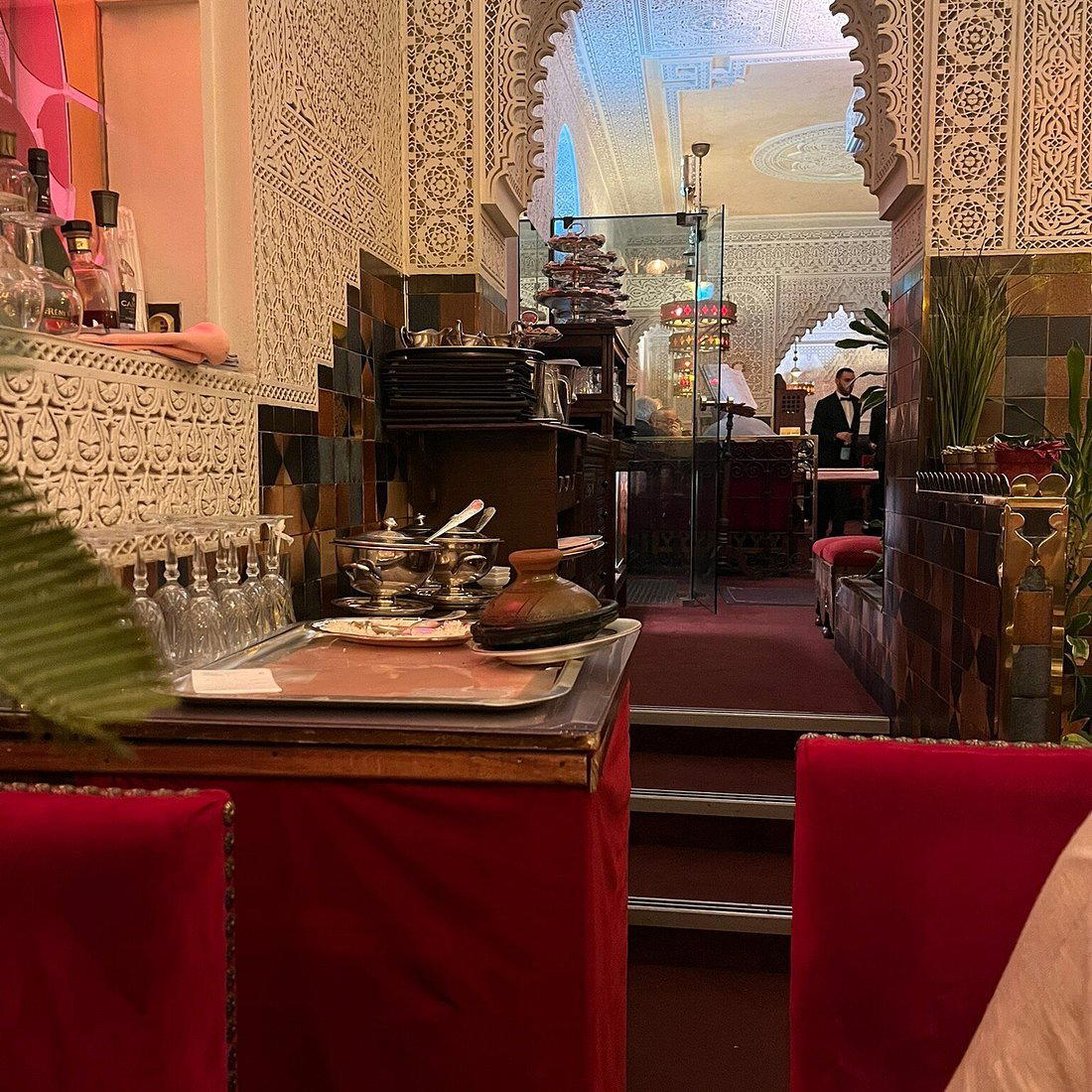
Paris has long maintained a North African dining scene that runs from neighbourhood canteens in the 18th and 20th arrondissements to a small, more formal tier that serves Maghrebi cuisine with the same structural seriousness applied to the city's French grande cuisine establishments. Timgad, at 21 Rue Brunel in the 17th arrondissement, has occupied that upper register for long enough that it functions less as a destination to discover and more as a fixed point of reference for Algerian cooking in the French capital. That kind of durability in Paris dining is not accidental. It reflects a sustained coordination between kitchen, dining room, and cellar that the city's most competitive restaurant environment tends to strip away from venues that cannot sustain it.
The 17th sits between the business formality of the 8th and the quieter residential fabric of the western arrondissements, and the street address on Rue Brunel positions Timgad within a neighbourhood that does not rely on tourist traffic. The dining room draws a clientele that returns on purpose, which tends to impose a different discipline on the front-of-house operation than venues built around first-time visitors. That distinction matters when assessing how a restaurant sustains its standards across years rather than seasons.
The Architecture of Service: Kitchen, Sommelier, Front-of-House
At the level of ambition Timgad represents, the quality of a meal is rarely determined by one department in isolation. The pattern in Paris's more durable formal restaurants, from the multi-Michelin floors of Alléno Paris au Pavillon Ledoyen and Arpège to the classicist precision of L'Ambroisie, is that kitchen output and floor execution function as a single integrated system. Remove either component and the experience degrades in ways that individual dishes cannot compensate for.
At Timgad, this integration is particularly consequential because Algerian and broader Maghrebi cuisine operates on a different structural logic than French haute cuisine. Spice sequencing, the pacing of tagines and couscous dishes, the transition between cold and warm preparations, these require a floor team that understands the kitchen's timing rather than simply delivering plates on cue. A sommelier working this kind of menu faces a pairing challenge that has no standard French template: the wine list must account for dishes where preserved lemon, ras el hanout, harissa, and slow-braised proteins compete and complement in ways that classic Burgundy or Bordeaux pairings were never designed to address. The most credible North African fine dining venues in Paris have resolved this by either building wine programs weighted toward Southern French and North African producers, or by training floor staff to guide guests through non-obvious pairings with genuine conviction rather than rote recommendation.
The front-of-house role in this format is more interpretive than at a French tasting-menu counter. Guests unfamiliar with the depth of Algerian cooking need guidance that goes beyond reciting ingredients, the team must communicate why a particular dish belongs in this tier rather than in a neighbourhood bistrot, and do so without condescension. That kind of hospitality is a skill set, not a default.
Algerian Cuisine at This Level: What It Means in Paris
France's relationship with Algerian cuisine is inseparable from its demographic and political history, but the culinary conversation has moved considerably since the mid-twentieth century. The question now is less whether Algerian food belongs in formal Paris dining and more what formal Algerian dining actually looks like when it is executed with the same resource commitment applied to the city's French establishments. Timgad has been part of answering that question for long enough that its existence influenced what came after it.
The comparison set here is not the Michelin-starred French kitchens along the 8th arrondissement's grand axes, where Le Cinq at the Four Seasons George V and Kei operate in a broadly European fine dining grammar. That is a narrower category, and occupying it for an extended period places Timgad in a different conversation than restaurants that succeed primarily on novelty.
France's broader fine dining geography offers instructive contrasts. Properties like Mirazur in Menton, Flocons de Sel in Megève, and Bras in Laguiole demonstrate how regional identity and culinary distinctiveness can coexist with formal ambition outside the Paris axis. Timgad's position within Paris itself, rather than in a region with a defined gastronomic identity, makes its durability more difficult to sustain and therefore more significant. The Paris restaurant environment that also contains Troisgros lineage, Auberge de l'Ill tradition, and the rigour of Paul Bocuse's legacy does not make space easily for cuisines outside its own canon.
For context on how other French regions handle the intersection of local identity and formal dining ambition, Au Crocodile in Strasbourg, Assiette Champenoise in Reims, Auberge du Vieux Puits in Fontjoncouse, and AM par Alexandre Mazzia in Marseille each illustrate different strategies. The international frame is equally relevant: Le Bernardin in New York and Atomix in New York both demonstrate how non-French culinary traditions can occupy the top tier of a market defined by French fine dining norms. Timgad's position in Paris represents the same challenge, in the city where the norms originated.
Planning Your Visit
Timgad is located at 21 Rue Brunel, 75017 Paris, in the 17th arrondissement, accessible from the Ternes or Argentine metro stations. Given its long-standing reputation, reservations are advisable well in advance, particularly for weekend evenings. Reservations: Book ahead through standard Paris reservation channels; this is not a walk-in venue at peak times. Dress: Smart dress is appropriate given the formal register of the dining room. Budget: For additional Paris dining context, see our full Paris restaurants guide.
Frequently asked questions
What's the address for Timgad?
Timgad is located at 21 Rue Brunel, 75017 Paris, France, Paris.
Is Timgad in Paris the right restaurant for someone wanting to understand Algerian cuisine at its most serious?
In Paris, where the Algerian dining conversation stretches from neighbourhood canteens in the 18th arrondissement to a handful of more formally positioned rooms, Timgad in the 17th arrondissement occupies the upper end of that range. The address at 21 Rue Brunel places it in a quartier associated with established, destination-led restaurants rather than casual neighbourhood eating. For a diner whose reference points are French fine dining and who wants Algerian cuisine treated with equivalent rigour, Timgad is the relevant comparison point in the city.
What's the best thing to order at Timgad?
Timgad has built its reputation on Algerian cuisine at a register that few Paris restaurants attempt, so the house's approach to North African classics, couscous, tagines, and pastilla, is the reason to visit. Without a current published menu on file, the most reliable strategy is to ask the front-of-house team which dishes represent the kitchen's current focus. At this level of ambition in Paris's North African dining scene, the set menu or chef's selection tends to show the range more fully than ordering à la carte.
How hard is it to get a table at Timgad?
Timgad at 21 Rue Brunel has held a longstanding position among Paris's most serious North African tables, which puts it in demand well beyond the immediate neighbourhood. Reservations are advisable, particularly for weekend evenings. For the most current availability, check the venue's official channels or use a Paris-based booking platform, as lead times can extend several weeks during peak periods.
Comparison Snapshot
Comparable venues nearby, for context on price, style, and recognition.
| Venue | Cuisine | Price | Awards | Notes |
|---|---|---|---|---|
| TimgadThis venue (the venue you are viewing) | Traditional Moroccan | $50–100 | Not listed | Not listed |
| Anna | Italian Wine Bar | Not listed | Gambero Rosso 2 Bottiglie | Haut Marais (Paris 3) |
| Casa Luca | Authentic Italian Trattoria | $30–50 | Not listed | Champs-Élysées |
| 116 | Japanese-French Fusion Izakaya | $30–50 | Not listed | Passy |
| Fitzgerald | Modern French Bistro with Mediterranean Touches | $50–100 | Not listed | Gros-Caillou |
| L'Evasion | Classic French Bistro | $50–100 | Not listed | 8e arrondissement (L'Europe) |
Recognition history
Dated appearances from independent guides and award organizations, with the underlying list record or original source where available.
Opinionated About Dining Casual in Europe Recommended
Opinionated About Dining