Thelewala
Our verdict
On MacDougal Street in Greenwich Village, Thelewala brings the fast-casual kathi roll format to one of New York's most food-dense blocks. The format is built around portability, speed, and South Asian street food tradition, qualities that sit at odds with the neighbourhood's increasingly polished dining scene, making it a useful counterpoint for anyone tracking how the Village eats across price tiers.

Pearl is the En Primeur Club membership app, where members save venues, book tables and use the concierge.
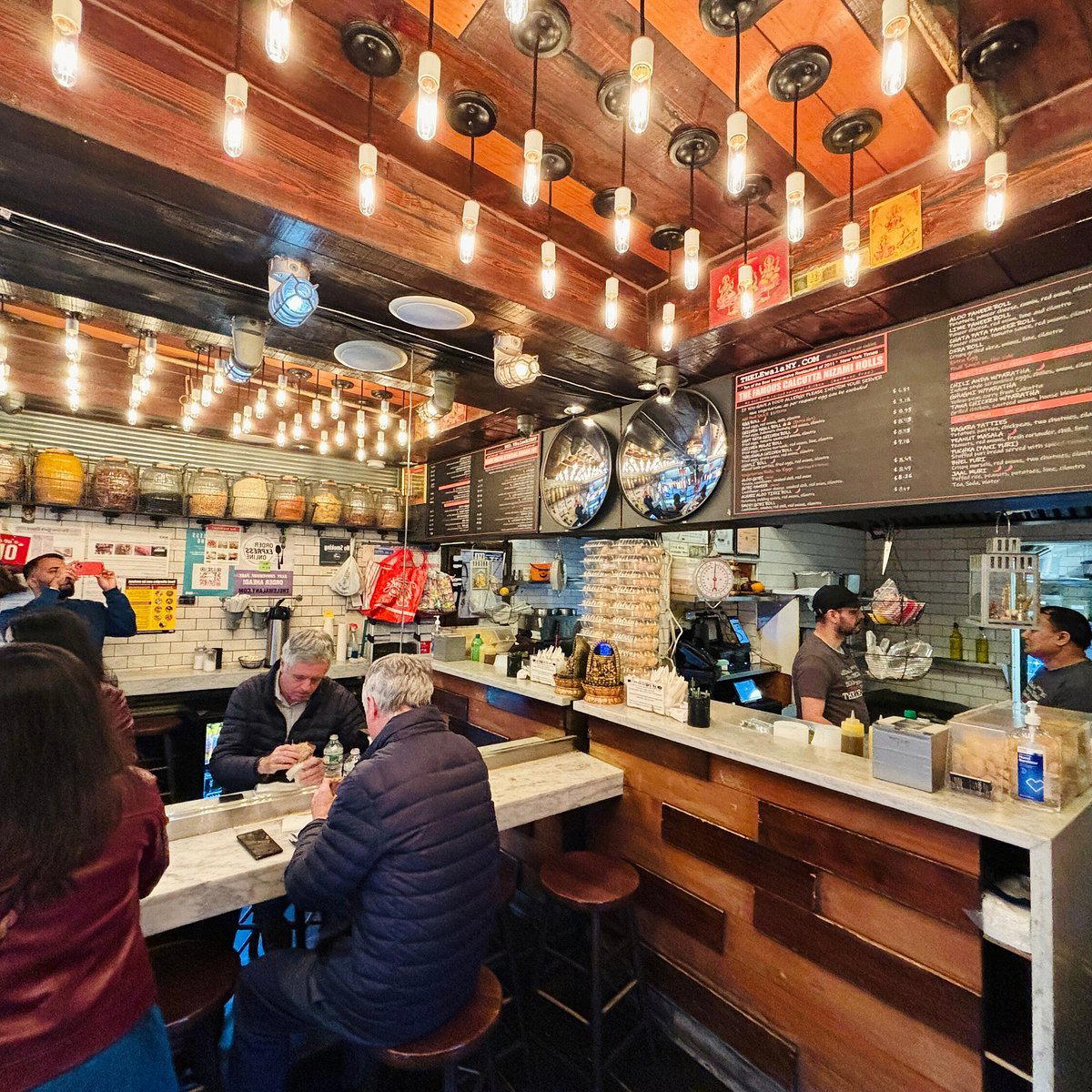
The menu
What to order
- Chicken Malai Roll
- Chatpata Paneer Roll
- Chicken Phall Roll
MacDougal Street and the Economics of the Everyday
Greenwich Village's MacDougal Street has long operated as a kind of open-air food court for NYU students, late-night wanderers, and the city's more cost-conscious diners. The block between Bleecker and West 3rd has drawn pizza slices, falafel wraps, and bubble tea for decades, and the throughput model that defines it, high volume, fast turnover, affordable price points, is almost entirely at odds with the tasting-menu culture that has come to define New York's premium dining conversation. Masa and Per Se represent one end of what New York asks of a restaurant; Thelewala, at 112 MacDougal, represents a different but equally legitimate answer.
The kathi roll, a street food format with roots in Kolkata's Nizam's restaurant, where flatbread wraps around skewered kebab, has arrived in New York through several vectors over the past two decades. What Thelewala does is anchor the format to a specific address in a neighbourhood more associated with tourist slices than subcontinental street food. That address matters: MacDougal Street draws foot traffic that few blocks in Manhattan can match, which means the format gets tested against a genuinely diverse cross-section of the city rather than a self-selecting clientele already primed for South Asian cuisine.
A Street Food Format Built for the City's Pace
The kathi roll's appeal in an urban context is structural rather than fashionable. It is food designed for movement: the filling is sealed inside flatbread in a way that tolerates being eaten standing, walking, or at a narrow counter without ceremony. In Kolkata, the format evolved around working-class lunch culture, where speed and caloric density mattered as much as flavour. In New York, those same properties translate directly to a city where the sit-down lunch has been retreating for years. The portability is not a gimmick; it is the point.
South Asian street food more broadly has been gaining institutional recognition in American cities at a pace that the restaurant industry has not always kept up with. While Atomix and Jungsik New York have established Korean cuisine at the highest tier of the city's dining hierarchy, South Asian formats at the premium end remain underrepresented in the awards conversation relative to their influence on how New York actually eats day to day. The fast-casual kathi roll sits in a different tier entirely, but it is worth noting that the format's staying power on a street as competitive as MacDougal is itself a form of validation.
Sourcing and the Ethics of the Quick-Service Model
The editorial angle that matters most for a venue like Thelewala is not décor or chef biography, there is no long-form tasting menu to unpack, no Michelin watch to track. What matters is whether a quick-service format, operating at speed and volume on one of Manhattan's busiest blocks, is making considered decisions about what goes into the flatbread. Across the broader quick-service category in New York, the gap between operators who treat sourcing as a priority and those who treat it as a cost variable has widened noticeably since the mid-2010s.
The sustainability pressures that have reshaped how venues like Blue Hill at Stone Barns and Single Thread Farm operate at the premium tier do filter down into the fast-casual space, if more slowly and with less fanfare. Whole-animal sourcing, minimal packaging, and waste-reduction practices are now competitive differentiators even in the counter-service format, particularly in a neighbourhood like Greenwich Village where the customer base skews educated and increasingly attentive to supply chain questions. A kathi roll operation that takes those questions seriously is operating in a different moral register than one that does not, even if the price point and the format look identical from the outside.
Without specific sourcing data on record for Thelewala, the honest editorial position is to flag the question rather than answer it. Any diner for whom ethical sourcing is a deciding factor should ask directly at the counter, a practice that quick-service venues are increasingly prepared for, and that the leading operators actively welcome.
Where Thelewala Sits in New York's Street Food Conversation
New York's street food canon is vast and contested. The city's cart and counter culture encompasses everything from Midtown's halal trucks to the Taiwanese beef noodle shops of Flushing, and the critical infrastructure that covers it, New York Times reviews, Eater heatmaps, Infatuation picks, has grown more attentive to that range in recent years. The South Asian fast-casual segment, which includes kathi roll specialists as well as chaat houses and dosa counters, sits within that conversation without always commanding the same column inches as, say, a new omakase counter or a tasting menu from a name chef.
For context on the premium end of New York's dining spectrum, the EP Club guide covers the full range, from Le Bernardin's seafood counter to the modernist ambition of Atomix. Thelewala occupies a different register but a useful one: it is a data point for how a specific street food tradition holds ground in one of the world's most competitive dining environments. For readers building a picture of how New York eats across all price tiers and formats, our full New York City restaurants guide maps the terrain from counter service to tasting menus.
Comparable conversations about how fast-casual formats relate to a city's broader culinary identity play out at venues like Emeril's in New Orleans and in the farm-to-table ethics that define operations like Lazy Bear in San Francisco, Alinea in Chicago, Providence in Los Angeles, Addison in San Diego, The French Laundry in Napa, The Inn at Little Washington, Bacchanalia in Atlanta, 8 1/2 Otto e Mezzo Bombana in Hong Kong, and Alain Ducasse at Louis XV in Monte Carlo. The sourcing ethics conversation is not limited to fine dining; it runs across the full spectrum.
Planning Your Visit
Thelewala is located at 112 MacDougal Street in Greenwich Village, a short walk from the West 4th Street subway station. The counter-service format means no reservation is required for most visits, though the block draws heavy foot traffic on weekend evenings. The format is designed for quick turnaround, so peak-hour waits tend to resolve fast.
Frequently asked questions
How do I find Thelewala?
Thelewala is located at 112 MacDougal St, New York, NY 10012, New York City.
How does Thelewala compare to other Indian street food options in New York City?
New York City's Indian street food offer spans everything from Jackson Heights cart vendors to Curry Hill sit-down counters, but dedicated kathi roll specialists at the Greenwich Village end of Manhattan are relatively sparse. Thelewala at 112 MacDougal Street occupies that gap by focusing on a single format rather than a broad menu. That specificity is what separates it from general Indian takeaways operating in the same borough.
What should I eat at Thelewala?
Thelewala's format centres on the kathi roll, a street food format originating in Kolkata in which spiced fillings are wrapped in flatbread for eating on the move. The Greenwich Village location at 112 MacDougal Street keeps the menu focused on that format rather than offering a broad Indian restaurant spread. If you are visiting for the first time, the kathi roll is the reason to go.
Do I need a reservation for Thelewala?
No. Thelewala operates as a counter-service venue at 112 MacDougal Street, which means walk-in ordering is the standard format. There are no tables to book and no timed seatings. Expect queues during peak evening hours, particularly given the venue's position on a high-traffic student and late-night corridor.
What has Thelewala built its reputation on?
Thelewala's standing in New York City comes from applying a specific subcontinental street food format, the kathi roll, to the fast-casual counter model in a neighbourhood that runs on affordable, portable food. Its location on MacDougal Street in Greenwich Village places it within a dense eating corridor frequented by NYU students and late-night diners. The venue does not carry Michelin recognition, but its reputation is grounded in consistency within a defined format rather than tasting-menu ambition.
Is Thelewala allergy-friendly?
Anyone with dietary restrictions should check the venue's official channels at 112 MacDougal Street, New York, NY 10012, or ask staff at the counter before ordering. Counter-service formats with spiced fillings often involve shared preparation surfaces, so direct confirmation is advisable.
Is Thelewala overpriced or worth every penny?
Thelewala sits within a street food price register consistent with New York City's counter-service Indian venues rather than full-service restaurant pricing. The kathi roll format is structurally a quick-eat proposition, and the MacDougal Street location competes in a corridor built around accessible price points for students and late-night visitors.
Category Peers
Comparable venues nearby, for context on price, style, and recognition.
| Venue | Cuisine | Price | Notes |
|---|---|---|---|
| ThelewalaThis venue (the venue you are viewing) | Indian Street Food - Nizami Rolls & Chaat | $10–20 | Not listed |
| Temple Canteen | Authentic South Indian Vegetarian | $10–20 | East Flushing |
| Kabab King | 24/7 Pakistani & Indian kebab diner | $10–20 | Jackson Heights |
| Jaz Indian Cuisine | Northern Indian | $30–50 | Hell's Kitchen |
| Dhaba | Authentic North Indian Punjabi | $20–30 | Murray Hill-Kips Bay |
| Atithi Indian Cuisine | Authentic Indian Cuisine | $20–30 | Williamsburg |