The Red Door
The Red Door on West Washington Street occupies a well-worn corner of Mission Hills that San Diego regulars treat as something close to a neighborhood institution. With a room that rewards repeat visits over first impressions, it draws a loyal clientele who return for the consistency and the sense of place rather than any single headline. For visitors, it offers a window into how San Diego dines when it isn't performing for tourists.
Pearl is the En Primeur Club membership app — saves, bookings, and concierge access live there. Same editors, same standards.
- Address
- 741 W Washington St, San Diego, CA 92103
- Phone
- +16192956000
- Website
- thereddoorsd.com
- Directions
- Get directions
 Saves & bookings on Pearl
What the Regulars Already Know
Mission Hills has a particular relationship with its dining rooms. The neighborhood sits just north of Hillcrest and west of Bankers Hill, and its residents tend to be the kind of San Diegans who eat out often enough to have opinions about the bread. Restaurants here earn loyalty the slow way: through consistency, through a room that feels lived-in rather than staged, and through the small recognitions that accumulate between a returning guest and a staff that notices. The Red Door, at 741 W Washington Street, is an Italian restaurant in San Diego's Mission Hills neighborhood, with. It is the kind of address that doesn't need to advertise itself to the people who matter most to it.
This is a meaningful distinction in a city where the dining conversation often gravitates toward Addison's formal French ambition in Del Mar or the Japanese precision of Soichi in Ocean Beach. Those are destination restaurants in the strictest sense: you plan around them, you book well ahead, you arrive with expectations calibrated over weeks. The Red Door operates in a different register entirely. Its pull is residential rather than ceremonial, and for many of its regulars, that is precisely what keeps them returning.
The Room and the Rhythm
West Washington Street in Mission Hills has the unhurried quality of a commercial strip that developed before anyone thought too hard about foot traffic strategy. The buildings are older, the signage modest, the pace noticeably slower than the Gaslamp or Little Italy. In that context, a red door reads as a landmark without trying to be one.
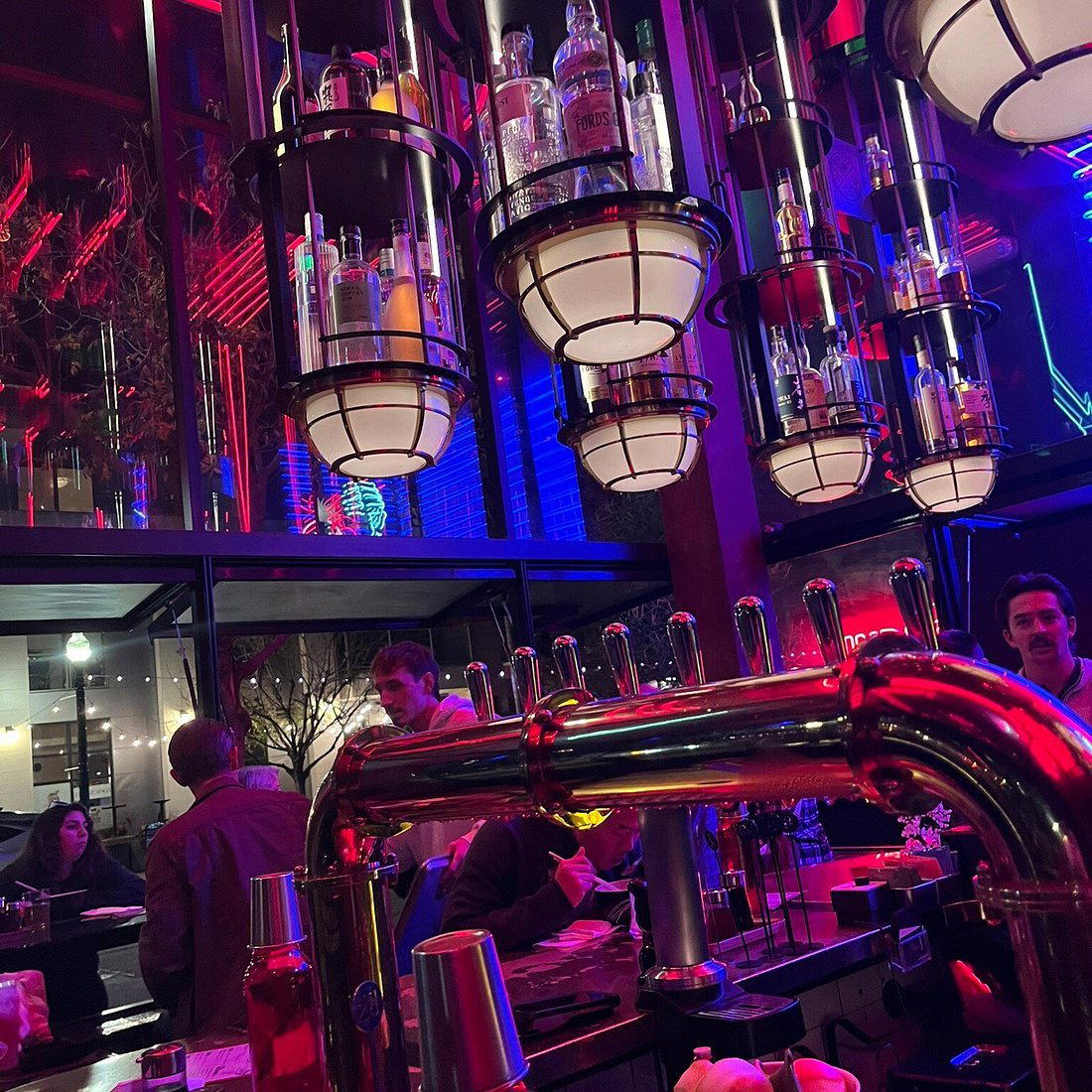
Inside, the design vocabulary of long-running neighborhood restaurants tends toward accumulated warmth rather than deliberate concept. Tables fill at a speed that reflects the local rhythm: earlier on weeknights when residents eat close to home, later when the crowd skews toward occasion. The bar, in rooms like this, often becomes a gathering point in its own right, the kind of place where solo diners eat without self-consciousness and regulars conduct the informal business of neighborhood life. That pattern, where the room functions as community infrastructure as much as restaurant, is what separates Mission Hills dining from the more transient energy of San Diego's waterfront corridors.
For comparison, consider how 1450 El Prado in Balboa Park draws a crowd defined more by occasion and setting than by neighborhood allegiance. The Red Door's geometry is the opposite: the setting is incidental to the loyalty, not its cause.
Where It Sits in San Diego's Dining Geography
San Diego's restaurant scene has matured considerably over the past decade, but it still distributes unevenly across the city. The high-spend, high-ambition tier is anchored by places like Addison, which operates at the level of destination dining comparable to The French Laundry in Napa or Providence in Los Angeles in terms of format discipline and booking complexity. Below that, a mid-tier of independently owned neighborhood restaurants carries much of the actual dining life of the city, places where the per-cover economics are different and the relationship between kitchen and guest is less mediated by ceremony.
The restaurant belongs to that second category, and within it to the specific subcategory of rooms that have earned standing through longevity rather than through awards cycles. That kind of standing is harder to manufacture than a Michelin star and, for a certain type of regular, more valuable. It is the logic that keeps a table at a known address booked even when newer options proliferate around it.
Nationally, the analogue is the kind of operator that earns James Beard recognition for sustained regional contribution rather than for innovation: places like Bacchanalia in Atlanta or Emeril's in New Orleans, where the institutional character of the room is itself the point. These are restaurants that their cities would notice if they closed.
The Unwritten Menu
The editorial angle that regulars consistently apply to a room like this is not about any single dish but about the cumulative logic of the menu over time. In neighborhood restaurants with stable clienteles, the kitchen develops a vocabulary that is partly legible from the printed menu and partly only available to those who have been coming long enough to know what to ask for. This is the unwritten menu: the preparation the kitchen does well that never quite makes the rotation, the seasonal shift that a regular notices before the chalkboard announces it, the bar order that marks someone as a known quantity.
What the pattern of Mission Hills dining suggests, and what the regulars' economy at a room like this implies, is that the kitchen prioritizes consistency over surprise. That is a choice, and not a lesser one. For the kind of diner who returns because they know what they are going to get, predictability is a form of respect.
The contrast with more experimental formats is instructive. Places like Lazy Bear in San Francisco or Alinea in Chicago are built around surprise as a structural element; the menu is different each visit by design. That model rewards first-time visitors differently than it rewards returnees. A room like The Red Door operates on the opposite philosophy, where the return visit is the baseline unit of value, not the exception.
Planning a Visit
The address is 741 W Washington Street, San Diego, CA 92103, in the Mission Hills neighborhood.
| Venue | Neighborhood | Price Tier | Format | Booking Lead Time |
|---|---|---|---|---|
| The restaurant | Mission Hills | Not confirmed | Neighborhood restaurant | Verify directly |
| Addison | Del Mar | $$$$ | Tasting menu, destination | Weeks to months ahead |
| Soichi | Ocean Beach | $$$$ | Omakase counter | Weeks ahead |
| 1450 El Prado | Balboa Park | Not confirmed | Occasion dining | Verify directly |
| 94th Aero Squadron | Kearny Mesa | Not confirmed | Theme/setting-led | Verify directly |
Price Lens
Comparable venues nearby, for context on price, style, and recognition.
| Venue | Cuisine | Price | Notes |
|---|---|---|---|
| The Red DoorThis venue — the venue you are viewing | Uptown, Authentic Italian Farm-to-Fork | $$$ | Not listed |
| CUCINA sorella | Not listed | $$$ | Mid-City:Kensington-Talmadge, California-Inspired Italian |
| The Godfather | Kearny Mesa, Classic Italian Steakhouse | $$ | Not listed |
| Cafe Luna | Not listed | $$ | Carmel Mountain Ranch, Traditional Italian |
| Tavola Nostra Pizzeria e Cucina | Not listed | $$ | Uptown, Modern Pinsa Romana & Italian Pizzeria |
| Mattarello Cooking | Uptown, Handmade Italian Pasta | $$ | Not listed |
Continue exploring
More in San Diego
Restaurants in San Diego
Browse all →
Bars in San Diego
Browse all →
At a Glance
- Cozy
- Intimate
- Classic
- Date Night
- Special Occasion
- Standalone
- Extensive Wine List
- Farm To Table
- Local Sourcing
Current opening hours
- Monday
- 3–9 PM
- Tuesday
- 11:30 AM–9 PM
- Wednesday
- 11:30 AM–9 PM
- Thursday
- 11:30 AM–9 PM
- Friday
- 11:30 AM–12 AM
- Saturday
- 12–10 AM, 11:30 AM–12 AM
- Sunday
- 12–10 AM, 11:30 AM–9 PM
Hours can change for holidays and private events. Last verified .
Cozy osteria atmosphere with warm, intimate lighting and welcoming service.