One of Lisbon's oldest surviving dining rooms, Tavares on Rua da Misericórdia carries more than two centuries of the city's table culture within its gilded walls. The formal setting places it at the ceremonial end of Lisbon dining, where the architecture itself structures the pace of a meal. It belongs to a small category of European restaurants where history is not decoration but operating context.
Pearl is the En Primeur Club membership app — saves, bookings, and concierge access live there. Same editors, same standards.
- Address
- R. da Misericórdia 37 R/C, 1200-270 Lisboa, Portugal
- Phone
- +351213421112
- Website
- restaurantetavares.pt
- Directions
- Get directions
 Saves & bookings on Pearl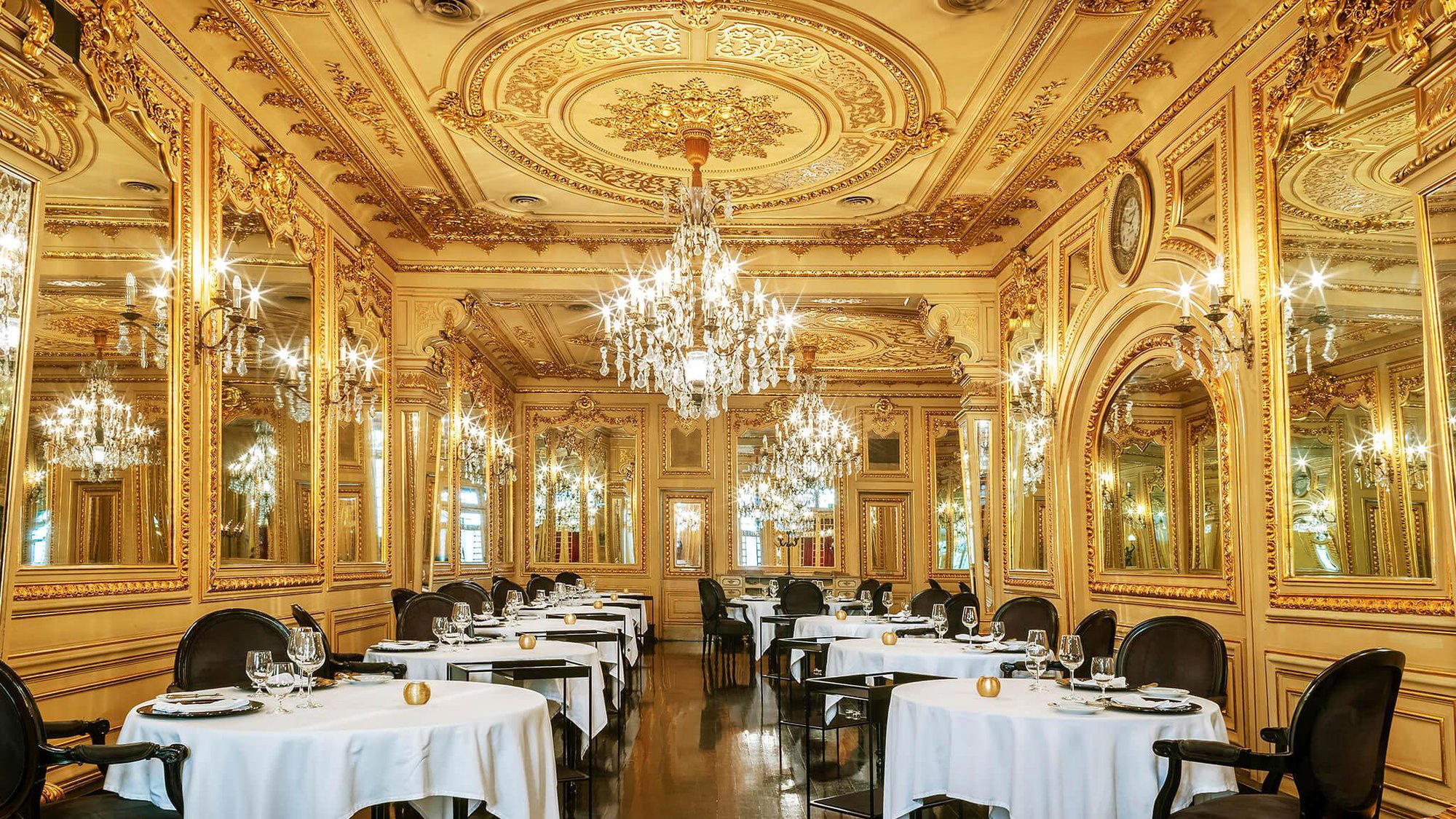
A Room That Sets Its Own Terms
There is a particular category of European dining room where the architecture does not merely frame the experience but actively disciplines it. Tavares, on Rua da Misericórdia in Lisbon's Chiado district, belongs to that category. The mirrors, gilt mouldings, and formal table spacing signal from the moment of entry that this is not a space for casual grazing. The room asks something of its guests: attention, pace, a willingness to submit to a meal as a structured event rather than a transaction. In a Lisbon dining scene that has shifted sharply toward tasting-menu ambition at places like Belcanto and CURA, Tavares occupies a different position: it is where the city's dining tradition is not reimagined but inhabited.
Founded in 1784, Tavares is documented as one of the oldest restaurants in Portugal, and the Belle Époque interior reflects a late-nineteenth-century renovation that shaped its ceremonial identity. That longevity is relevant not as nostalgia but as competitive context. Restaurants like Antiqvvm in Porto or The Yeatman in Vila Nova de Gaia negotiate between heritage and contemporary ambition. Tavares resolves that tension differently: the room itself is the primary experience, and the kitchen operates in deference to it.
The Architecture of a Meal
One useful way to approach Tavares is through the logic of progression rather than individual dishes. In rooms of this age and formality, the meal has a structural arc that begins well before the first course arrives. The aperitif moment in a gilded room, the unhurried transfer to the table, the physical weight of the menu in hand, these are not incidental. They are the opening movement of an experience calibrated to unfold over time.
Portugal's classical table tradition draws on a canon that includes salt cod preparations, slow-braised meats, and rice dishes with a depth of stock that reflects generations of refinement. At the formal end of Lisbon dining, these traditions appear with more ceremony than at a neighbourhood tasca, but the underlying grammar remains legible. The progression from cold starters through fish to meat, with cheese and dessert as deliberate codas, follows a European formal dining structure that Portuguese kitchens have maintained longer than most. Tavares positions itself within that tradition rather than against it.
For comparison, the modern Portuguese tasting menu format at Eleven or the progressive Spanish register at 50 Seconds from Martin Berasategui deploys the tasting-menu arc as a vehicle for invention. Tavares uses a similar temporal structure for a different purpose: the progressive meal is here a ritual, a form of civic dining that connects the guest to a lineage of Lisbon tables going back more than two centuries.
Where Tavares Sits in the Lisbon Hierarchy
Lisbon's fine-dining tier has expanded and differentiated rapidly over the past decade. The city now has multiple tasting-menu restaurants operating at the level of international recognition, with Michelin-starred addresses spread across the centre and waterfront. Within this broader group, Tavares occupies a specific niche: the historical formal dining room, a category that exists in most European capitals but that Lisbon has fewer examples of than Paris, Vienna, or Madrid.
That scarcity gives Tavares a positional clarity. Guests choosing between Tavares and, say, 2Monkeys are not making a quality comparison so much as a format choice. The former is chosen for occasion, ceremony, and a specific kind of temporal generosity; the latter for creativity and a different kind of precision. Both sit within Lisbon's premium tier, but they answer different questions about what a significant meal should feel like.
Across Portugal more broadly, rooms that carry this kind of historical weight are spread thinly. Vila Joya in Albufeira, Ocean in Porches, and Il Gallo d'Oro in Funchal each represent a version of refined formal dining in the Portuguese context, but none carries the specific urban ceremonial weight of a nineteenth-century Lisbon dining room on Rua da Misericórdia. For international reference points, the closest parallels are not the technically ambitious rooms of Le Bernardin in New York or Atomix, but rather the older European rooms where the space itself has accumulated enough history to function as an argument.
The Chiado Address and What It Implies
Rua da Misericórdia runs through Chiado, one of Lisbon's most historically dense neighbourhoods, connecting the Bairro Alto plateau to the riverside flatlands of Cais do Sodré. The street has long been associated with the city's literary and intellectual life, and the concentration of older establishments in this corridor means that Tavares reads differently from a restaurant opening at the same address today. The location is not merely convenient; it is part of the restaurant's identity, embedding it in a neighbourhood that has maintained civic continuity even as adjacent areas have transformed around tourism pressure.
For practical planning, the address is walkable from most central Lisbon hotels and easily reached by tram from Alfama. Reservations at a room of this standing are advisable well in advance, particularly for weekend evenings and during the busier spring and autumn travel windows. The formality of the room implies a dress code expectation consistent with European fine dining, though Lisbon's general style leans less rigid than, for example, the dining rooms of Casa de Chá da Boa Nova in Leça da Palmeira. Those planning a broader Portuguese dining itinerary should also consider A Cozinha in Guimarães, Bon Bon in Lagoa, Al Sud in Lagos, and A Ver Tavira in Tavira to map the range of what Portuguese fine dining looks like beyond the capital.
What It’s Closest To
Comparable venues nearby, for context on price, style, and recognition.
| Venue | Cuisine | Price | Notes |
|---|---|---|---|
| TavaresThis venue — the venue you are viewing | Classical French & Portuguese Fine Dining | $$$$ | Not listed |
| JNcQUOI Asia | Pan-Asian Fusion | $$$$ | Rato |
| Cícero | Modern Brazilian-French Fusion Bistro | $$$$ | Chiado |
| Seen by Olivier | Contemporary Mediterranean-Japanese Fusion | $$$$ | Rato |
| Fiammetta | Authentic Traditional Italian Trattoria | $$$ | Campo de Ourique |
| Cantina Peruana | Contemporary Peruvian with Asian & Spanish Influences | $$$ | Chiado |
Continue exploring
More in Lisbon
Restaurants in Lisbon
Browse all →
Bars in Lisbon
Browse all →
Hotels in Lisbon
Browse all →

At a Glance
- Elegant
- Ornate
- Romantic
- Well Known
- Sophisticated
- Classic
- Date Night
- Special Occasion
- Celebration
- Business Dinner
- Historic Building
- Private Dining
- Design Destination
- Extensive Wine List
- Craft Cocktails
- Sommelier Led
- Local Sourcing
Grand baroque dining room with stained glass, gilded carvings, dazzling crystal chandeliers, and belle époque and art nouveau decorative elements creating an ornate, palatial atmosphere.