Takumi 2nd Tonkotsu
Our verdict
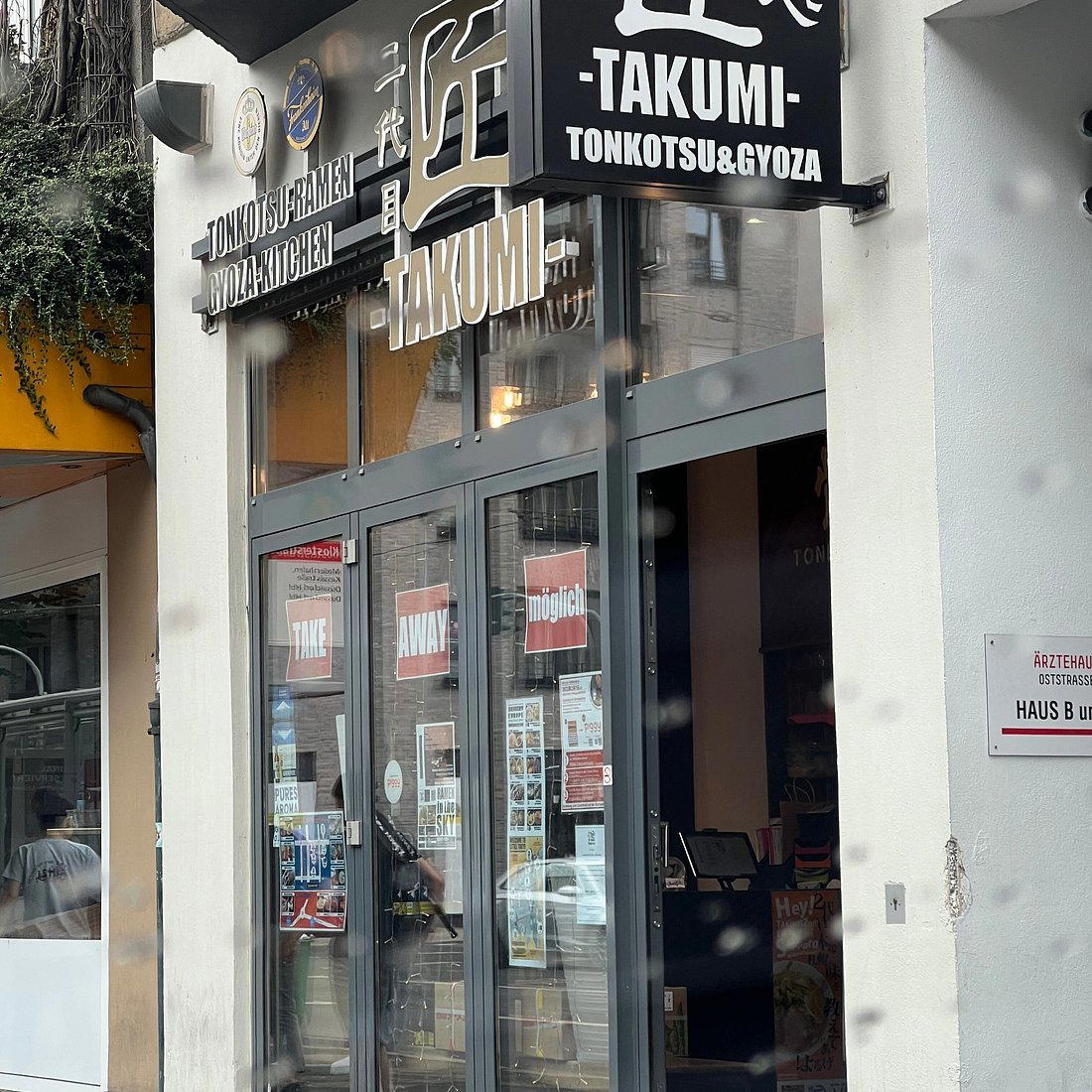
On Oststraße in central Düsseldorf, Takumi 2nd Tonkotsu is part of the city's most respected Japanese ramen operation. The Takumi group established the template for serious tonkotsu in the Rhineland, and this second location carries that reputation into a neighbourhood defined by its density of casual international eating. For ramen done with discipline and consistency, it sits at the top of Düsseldorf's Japanese casual dining tier.

Pearl is the En Primeur Club membership app, where members save venues, book tables and use the concierge.
The Ritual of the Bowl: How Tonkotsu Ramen Is Eaten in Düsseldorf
There is a particular choreography to eating ramen at a serious Japanese shop, and it applies as much on Oststraße as it does in Fukuoka. You sit, you order with economy, and when the bowl arrives you eat quickly. Tonkotsu broth is a living thing in the sense that it changes as it cools: the fat congeals, the noodles absorb, and the window for the correct experience closes within minutes. The places in any city that understand this tend to impose a kind of quiet focus on their dining rooms, whether or not they post rules on the wall.
Takumi 2nd Tonkotsu, at Oststraße 51 in Düsseldorf's central 40211 district, belongs to the Takumi group, which has done more than any other operation to set the reference point for Japanese ramen in the Rhineland. The parent address on Immermannstraße, in the heart of Düsseldorf's Japantown, built a reputation substantial enough to justify a dedicated second site with a tonkotsu focus. That original Takumi sits in one of the most concentrated clusters of authentic Japanese eating in Germany, a neighbourhood shaped by decades of corporate Japanese presence in the city, and the second location extends that credibility into a broader part of the city centre.
Tonkotsu as a Category, and Where This Fits Within It
Tonkotsu ramen occupies a specific register within Japanese noodle culture. The broth, derived from pork bones cooked at a rolling boil for many hours, produces a cloudy, collagen-rich liquid with a depth that lighter shoyu or shio broths do not attempt. It originated in northern Kyushu, particularly Fukuoka, and the most traditional preparations keep the flavour profile relatively lean: the tare, the fat, the noodle gauge, and the toppings are all calibrated against a broth that is already doing considerable work.
In Germany, the ramen category has grown substantially since the mid-2010s, splitting between fast-casual approximations and more serious kitchens that control their broth in-house and treat noodle texture as a variable worth specifying. Takumi sits clearly in the second group. The Immermannstraße address built its standing on exactly this distinction, and that positioning carries into Oststraße. For the eating public in Düsseldorf, the Takumi name functions as a trust signal in a category where quality variance is wide.
Internationally, the equivalent conversation plays out at a different price point. Venues like Atomix in New York City represent the fine-dining end of Korean cuisine's international presence, and Le Bernardin in New York City demonstrates what a singular culinary tradition looks like when executed at the highest level of consistency over decades. Ramen, by contrast, lives at the casual end of the spectrum, and Takumi's version of seriousness is not about price or formality but about broth discipline and the refusal to cut corners on process.
The Oststraße Setting and What It Signals
Oststraße runs through a part of the city centre that accommodates a broad range of eating options, from quick-service through to mid-market sit-down restaurants. The address puts Takumi 2nd in contact with a different foot traffic pattern than the Japantown original, drawing on office workers, shoppers, and the kind of repeat lunch clientele that builds genuine neighbourhood familiarity over time. This is where casual dining concepts prove whether their standards travel: a second location that maintains the founding address's discipline is a more meaningful signal than any single award.
Düsseldorf's eating culture at the casual end is genuinely diverse. The city's international population, anchored partly by its long-standing Japanese business community and partly by European Union adjacency, has produced a broader range of credible non-German casual restaurants than most German cities of comparable size. Alanya Döner and 3h's burger & chicken represent the fast-casual end of that diversity, while venues like Amuni Wein- und Käsebar, Anfora, and Arca Alacati point toward the city's mid-market European offer. Takumi 2nd occupies a distinct niche within this mix: a focused, cuisine-specific casual concept with a verifiable culinary lineage.
For full context on Düsseldorf's eating and drinking options across all categories, the full Düsseldorf restaurants guide maps the city's range in detail.
Ramen Pacing and What It Asks of the Diner
The editorial angle of the dining ritual matters more in ramen than in almost any other casual format. Unlike a pizza or a shared mezze, ramen is time-sensitive in a way that rewards attentiveness and penalises distraction. The custom at traditional Japanese ramen shops of finishing quickly, not lingering over the bowl, is not arbitrary rudeness but a response to the physics of the food. At Takumi, that understanding shapes the experience whether or not it is stated explicitly: the bowl is the centrepiece, and the meal is built around it rather than around extended social performance.
This puts Takumi 2nd in a different category from Düsseldorf's more formal dining rooms. The city has access to serious fine dining through its proximity to venues like Vendôme in Bergisch Gladbach and Aqua in Wolfsburg, and Germany's broader fine dining infrastructure includes multi-star operations such as Schwarzwaldstube in Baiersbronn, JAN in Munich, CODA Dessert Dining in Berlin, ES:SENZ in Grassau, Victor's Fine Dining by Christian Bau in Perl, Waldhotel Sonnora in Dreis, Restaurant Haerlin in Hamburg, and Schanz in Piesport. Takumi 2nd operates in a completely different register, where the comparison set is other serious ramen shops in the DACH region rather than tasting-menu destinations.
Know Before You Go
- Address: Oststraße 51, 40211 Düsseldorf, Germany
- Price range: Information not currently available; comparable serious ramen shops in Germany typically position in the €12–18 per bowl range
- Booking: Walk-in policy not confirmed; popular ramen shops of this standing in Germany frequently operate on a first-come basis with queues at peak times
- Getting there: Oststraße is served by multiple U-Bahn and tram routes through central Düsseldorf; the street is walkable from the main station
- Recommended timing: Midweek lunch or early dinner typically offers shorter waits at comparable ramen venues in German city centres
Frequently asked questions
Where is Takumi 2nd Tonkotsu in Dusseldorf?
Takumi 2nd Tonkotsu is located at Oststraße 51, 40211 Düsseldorf, Germany, Dusseldorf.
How does Takumi 2nd Tonkotsu differ from the original Takumi on Immermannstraße?
The original Takumi on Immermannstraße sits at the centre of Düsseldorf's Japanese community district, where the surrounding context, Japanese grocers, travel agencies, and specialist restaurants, reinforces its culinary identity. Takumi 2nd on Oststraße 51 operates in a more mixed city-centre setting, making the same tonkotsu ramen accessible to a wider dining public rather than primarily to the Japanese expatriate and enthusiast crowd. The broth focus remains consistent across both addresses.
What's the best thing to order at Takumi 2nd Tonkotsu?
The shop's name makes the answer clear: tonkotsu broth is the central reference point here, and it should be the starting order. The Takumi group built its reputation in Düsseldorf's Japanese dining corridor on pork-bone ramen long-cooked to a milky consistency, so arriving and ordering anything else first would be working against the kitchen's evident focus. Supplement with whatever the counter is running on the day.
Can I walk in to Takumi 2nd Tonkotsu?
No confirmed booking policy is available for this address. Ramen shops in Düsseldorf's Japanese food corridor, particularly those affiliated with an established group like Takumi, tend to run at capacity during peak lunch and dinner windows, so arriving off-peak on a weekday reduces the wait. Contacting the restaurant directly via Oststraße 51 is the most reliable way to confirm current walk-in practice.
What makes Takumi 2nd Tonkotsu worth seeking out?
The Takumi group's position within Düsseldorf's Japanese dining scene is the clearest credential: the original Immermannstraße address helped define the city's reputation as continental Europe's most significant Japanese food destination outside Japan. This second site on Oststraße extends that reach into a broader part of the city centre, giving access to the same tonkotsu-focused approach without requiring a trip to the Japantown corridor. That group continuity, rather than any single dish, is the signal that separates it from standalone ramen entries in the city.
Recognition Snapshot
Comparable venues nearby, for context on price, style, and recognition.
| Venue | Cuisine | Price | Notes |
|---|---|---|---|
| Takumi 2nd TonkotsuThis venue (the venue you are viewing) | Authentic Japanese Tonkotsu Ramen | $10–20 | Not listed |
| Takumi Chicken & Veggie | Japanese Chicken & Vegetable Ramen | $20–30 | Stadtmitte |
| Sayomi 2nd | Japanese Fusion | Not listed | Flingern Nord |
| Kyodaina Poke & Sushi | Japanese Poke & Sushi | $10–20 | Unterbilk |
| La Noodle | Authentic Chinese Hand-Pulled Noodles | $10–20 | Pempelfort |
| da noi | Authentic Italian Pizzeria & Trattoria | $20–30 | Stadtmitte |