Tacos de la santa cruz
On Aguacate street in Puerto Vallarta, Tacos de la Santa Cruz operates in the register that defines everyday Mexican eating: straightforward preparation, tight margins, and a local clientele that returns on habit rather than occasion. It sits inside the city's street-food tradition rather than apart from it, making it a reliable reference point for visitors trying to read Puerto Vallarta's taco culture beyond the tourist corridor.
Pearl is the En Primeur Club membership app — saves, bookings, and concierge access live there. Same editors, same standards.
- Address
- Aguacate, Pto Vallarta, Jalisco
- Directions
- Get directions
 Saves & bookings on Pearl
Aguacate Street and the Grammar of the Puerto Vallarta Taco Stand
Puerto Vallarta's restaurant conversation tends to organize itself around the Zona Romántica and the Malecón, where addresses like Café des Artistes and Campomar Puerto Vallarta draw travelers willing to pay for ambition and setting. But the city has always run a parallel track: the taco stands and fondas on residential streets where the customer base is almost entirely local, the pricing is set by what workers and families can afford daily, and the operation continues largely indifferent to tourist cycles. Tacos de la Santa Cruz, on Aguacate street, belongs to that second category.
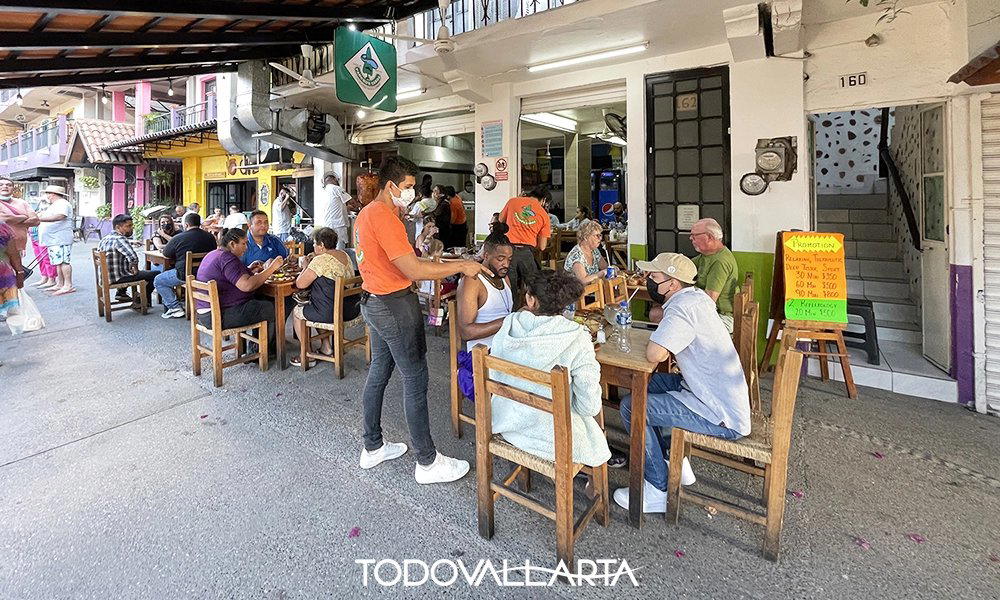
The Aguacate address places it away from the beach-facing restaurant strip, in the kind of block where foot traffic is purposeful rather than exploratory. Approaching a spot like this, the cues are familiar across Mexico: the smell of rendered fat and chile-seasoned protein arriving before the stall is visible, plastic chairs arranged without ceremony, a handwritten or printed board indicating what is available that day. The physical environment is the anti-thesis of designed hospitality. That is precisely what makes it legible as a reference point for anyone trying to understand how Puerto Vallarta actually eats, as opposed to how it performs eating for visitors.
The Lunch-Dinner Divide in Mexican Street Eating
One of the more instructive ways to read a taco operation in Mexico is through the lens of when it operates and who shows up at each hour. The rhythm differs markedly from what European or North American dining culture would predict. In many Mexican cities and coastal towns, the heaviest street-food service happens at midday, not in the evening. Comida, the main meal of the day, lands between roughly 2pm and 4pm for large portions of the population. A taco stand drawing significant lunch traffic is serving as a full meal provider, not a snack stop.
Evening service at street taco operations tends to attract a different crowd and sometimes a different menu format. Tacos de noche in many regions skew toward al pastor and carnitas operations that run from early evening into late night, serving as a punctuation mark on the workday rather than its centerpiece. Whether Santa Cruz runs both services or concentrates on one is not confirmed in available records, but the pattern is a useful frame for anyone planning a visit: arriving at the midday window typically yields the fuller experience at this category of spot, with more preparation underway and the implicit infrastructure of a proper comida rather than a lighter evening offering.
For visitors coming from the polished end of Puerto Vallarta's dining spectrum, including options like Balam Balam or the cafe end represented by Bean and Brick and Calmate Cafe, Tacos de la Santa Cruz represents a different axis entirely. The question is not whether one is better than the other but what each one is measuring. A taco stand on a residential street measures speed, repetition, and value against the daily budget of a working neighborhood. A structured restaurant measures experience design, sourcing ambition, and reservation logistics. Both are worth understanding as parts of the same city.
Taco Tradition in Jalisco and the Coastal Context
Jalisco's taco vocabulary is distinct within Mexico. The state is associated with birria, the slow-braised meat preparation, often goat or beef, served in consommé and popularized far beyond its regional origin over the past decade. It is also associated with the torta ahogada, the drowned sandwich, though that format belongs primarily to Guadalajara. Puerto Vallarta, as a coastal city, sits at an intersection of interior Jalisco tradition and the fresh seafood supply that comes with Pacific proximity. Taco operations here can reasonably draw on both registers: the braised and spiced meats of the interior and the fish and shrimp preparations that define coastal eating along this stretch of the Pacific.
For broader context on where Jalisco's dining sits within Mexico's current culinary conversation, Alcalde in Guadalajara represents the state's ambitious restaurant tier. At the other end of the formality scale, operations like Santa Cruz represent the everyday infrastructure that those ambitious kitchens often reference as a source of technique and tradition. Mexico's most recognized restaurants, from Pujol in Mexico City to Levadura de Olla Restaurante in Oaxaca, consistently cite the logic of street cooking as a foundation, which is one reason understanding both ends of the spectrum matters for any serious reading of Mexican cuisine.
Puerto Vallarta's street food is documented less systematically than that of Mexico City or Oaxaca, which means spots like Santa Cruz tend to circulate through local word-of-mouth rather than formal criticism or guidebook coverage. See our full Puerto Vallarta restaurants guide for a wider map of the city's eating across price tiers and formats.
Planning a Visit: What to Know Before You Go
Specific hours, booking requirements, and pricing for Tacos de la Santa Cruz are not confirmed in current records. What can be said with confidence is structural: taco stands of this type do not take reservations, operate on a first-come basis, and move quickly enough that turnover is rarely a constraint. The Aguacate street address in Puerto Vallarta is the locating anchor; arriving and asking locally for the stall is the standard approach when a fixed number is not available. Payment at operations in this category is almost universally cash, and the price per taco across Mexico's street tier in 2024 remains among the most accessible entry points in the country's food system.
Timing, as noted above, tends to matter. Midday arrival captures the peak service window that characterizes Mexican street eating at its most complete. If the operation runs an evening shift, it likely draws a different crowd and possibly a shorter menu, consistent with the broader national pattern. For visitors combining Santa Cruz with other Puerto Vallarta stops, the geographic range of the city means that planning by neighborhood rather than by individual venue reduces travel time. Aguacate street falls within the broader center of Puerto Vallarta, accessible from the Romántica zone on foot or by the short taxi rides that are standard across the city.
Category Peers
Comparable venues nearby, for context on price, style, and recognition.
| Venue | Cuisine | Price | Notes |
|---|---|---|---|
| Tacos de la santa cruzThis venue — the venue you are viewing | Traditional Mexican Taqueria | $$ | Not listed |
| Nacho Daddy | Tex-Mex | $$ | Zona Romantica |
| Taco time | Mexican Street Tacos & Shrimp Burritos | $ | Zona Romantica |
| Taqueria "El Moreno" | Authentic Mexican Taqueria | $ | Zona Romántica |
| El Flaco | Street Tacos | $ | Centro |
| Mariscos La Tia | Authentic Mexican Seafood | $$ | Colonia 5 de Diciembre / Guadalupe Victoria |
Continue exploring
More in Puerto Vallarta
Restaurants in Puerto Vallarta
Browse all →
Bars in Puerto Vallarta
Browse all →



At a Glance
- Lively
- Rustic
- Casual Hangout
- Late Night
- Standalone
- Street Scene
Casual street food atmosphere at a well-known local taco stand with a salsa bar.
Know Before You Go
- Getting there
- Aguacate, Pto Vallarta, Jalisco