Saudade occupies a considered address at 34 Rue des Bourdonnais in Paris's 1st arrondissement, a quarter where the city's oldest commercial traditions press up against contemporary dining ambition. The name itself carries the weight of Portuguese longing — a deliberate framing that sets this address apart from the French-forward establishments that dominate the neighbourhood's fine-dining tier.
Pearl is the En Primeur Club membership app — saves, bookings, and concierge access live there. Same editors, same standards.
- Address
- 34 Rue des Bourdonnais, 75001 Paris, France
- Phone
- +33142363071
- Website
- restaurantsaudade.fr
- Directions
- Get directions
 Saves & bookings on Pearl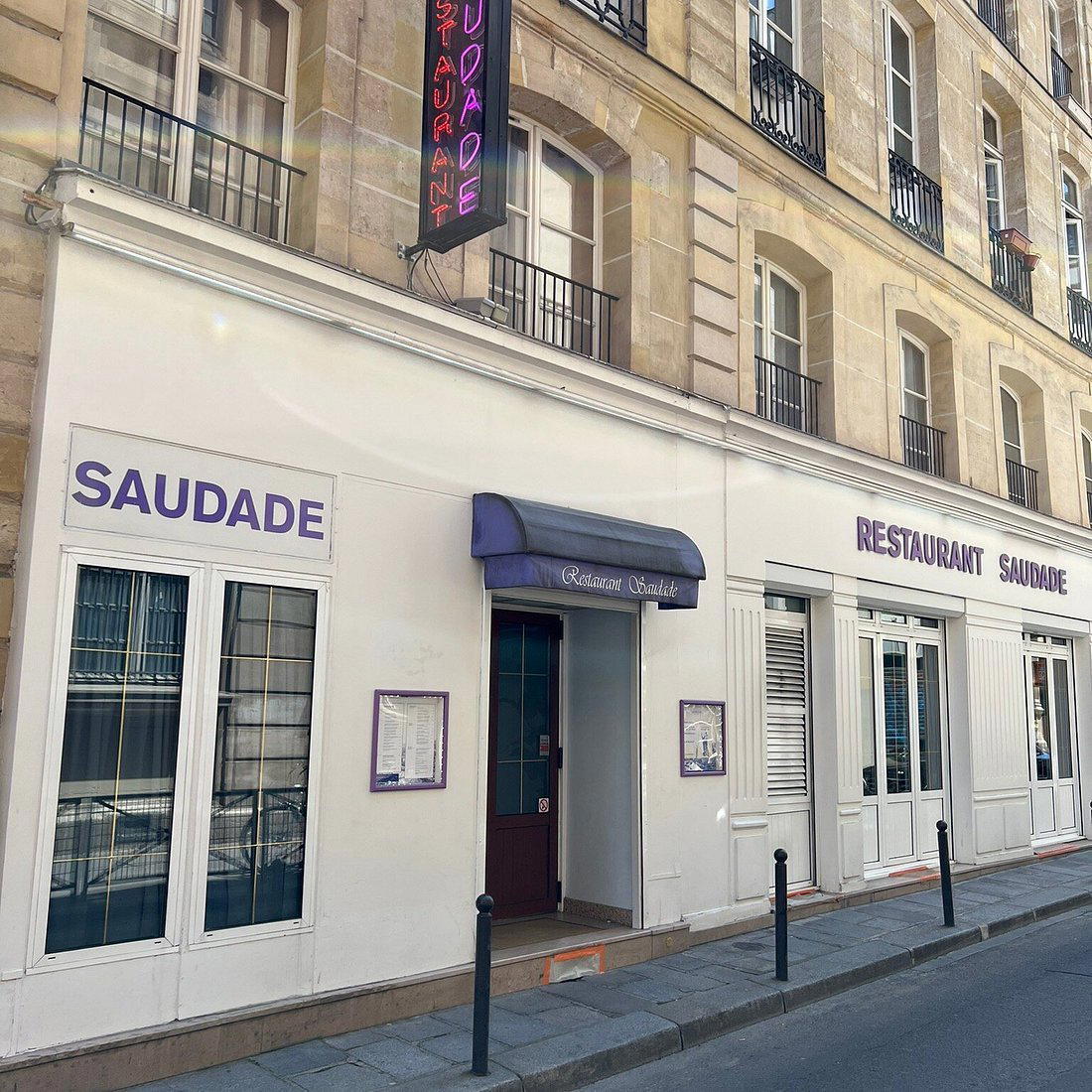
The 1st Arrondissement and the Architecture of Expectation
Paris's 1st arrondissement has never been a district that rewards casual stumbling. The streets around Les Halles and the Rue de Rivoli carry centuries of mercantile gravity, and the restaurants that have held ground here do so against considerable competition from destinations with deeper name recognition and longer critical histories. Saudade, at 34 Rue des Bourdonnais, occupies a street that threads between the old market quarter and the Seine — a location that places it physically within one of the city's most layered urban grids.
The name itself is the first editorial signal. Saudade is a Portuguese concept that resists clean translation: a melancholic longing for something absent, a feeling that is as much about absence as presence. For a restaurant in the heart of Paris — a city that has historically legislated its own culinary canon with considerable force, to take that word as its identity is a positioning choice with consequences. It announces difference without explaining it, and invites the diner to bring their own interpretive frame before a single plate arrives.
Space as Argument: What the Physical Container Communicates
In Paris's leading dining tier, the relationship between a room and its cooking has become increasingly deliberate. At Alléno Paris au Pavillon Ledoyen, the Belle Époque pavilion does the work of establishing grandeur before the menu opens. At L'Ambroisie on the Place des Vosges, the Flemish tapestries and stone floors argue for a particular idea of what French classicism looks and feels like. At Kei in the 1st, the modern interior signals a deliberate break from that classicism even as the cooking negotiates between French technique and Japanese precision.
Saudade's address on Rue des Bourdonnais places it in a street of older Parisian building stock, the kind of architecture that carries visible age in its stonework and proportions. Whether the interior works with or against that context is precisely the question that an address like this forces a restaurant to answer. In cities where dining rooms have become as curated as the food they contain, the physical container is never neutral. The decision to call a space in central Paris by a Portuguese word of longing suggests an interior that is unlikely to default to the Haussmannian-bistro template or the minimalist-Nordic aesthetic that has spread across European fine dining over the past decade.
Across the broader French fine-dining spectrum, the design question splits in recognisable ways. Destination restaurants in rural France, from Bras in Laguiole to Flocons de Sel in Megève, tend to use landscape and local material to create an argument for rootedness. Urban rooms in Paris must work harder to establish a sense of place that the countryside provides automatically. The rooms that succeed at this, Arpège with its wooden counter, Le Cinq with its formal symmetry, do so by committing fully to a spatial logic rather than hedging toward generic comfort.
The Portuguese Strand in Paris Dining
Portuguese cooking occupies a specific and underrepresented position in the Paris restaurant scene. French dining culture has absorbed influences from North Africa, Japan, and the broader Mediterranean with considerable confidence, but Iberian cooking, and Lusophone cooking in particular, has historically been treated as peripheral rather than central. The category of restaurants in Paris that take Portuguese cuisine seriously at anything above the casual register is small. That makes an address like Saudade's, in the 1st arrondissement rather than in the more ethnically diverse northern districts where Portuguese communities have historically concentrated, a deliberate statement about where this cuisine can and should be served.
The Portuguese kitchen brings a set of preoccupations that are legible to French fine-dining sensibilities, seafood, preserved and cured fish, slow-cooked meats, pastry traditions of considerable complexity, while remaining genuinely distinct from the French canon. Bacalhau, the salt cod that anchors much of Portuguese cooking, is a product with as much technical depth as the leading charcuterie traditions of Burgundy or Alsace. The wine culture, from the Douro to the Alentejo to the Azores, has developed a seriousness in the past two decades that gives a Portuguese-focused room access to a genuinely interesting cellar. A restaurant that takes the Saudade framing seriously has material to work with.
Placing Saudade in the Paris Tier Structure
The 1st arrondissement concentrates a peer group with considerable institutional weight. L'Ambroisie has held three Michelin stars in the adjacent Marais for decades. Kei carries three stars in the 1st itself. The address places Saudade in a district where the comparison set is demanding, and where critical attention is distributed across a dense field of established names. For France's broader constellation of destination dining, the international peer references extend to rooms like Mirazur in Menton, Troisgros in Ouches, and Auberge de l'Ill in Illhaeusern, rooms that have accumulated reputations over generations. Saudade's position within that structure is still taking shape, which is precisely the condition that makes an address worth watching before consensus hardens around it.
International reference points for this kind of cross-cultural urban dining extend well beyond France. In New York, Le Bernardin has long demonstrated what it means to take a single culinary tradition, in that case, the French treatment of fish, with absolute seriousness in a competitive metropolitan context. Atomix has made a different argument: that a cuisine considered peripheral to a city's mainstream can, with enough precision and commitment, redefine what that city's top tier looks like. Both models are instructive for how a Portuguese-named room in central Paris might eventually be read.
Planning Your Visit
Saudade is located at 34 Rue des Bourdonnais, 75001 Paris, in the 1st arrondissement. The address is within walking distance of the Châtelet-Les Halles transport hub, which connects to the RER and multiple Métro lines. For the broader French dining context, see our full Paris restaurants guide, which maps the city's dining tiers and neighbourhoods in detail. Those planning a wider France itinerary may also want to consider regional destination rooms including Au Crocodile in Strasbourg, Assiette Champenoise in Reims, Auberge du Vieux Puits in Fontjoncouse, Paul Bocuse in Collonges-au-Mont-d'Or, and AM par Alexandre Mazzia in Marseille.
| Venue | Arrondissement / Location | Price Tier | Cuisine Focus |
|---|---|---|---|
| Saudade | 1st (Rue des Bourdonnais) | Not confirmed | Portuguese (indicated by name) |
| Kei | 1st | €€€€ | Contemporary French / Japanese |
| L'Ambroisie | 4th (Place des Vosges) | €€€€ | French Classic |
| Alléno Paris | 8th (Champs-Élysées) | €€€€ | Creative French |
How Saudade Paris compares with similar nearby venues.
| Venue | Cuisine | Price |
|---|---|---|
| Odette | Modern Cuisine | €€€ |
| La Poule au Pot | Traditional Cuisine | €€€ |
Continue exploring
More in Paris
Restaurants in Paris
Browse all →
Bars in Paris
Browse all →
Hotels in Paris
Browse all →
At a Glance
- Romantic
- Classic
- Cozy
- Intimate
- Date Night
- Celebration
- Special Occasion
- Group Dining
- Live Music
- Standalone
- Historic Building
- Extensive Wine List
- Local Sourcing
Current opening hours
- Monday
- 12–2 PM, 7–10:30 PM
- Tuesday
- 12–2 PM, 7–10:30 PM
- Wednesday
- 12–2 PM, 7–10:30 PM
- Thursday
- 12–2 PM, 7–10:30 PM
- Friday
- 12–2 PM, 7–10:30 PM
- Saturday
- 12–2 PM, 7–10:30 PM
- Sunday
- Closed
Hours can change for holidays and private events. Last verified .
Warm and welcoming atmosphere decorated with classic Portuguese tiles and ceramics reminiscent of Lisbon; intimate setting with soft lighting and traditional decor that transports diners to Portugal.
Know Before You Go
- Getting there
- 34 Rue des Bourdonnais, 75001 Paris, France