Pavé

Pavé brings a French bakery lens to Manhattan, where viennoiserie, bread culture, and commuter rhythm meet the city’s appetite for precise, portable luxury. Chef Jonghun Won gives the page its clearest credential, but the stronger story is provenance: butter, flour, fermentation, and craft as the real measure of a serious bakery.
 Request Booking on Pearl
Pearl is the En Primeur Club membership app — saves, bookings, and concierge access live there. Same editors, same standards.
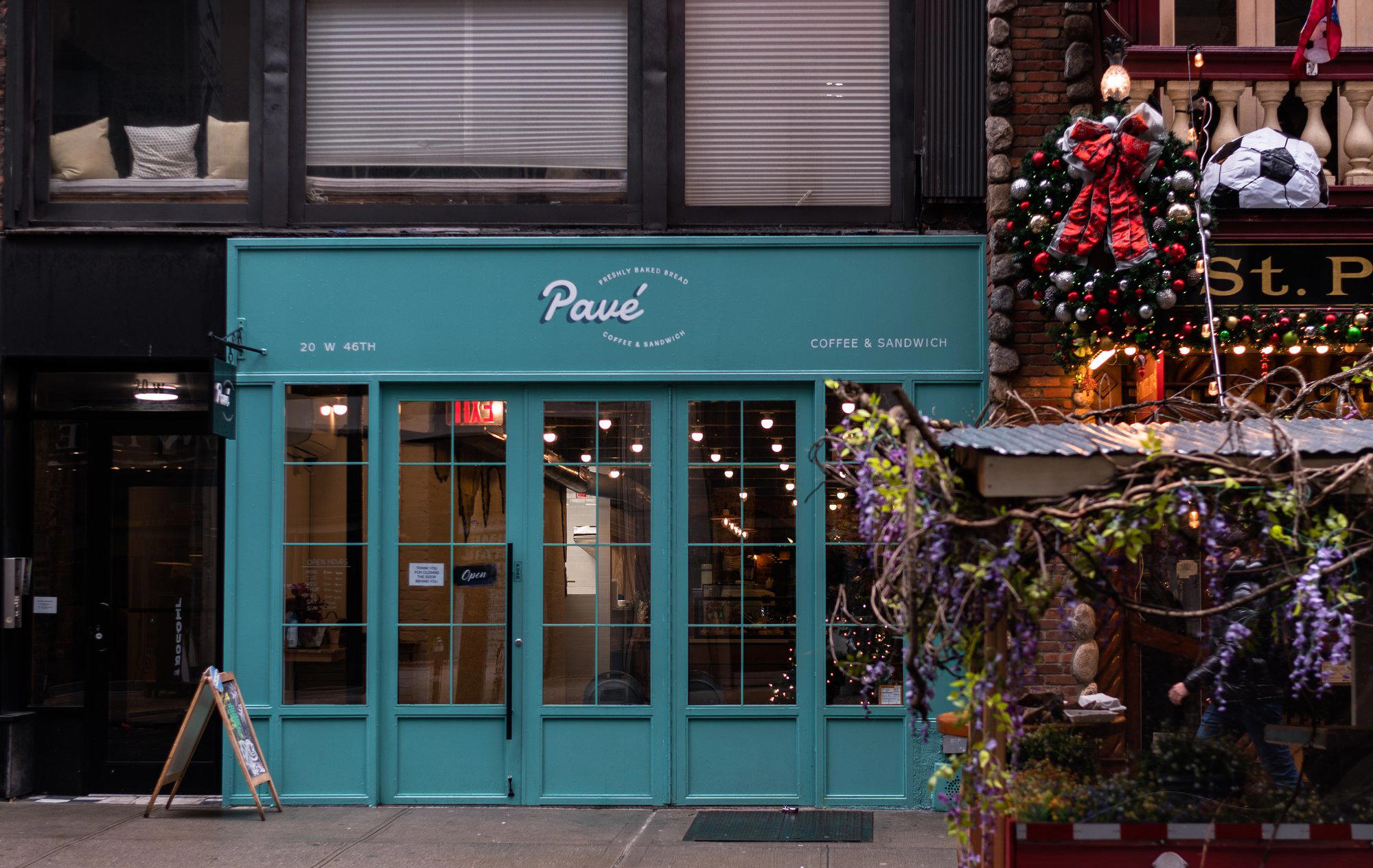
The first read on a serious French bakery in Manhattan is rarely the sign above the door; it is the tempo around it: coffee in hand, paper bags folded under arms, a counter where laminated pastry competes with the city’s impatience. Pavé belongs to the New York category where breakfast, snack, and edible craft overlap. The point is not theatrical dining, but the discipline of flour, butter, fermentation, and timing working at street speed.
French bakery culture is tied to place. In France, regional identity shows through grain, dairy, salt, and technique before decoration. In Manhattan, that language shifts with the audience. A croissant or loaf is measured not only as tradition, but against the city’s dense bakery circuit, specialty coffee habits, and willingness to queue for one well-made item. Provenance is more than a supplier story; it separates generic pastry from one with structure, aroma, and intention.
French bakery craft in a city that eats on the move
Manhattan has absorbed French baking into hotel pastry counters, neighborhood boulangeries, café-bakery hybrids, and chef-led shops that treat viennoiserie with restaurant-level control. Pavé sits in the chef-led lane, with Jonghun Won attached to a French bakery identity rather than a broad café concept. That matters because the category rewards repetition: lamination, proofing, bake time, and turnover leave little room for improvisation during a morning rush.
The stronger New York bakeries reveal seriousness through restraint. Sugar is not the only signal. Crumb, crust, butter quality, and how a pastry handles humidity say more about standards than ornamental finishes. For a French bakery, terroir is less literal than in wine, but the principle is close: raw materials and technique must speak clearly. Flour shapes chew and aroma. Butter determines richness and how cleanly laminated pastry fractures. Fermentation decides whether bread tastes flat or developed. Pavé is best read through that ingredient-first framework.
That places it near a broader American bakery conversation, not inside a purely Parisian fantasy. New York has its own morning canon, from bagels to bodega rolls to specialty pastry. The useful comparison is not whether a Manhattan bakery imitates France exactly, but whether it translates French methods into the city’s pace without sanding off the craft. In that sense, Pavé shares a category conversation with Bien Cuit, French Bakery in New York City, while the wider EP Club archive shows how French bakery formats travel beyond New York through places such as Bouchon Bakery, French Bakery in Napa.
Where provenance does the work
The appeal of a French bakery is often discussed through romance, but the better lens is agricultural. Bread and pastry rely on a short ingredient list, leaving nowhere to hide. Butter, grain, eggs, salt, chocolate, fruit, and nuts carry the burden. In Manhattan, where rent and labor push many bakeries toward volume, ingredient clarity becomes editorial judgment. A shop either treats base materials as the main event or covers them with novelty.
Pavé’s French bakery designation gives the format a clear boundary. That helps because Manhattan casual dining blurs categories quickly: café, bakery, dessert shop, brunch room, and takeaway counter can share a block. A bakery working from French technique asks a different question than a café with pastries on display. It asks whether laminated items have definition, whether bread has the right crust-to-crumb relationship, and whether sweets keep balance rather than chasing excess.
Chef Jonghun Won is the relevant human credential, but the work should not be reduced to biography. In this category, authorship matters only when it appears in sourcing discipline and repeatable technique. The useful assessment is structural: French bakery craft in Manhattan succeeds when the chef’s hand is visible through consistency, not performance. A croissant does not need a speech. It needs clean layers, proper fermentation, and restraint that keeps butter and grain legible.
That is why provenance is the editorial anchor. New York diners will pay for quality when the product justifies its place in daily routine. A pastry counter cannot lean on ceremony like a tasting-menu restaurant. It earns repeat visits through texture, timing, and reliability. Pavé’s value lies in that low-drama test of craft.
How to place Pavé in a Manhattan food day
For a Manhattan eating itinerary, a French bakery works better as an anchor than an afterthought. It can set the tone for a morning before a museum, shopping route, or day of restaurant reservations. The city offers adjacent contrasts: burgers at 7th Street Burger (Hamburgers), espresso and bakery culture at Abraço Bakery (Café), bagel minimalism at Apollo Bagels (Bagels), and a more bistro-coded meal at Au Cheval (French Bistro). Later, the city’s drinking culture can shift the register toward Angel's Share (Wine Bar).
Readers mapping a broader trip should treat Pavé as part of Manhattan’s daytime food infrastructure rather than a trophy stop. Pair it with nearby cultural or shopping plans and save heavier meals for later. For wider context, EP Club’s city pages collect the larger field across Our full Manhattan restaurants guide, Our full Manhattan hotels guide, Our full Manhattan bars guide, Our full Manhattan wineries guide, and Our full Manhattan experiences guide.
The broader American context matters because bakery and casual dining formats now travel by technique rather than city cliché. The same reader interested in Pavé’s craft-first logic may recognize related questions of format and place at Jōdo Saké Bar in Los Angeles, Onigiri Time in Pasadena, ¿Por Qué No? in Portland, 'Ai Love Nalo in Waimanalo Beach, 'āina in San Francisco, and 'Ama 'Ama in Kapolei. The through-line is not cuisine type, but whether a place expresses location through ingredients and format rather than surface styling.
Pavé is strongest as a Manhattan French bakery for readers who care about craft at breakfast scale: a stop where technique, sourcing logic, and city rhythm matter more than ceremony. In a dining city crowded with louder formats, that quieter precision is the reason to pay attention.
Side-by-Side Snapshot
Comparable venues by cuisine and price in the same metro.
| Venue | Cuisine | Price | Notes |
|---|---|---|---|
| PavéThis venue — the venue you are viewing | French Bakery-Cafe | $$ | Not listed |
| Fabrique | Swedish artisan bakery & café | $$ | Meatpacking District |
| Boqueria | Barcelona-style Spanish tapas bar | $$ | SoHo |
| Congee Village Restaurant & Bar | Traditional Cantonese & Congee House | $$ | Lower East Side |
| 7th Street Burger | NYC Smash Burger Shop | $ | Manhattan |
| Apollo Bagels | Modern NYC Bagel Shop | $ | Financial District |
Recognition history
Dated appearances from independent guides and award organizations, with the underlying list record or original source where available.
Opinionated About Dining Cheap Eats in North America Recommended
Opinionated About Dining
Continue exploring
More in Manhattan
Restaurants in Manhattan
Browse all →
Bars in Manhattan
Browse all →
Hotels in Manhattan
Browse all →




At a Glance
- Cozy
- Classic
- Quiet
- Solo
- Casual Hangout
- Brunch
- Standalone
- Street Scene
A small, pristine storefront cafe with a cozy, Euro-style feel and a quiet, work-friendly atmosphere.