Old Swiss House
One of Lucerne's most recognised traditional addresses, Old Swiss House sits steps from the Lion Monument on Löwenplatz, drawing visitors and locals alike to its wood-panelled rooms and classically grounded kitchen. The restaurant operates within a Swiss fine-dining tradition that treats heritage technique as a living practice rather than a museum piece, placing it in a different register from Lucerne's newer contemporary openings.
Pearl is the En Primeur Club membership app — saves, bookings, and concierge access live there. Same editors, same standards.
- Address
- Löwenpl. 4, 6004 Luzern, Switzerland
- Phone
- +41414106171
- Website
- oldswisshouse.ch
- Directions
- Get directions
 Saves & bookings on Pearl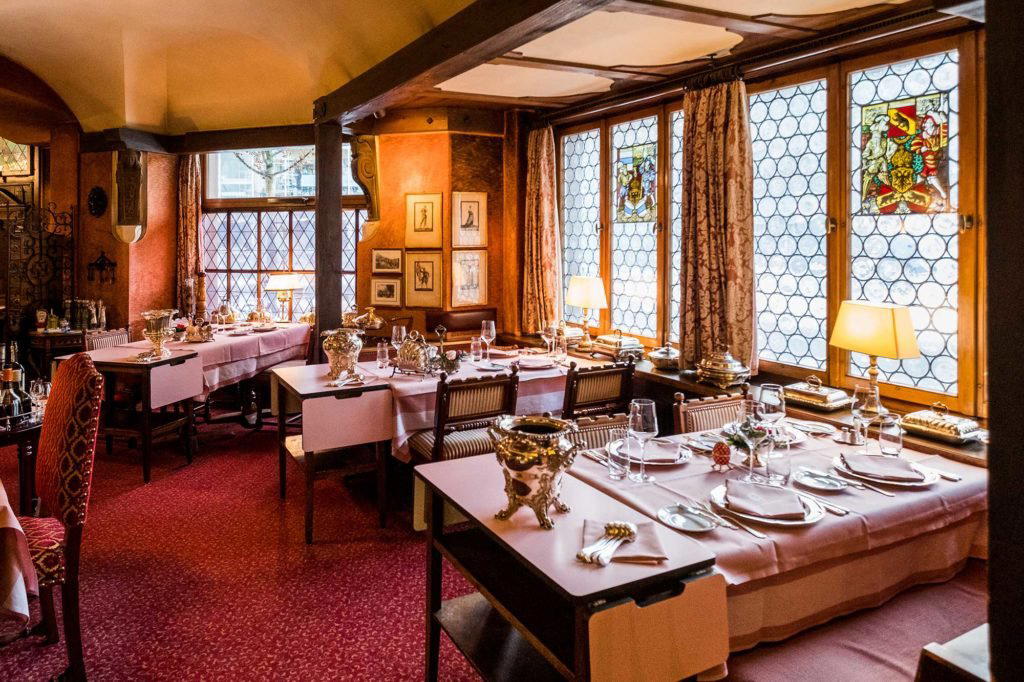
Löwenplatz and the Weight of Swiss Dining Tradition
A short walk from Lucerne's Lion Monument, Löwenplatz has historically functioned as a threshold between the tourist-facing waterfront and the more lived-in residential quarters of the city. It is precisely that in-between quality that has allowed certain addresses here to hold their own identity without being swallowed by the lakeside spectacle. Old Swiss House, at Löwenpl. 4, occupies a building whose carved timber interiors and stained glass set an immediate register: this is a dining room designed to feel like an argument for permanence in a city that has spent over a century serving transient visitors.
The broader question that places like Old Swiss House raise is whether Swiss classical cooking is a living tradition or an exercise in careful preservation. Switzerland's fine-dining scene has, in recent decades, split decisively between restaurants building on European classical foundations and a newer cohort oriented toward contemporary technique and local-forager sourcing. Lucerne's own current roster reflects that split: Colonnade operates in a Modern French register at the leading price tier, while Lucide takes a contemporary approach at a similar price point. Maihöfli by UniQuisine sits a tier below with creative cooking, and Barbatti and Bayts represent the city's more casual end. Old Swiss House maps to a different axis entirely: not a laboratory, not a brasserie, but a room where the formal European dining tradition is treated as the default, not the exception.
Indigenous Products, Classical Structure
The editorial angle that matters most at a restaurant like Old Swiss House is how Swiss produce interacts with inherited European technique. Switzerland's culinary geography is genuinely varied: the Alpine dairy belts of central Switzerland produce cream, butter, and aged cheese that carry a depth you cannot replicate with industrially sourced equivalents; Lake Lucerne itself sits within a broader freshwater system that has historically supplied kitchens in the region with perch, trout, and pike. The question a classically structured Swiss kitchen faces is whether those indigenous products are allowed to drive the menu or whether they function merely as decorative local colour inside an otherwise generic European framework.
Tradition of applying French-derived classical technique to Swiss Alpine ingredients has a long lineage in this part of the country. At its most considered, it produces dishes where the fat content of local butter or the mineral quality of Alpine water supplies shapes the texture of a sauce in ways that a more standardised input would not. At its least considered, it produces a kind of postcard cooking: rösti as prop, cheese as wallpaper. The restaurants doing this most rigorously in Switzerland today tend to be the ones that have invested in relationships with specific producers rather than regional categories. Schloss Schauenstein in Fürstenau has built one documented version of this producer-relationship model in the Swiss context, while Cheval Blanc by Peter Knogl in Basel applies French classical rigour to Swiss-sourced produce at the highest award level. Memories in Bad Ragaz and focus ATELIER in Vitznau, the latter located on Lake Lucerne itself, represent the more contemporary end of this same Swiss fine-dining tradition.
The Room as an Editorial Statement
In Switzerland, the dining room has often done as much argumentative work as the kitchen. The carved interiors at the restaurant belong to a category of Swiss restaurant architecture that was built to signal permanence and cultural rootedness at a moment when Lucerne was positioning itself as a destination for well-travelled European visitors. That context matters because it means the room is not nostalgic by accident: it was designed from the outset to project a specific version of Swiss identity, one shaped by craft, by material quality, and by a formality that resists the pressure to modernise for its own sake.
That design logic places the restaurant in a different conversation from Lucerne's newer contemporary openings and aligns it more closely with the kind of grand European dining institution that has found a loyal following by refusing to pivot. Outside Switzerland, Le Bernardin in New York City offers a useful comparison for how classical European technique can maintain relevance without constant reinvention, while Atomix in New York City and IGNIV Zürich by Andreas Caminada in Zurich represent the contrasting contemporary pole. Einstein Gourmet in Sankt Gallen, 7132 Silver in Vals, Da Vittorio - St. Moritz in St. Moritz, and L'Atelier Robuchon in Geneva each represent different facets of Swiss fine dining's current range, from Italian-accented luxury to the Robuchon atelier format transplanted to Geneva's hotel corridor.
Planning Your Visit
The restaurant sits at Löwenpl. 4 in central Lucerne, within easy walking distance of both the Kapellbrücke and the train station, making it one of the more geographically accessible fine-dining addresses in the city. Lucerne's peak season runs from late spring through early autumn, when the lake draws the heaviest visitor concentration and reservation windows at the city's better tables compress accordingly. For those planning a visit during the summer months, securing a reservation well ahead of arrival is the prudent approach. The restaurant's position on Löwenplatz, adjacent to among the more frequently visited monuments in Switzerland, means foot traffic around the building is high during the tourist season, which reinforces the case for a confirmed booking rather than a walk-in attempt. For a full picture of where the restaurant sits within Lucerne's broader dining options, the full Lucerne restaurants guide maps the city's current scene across price tiers and styles.
How Old Swiss House Lucerne compares with similar nearby venues.
| Venue | Cuisine | Price |
|---|---|---|
| Stiefels Hopfenkranz | Modern Cuisine | €€€ |
Continue exploring
More in Lucerne
Restaurants in Lucerne
Browse all →
Bars in Lucerne
Browse all →
Hotels in Lucerne
Browse all →

At a Glance
- Classic
- Historic
- Rustic
- Elegant
- Cozy
- Special Occasion
- Celebration
- Historic Building
- Open Kitchen
- Extensive Wine List
Current opening hours
- Monday
- Closed
- Tuesday
- 11:30 AM–2:30 PM, 6–11:30 PM
- Wednesday
- 11:30 AM–2:30 PM, 6–11:30 PM
- Thursday
- 11:30 AM–2:30 PM, 6–11:30 PM
- Friday
- 11:30 AM–2:30 PM, 6–11:30 PM
- Saturday
- 11:30 AM–2:30 PM, 6–11:30 PM
- Sunday
- Closed
Hours can change for holidays and private events. Last verified .
Ornate and charmingly old-fashioned with stained glass, dark woods, flock wallpaper, old silver collections, oil paintings in gilded frames, and a historical atmosphere.