

Michelin Plate
Our verdict
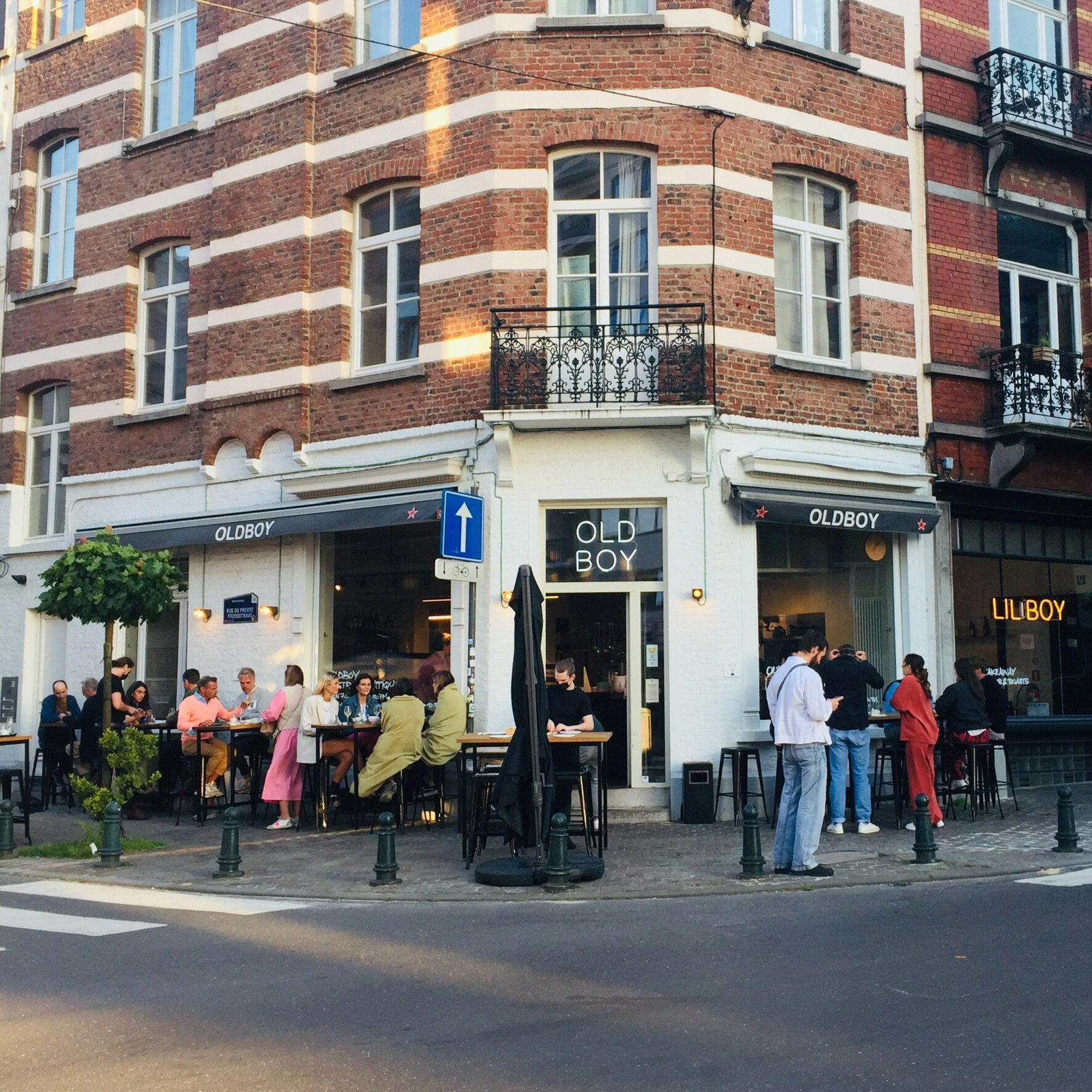
Old Boy brings Southeast Asian fire cooking to the sourced-ingredient vocabulary of contemporary Brussels. The room fills fast, the natural wine list is considered, and the kitchen earns its reputation one charred, carefully-spiced plate at a time.

Pearl is the En Primeur Club membership app, where members save venues, book tables and use the concierge.
The menu
What to order
- Grilled prawns with tamarind sauce
- Iberico pork collar
- Kaprao mussels
- Grilled duck breast
Smoke, Sourcing, and the Ixelles Cross-Cultural Table
Ixelles has long functioned as Brussels’ most restless dining neighbourhood, where a tram-connected grid of residential streets supports an unusually dense cluster of independent restaurants ranging from hyper-local farm-to-table formats like Amen to Japanese precision counters such as Kamo. That pairing is less obvious than it sounds and more disciplined than a quick summary might suggest.
The neighbourhood has developed a particular appetite for this kind of synthesis. Where places like Car Bon keep Chinese reference points as their structural frame, and Humus x Hortense operates within a plant-forward creative register, Old Boy sits in a tier that foregrounds fire as technique and Southeast Asia as flavour grammar. Those are distinct editorial positions within the same compact postcode.
Where the Ingredients Come From
The sourcing story at Old Boy runs through two named Belgian producers: Le Monde des Mille Couleurs and Dierendonck. Dierendonck is a name known to anyone paying attention to Belgian butchery. The family operation, based in Sint-Niklaas, built a reputation over decades for working with heritage breeds and applying old-school ageing and cutting techniques that have become a model for a generation of Belgian chefs looking to connect contemporary menus back to regional animal husbandry. When a kitchen with a Southeast Asian fire focus chooses to source its meat through that supply chain, it is making a specific statement about what the grill can do with quality raw material.
Le Monde des Mille Couleurs occupies a complementary space as a specialist vegetable and herb producer whose output has been referenced across the Belgian fine dining circuit. For a restaurant working with Thai basil, Southeast Asian aromatics, and the fresh herb vocabulary of Bangkok, having a Belgian grower who can supply that spectrum at the quality level a flame-driven kitchen demands changes what is achievable on the plate.
This model, locally sourced ingredients restructured through a foreign culinary framework, has become one of the defining moves of European urban dining across the last decade. What distinguishes the more rigorous examples from mere eclecticism is whether the sourcing and the technique are genuinely integrated or just coexisting. At Old Boy, the grilled duck breast with green curry sauce, coconut milk, and Thai basil is the clearest illustration of the approach. The duck is a Belgian product handled with the care its provenance warrants. The sauce structure is unambiguously Thai. The result is neither fusion in the diluted sense nor a direct appropriation: it is a dish that only works if both halves are taken seriously.
The Room and the Atmosphere
Old Boy’s interior has been described as cool and hip, a shorthand that in Brussels tends to signal a particular aesthetic register: stripped-back materials, considered lighting, the kind of space that photographs well but functions as a working dining room rather than a set piece. The room reportedly fills to capacity most evenings, which shapes the atmosphere considerably. Dense seating, the percussion of a live kitchen, and the aromatic fallout of a grill-forward menu running at full pressure produce an energy that is closer to a Bangkok street stall operating at its peak than to the quieter registers of Brussels’ more formal rooms.
That energy is part of the offer. A restaurant working with this cuisine vocabulary in a room this compact is making a deliberate choice about what kind of experience it wants to produce. Readers who prefer the measured pacing of Ixelles’ longer tasting menu formats, or who want the kind of white-tablecloth calm associated with Belgium’s more decorated rooms like Hof van Cleve, Boury, or Zilte, should calibrate expectations accordingly. Old Boy operates in a different register entirely, one that has more in common with the informal intensity of a New Orleans neighbourhood spot than with a Michelin-tracked dining room.
The Wine List
The natural wine list is worth separate attention. In a city where the natural wine movement has moved from novelty to mainstream across the last five years, the quality of a list is now defined less by the fact of its existence and more by the curation behind it. A natural wine list that aligns with the acidity and spice register of Southeast Asian cooking requires a specific kind of editorial work: skin-contact whites with the texture to hold against coconut milk, low-intervention reds that do not fight chilli heat, sparkling options that reset the palate between high-intensity dishes. Whether Old Boy’s list achieves that calibration consistently is something only repeated visits confirm, but the framing of it as “spot-on” suggests it has been built with the menu in mind rather than assembled for aesthetic reasons alone. The restaurant fills regularly and booking ahead for dinner is strongly advised. Ixelles is well-served by Brussels public transport, and the neighbourhood rewards arriving with time to walk: the density of independent restaurants, bars, and wine spots in the immediate area makes it one of the more productive urban dining quarters in the country. For a broader look at what the neighbourhood offers, the full Ixelles restaurants guide maps the range from casual to formal. The Ixelles bars guide and experiences guide are useful for building out the wider visit, while the hotels guide covers accommodation options in the commune.
For those building a broader Brussels dining itinerary, Bozar Restaurant represents the city’s more classical register, and Amore, Pasta e Gioia offers a lower-key Ixelles option for days when the fire-and-spice approach is not the call. Across Belgium, the broader fine dining circuit runs through Willem Hiele and Bartholomeus on the coast, and Le Bernardin in New York anchors the international reference point for anyone mapping European fish-forward cooking against its transatlantic peers. The Ixelles wineries guide rounds out the picture for those whose interest extends to what is in the glass.
Frequently asked questions
Is Old Boy child-friendly?
Old Boy is not oriented toward younger diners. The kitchen runs on bold spice, smoke, and high heat, and the room at rue de Tenbosch 110 fills to capacity most evenings with a loud, energetic crowd. It is better suited to adults who want an active, grill-forward dinner.
What's the vibe at Old Boy?
The room is compact, hip, and loud on most evenings, driven by an active grill kitchen and a full dining room. The interior aesthetic reads as stripped-back cool, consistent with Ixelles' more considered end of casual dining. Expect noise and energy rather than a quiet table.
Does Old Boy have a Michelin star or similar recognition?
Old Boy has received recognition including: Old Boy is the epitome of smoky, flame-licked Southeast Asian vibes, but with Belgian ingredients from local producers of the likes of Le Monde des Mille Couleurs and Dierendonck. The result is sparkling, lively fusion cuisine that spans Ba….
What's the best thing to order at Old Boy?
The grilled duck breast with green curry sauce, coconut milk, and Thai basil is the dish that anchors the menu. It uses Belgian-sourced meat and runs it through a Southeast Asian spice framework, which is exactly what Old Boy is doing across the board. Order it as a reference point for everything else.
How do I find Old Boy?
Old Boy is located at rue de Tenbosch 110, Ixelles.
Is Old Boy reservation-only?
Old Boy fills consistently for dinner and booking ahead is strongly advised. Walk-ins may find space on quieter weekday evenings, but the restaurant is known to run at capacity, particularly at weekends. A reservation is the reliable option.
What's the defining dish or idea at Old Boy?
The defining idea is Belgian sourcing filtered through Southeast Asian technique. Producers like Le Monde des Mille Couleurs and Dierendonck supply the ingredients; the kitchen runs them through fire, spice, and the flavour logic of Bangkok and China. The grilled duck breast with green curry and Thai basil captures the approach in a single plate.
Fast Comparison
Comparable venues nearby, for context on price, style, and recognition.
| Venue | Cuisine | Price | Awards | Notes |
|---|---|---|---|---|
| Old BoyThis venue (the venue you are viewing) | Southeast Asian Fusion | $50–100 | Michelin Plate | Not listed |
| Car Bon | Authentic Sichuan Chinese | $20–30 | Michelin Bib Gourmand | Ixelles |
| Ricciocapriccio | Modern Italian Mediterranean | $30–50 | Michelin Plate | Ixelles |
| Odette en Ville | Modern French with International Influences | $50–100 | Michelin Plate · We're Smart World 1 Radish | Ixelles |
| Wine Fever | French Wine Bar | $20–30 | Not listed | Ixelles |
| Gazzetta | Authentic Italian Trattoria | $20–30 | Not listed | Ixelles |
Recognition history
Dated appearances from independent guides and award organizations, with the underlying list record or original source where available.
Michelin Plate
Michelin
Opinionated About Dining Casual in Europe Recommended
Opinionated About Dining
Continue exploring
More in Ixelles
Restaurants in Ixelles
All restaurants in Ixelles →
Bars in Ixelles
Browse all →
Hotels in Ixelles
All hotels in Ixelles →
Wineries in Ixelles
Browse all →
Details
- Trendy
- Lively
- Cozy
- Date Night
- Special Occasion
- Open Kitchen
- Natural Wine
- Local Sourcing
- Set Menu
- Small Plates
- Natural Wine
Current opening hours
- Monday
- 6:30–10:30 PM
- Tuesday
- 12–2:30 PM, 6:30–10:30 PM
- Wednesday
- 12–2:30 PM, 6:30–10:30 PM
- Thursday
- 12–2:30 PM, 6:30–10:30 PM
- Friday
- 12–2:30 PM, 6:30–10:30 PM
- Saturday
- 12–2:30 PM, 6:30–10:30 PM
- Sunday
- Closed
Hours can change for holidays and private events. Hours as of .
Cool, hip interior packed with buzzy vibrancy and trendy atmosphere.