

Michelin Plate · We're Smart World 2 Radishes
Our verdict
Set inside the Palais de Tokyo, Monsieur Bleu occupies one of Paris's most architecturally charged dining rooms, a 1930s Art Deco space that frames an internationally inflected menu of French classics and Asian-accented dishes. Michelin has awarded it a Plate in both 2024 and 2025, reflecting consistent execution across a menu designed to speak to a broad, cosmopolitan audience. The 16th arrondissement address places it squarely on the Seine-facing museum corridor.

Pearl is the En Primeur Club membership app, where members save venues, book tables and use the concierge.
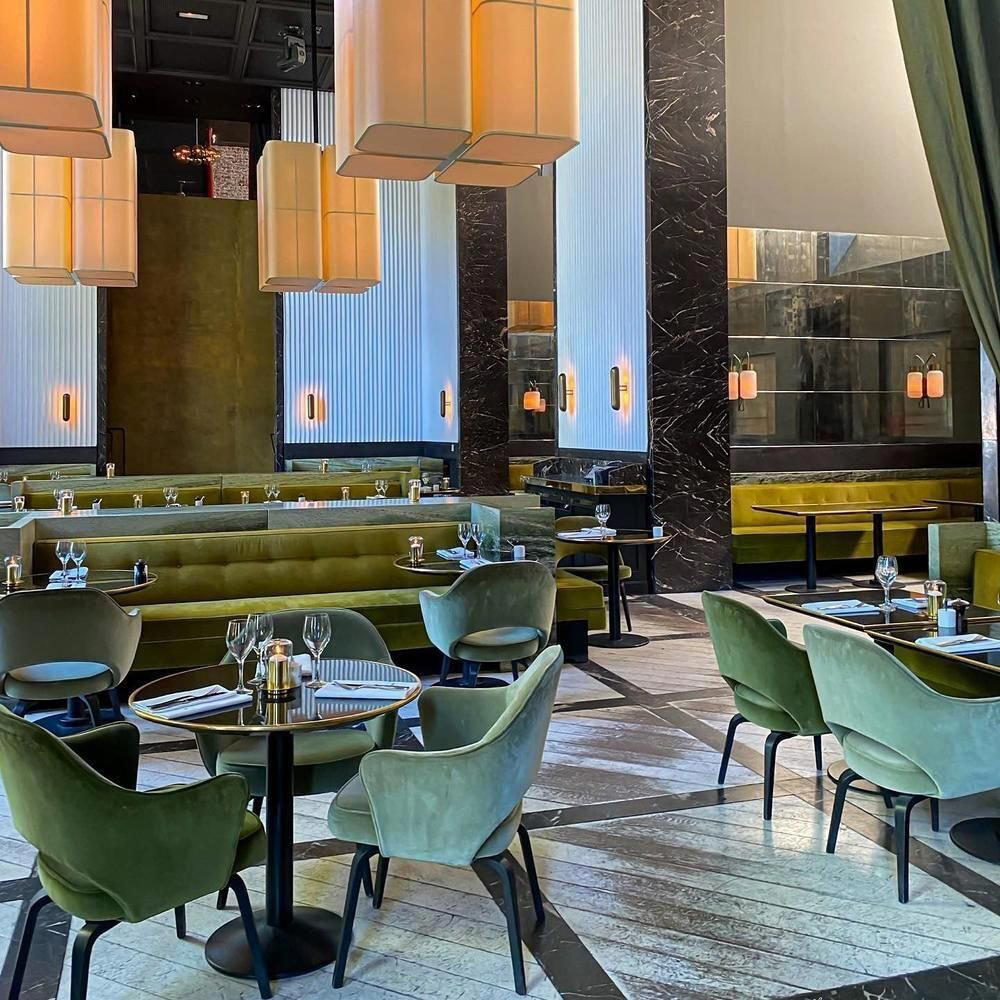
A 1930s Shell, a Contemporary Menu
When the Palais de Tokyo first opened its doors in 1937 for the International Exposition, few could have anticipated that its ground-floor volume would eventually house one of Paris's more photographed dining rooms. The building was conceived as a monument to modernism at a moment when Art Deco was reaching its terminal elegance, and the interior spaces it produced, high ceilings, geometric ornament, long sightlines broken by structural columns, remain largely intact. Monsieur Bleu occupies that inheritance and makes it the dominant fact of the experience. You are, before you are anything else, inside a significant room.
The 16th arrondissement dining corridor along the Avenue de New York is a specific sub-market within Paris. Restaurants here compete less on neighbourhood foot traffic and more on institutional adjacency: the Musée d'Art Moderne sits across the courtyard, the Seine runs fifty metres to the south, and the Eiffel Tower is visible from the terrace. That context shapes the clientele and, by extension, the menu logic. This is not a kitchen cooking primarily for Parisian regulars debating natural wine lists; it is a kitchen calibrated for an international visitor who expects French technique but welcomes more familiar reference points.
The Room as the Primary Argument
In Paris, dining room design tends toward two poles: the historically preserved brasserie (tiled floors, zinc bar, banquettes of cracked leather) and the contemporary fit-out that signals ambition through material restraint. Monsieur Bleu sits between them, using the Palais de Tokyo's Art Deco bones as structural theatre without attempting to replicate a period interior wholesale. The proportions are generous in the way that civic architecture of the 1930s tended to be, ceilings at a height that absorbs noise without producing the deadening acoustic of an over-upholstered room, columns that divide the space into semi-distinct sections without fragmenting sight lines entirely.
The terrace, operational through warmer months, extends the room southward toward the river and the Trocadéro vista. Tables here are among the most sought-after in the arrondissement during spring and summer, not because of anything particular to the food or service, but because the view geometry is difficult to replicate at this price point. Comparable river-facing terraces in Paris tend to sit either in more casual street-level cafés or in significantly more expensive hotel dining rooms. Monsieur Bleu occupies a middle tier that makes the terrace seats genuinely competitive. For visitors planning around Paris's outdoor dining season, April through September represents the window when the architectural setting fully pays off.
Menu Architecture: French Base, International Register
The menu operates from a French classical foundation while incorporating Asian-influenced preparations alongside more familiar brasserie reference points. This is a positioning choice that reflects where the restaurant sits institutionally: a museum-adjacent dining room drawing substantial international traffic needs a menu that does not require fluency in regional French cuisine to navigate. Chef Benoit Dargere has held a Michelin Plate in consecutive years, 2024 and 2025, which signals consistent technical execution rather than the kind of conceptual ambition that courts stars. The Plate recognition places Monsieur Bleu in a distinct tier below the starred restaurants of the same arrondissement, but above the tourist-facing brasseries that trade primarily on setting.
Vegetable preparations appear with enough prominence on the menu to suggest genuine commitment rather than tokenism, which puts Monsieur Bleu in step with a broader shift in Parisian dining toward produce-led courses that do not default to meat as the primary event. Within the €€€ price tier, this kind of menu range, Asian accents, French classics, substantive vegetable dishes, is more common in younger, independently operated restaurants than in museum-attached dining rooms, which typically default to safer, more conservative programming. The kitchen appears to have read its audience more carefully than the institutional setting might suggest.
Placing Monsieur Bleu in the Paris Modern Cuisine Field
Paris's modern cuisine category at the €€€ tier is competitive and varied. On one end, there are highly focused tasting-menu operations, restaurants like Accents Table Bourse and Anona that have earned Michelin stars and attract a dining-out-as-destination crowd. At the higher end of the Paris spectrum, the €€€€ tier includes institutions such as 114, Faubourg, and the kind of formal French classicism represented by rooms like Amâlia. Monsieur Bleu sits between those registers: more polished and more expensive than a neighbourhood bistro, less ceremonial than a full tasting-menu operation.
Beyond Paris, the modern cuisine conversation extends to properties like Flocons de Sel in Megève, Mirazur in Menton, and France's deeper classical lineage at Troisgros in Ouches, Paul Bocuse in Collonges-au-Mont-d'Or, Bras in Laguiole, and Auberge de l'Ill in Illhaeusern. For those tracking international modern cuisine formats, Frantzén in Stockholm and FZN by Björn Frantzén in Dubai represent the northern European and Gulf expressions of the same broader movement. Monsieur Bleu's value proposition is not culinary ambition at that level; it is architectural setting, reliable mid-tier execution, and access to one of Paris's better terraces, combined in a format that works for both first-time visitors and regulars who want a composed meal without full tasting-menu commitment.
For a broader view of comparable dining in the city, our full Paris restaurants guide maps the field across cuisines and price points. Other EP Club Paris resources cover hotels, bars, wineries, and experiences. For mountain dining at the other end of France's modern cuisine range, Auberge de Montfleury offers a contrasting register.
Planning Your Visit
Address: Palais de Tokyo, 20 Avenue de New York, 75116 Paris. Getting there: The Iéna metro station (Line 9) places you at the edge of the Palais de Tokyo complex; the Bir-Hakeim RER stop is a short walk along the river. Budget: The €€€ price bracket puts a dinner for two with wine in a range consistent with mid-tier Parisian brasseries and below the starred rooms of the same arrondissement. Reservations:Timing: Lunch service makes use of the building's natural light and is worth considering as an alternative to dinner for first visits, the room reads differently under daylight, and the museum complex is active during afternoon hours, giving the meal a natural continuation point.
Frequently asked questions
Where is Monsieur Bleu located?
Monsieur Bleu is located at Palais De Tokyo, 20 Av. de New York, 75116 Paris, France, Paris.
Is Monsieur Bleu reservation-only?
Monsieur Bleu sits inside the Palais de Tokyo at 20 Avenue de New York, 75116 Paris, and at the €€€ price tier, booking ahead is strongly advisable. The dining room draws both museum visitors and destination diners, which puts pressure on covers, particularly at weekday lunch and weekend evenings. Reservations can be made directly through the restaurant.
Comparable Options
| Venue | Cuisine | Price | Awards | Notes |
|---|---|---|---|---|
| Monsieur BleuThis venue (the venue you are viewing) | Modern French Neo-Brasserie | $100–150 | Michelin Plate · We're Smart World 2 Radishes | Not listed |
| Alléno Paris au Pavillon Ledoyen | Modern French Fine Dining | $150–200 | 3 Michelin Stars · World's 50 Best #79 | Creative |
| Kei | Modern French with Japanese Influences | $300–500 | 3 Michelin Stars · World's 50 Best #93 | Contemporary French, Modern Cuisine |
| L'Ambroisie | Classic French Haute Cuisine | $300–500 | 2 Michelin Stars · World's 50 Best #23 | French, Classic Cuisine |
| Le Cinq - Four Seasons Hôtel George V | Modern French Fine Dining | $300–500 | 3 Michelin Stars · World's 50 Best #24 | French, Modern Cuisine |
| Plénitude | Modern French Sauce-Led Fine Dining | $300–500 | 3 Michelin Stars · World's 50 Best #14 | Contemporary French |
Recognition history
Dated appearances from independent guides and award organizations, with the underlying list record or original source where available.
Michelin Plate
Michelin
We're Smart World 2 Radishes
We're Smart World
Full recognition history (4 entries)
Michelin Plate
Michelin
Michelin Plate
Michelin
Continue exploring
More in Paris
Restaurants in Paris
All restaurants in Paris →
Bars in Paris
All bars in Paris →



Details
- Elegant
- Trendy
- Modern
- Sophisticated
- Date Night
- Special Occasion
- Business Dinner
- Terrace
- Design Destination
- Hotel Restaurant
- Craft Cocktails
- Street Scene
- A La Carte
- Small Plates
Current opening hours
- Monday
- 12–2:30 PM, 7 PM–2 AM
- Tuesday
- 12–2:30 PM, 7 PM–2 AM
- Wednesday
- 12–2:30 PM, 7 PM–2 AM
- Thursday
- 12–2:30 PM, 7 PM–2 AM
- Friday
- 12–2:30 PM, 7 PM–2 AM
- Saturday
- 12–3:30 PM, 7 PM–2 AM
- Sunday
- 12–3:30 PM, 7 PM–2 AM
Hours can change for holidays and private events. Hours as of .
Elegant Art Deco-inspired interiors with a cozy, intimate feel despite high ceilings, chic and lively atmosphere.