Michelin Bib Gourmand
Our verdict
A Siming District institution with over two decades of history, Ming Yue Xia Mian on Xiahe Road earns its Michelin Bib Gourmand recognition through a prawn noodle broth built on hundreds of prawn heads, finished with tomalley oil and grated garlic. The bowl arrives loaded with shelled prawns, prawn balls, char siu, lean pork, pork intestine, and bean sprouts. At single-digit renminbi prices, it draws a crowd from opening until the last portion sells out.

Pearl is the En Primeur Club membership app, where members save venues, book tables and use the concierge.
The menu
What to order
- Prawn noodles
- Prawn ball soup
Prawn Broth and Morning Queues: Xiamen’s Old-Town Noodle Tradition
On Xiahe Road in the Siming District, the scene outside Ming Yue Xia Mian follows a pattern familiar across Xiamen’s older residential quarters: a modest shopfront, no signage designed for tourists, and a line that forms before most of the city has finished its first cup of tea. This is what a functioning neighbourhood noodle institution looks like in Fujian, and it has looked roughly this way for more than twenty years. The restaurant holds a Michelin Bib Gourmand for 2024 and 2025, placing it in a category the guide reserves for spots where eating well costs relatively little. That recognition has not visibly changed the format.
Prawn noodles are one of Xiamen’s defining street-level dishes, sitting alongside sha cha noodles as the genre most likely to generate local loyalty and heated neighbourhood debate. Where sha cha relies on a peanut-and-seafood-paste base, prawn noodles draw their authority from the broth itself: the depth that comes from slow-cooked crustacean shells, the orange slick of tomalley oil on the surface, and the garlic hit that lifts everything without overwhelming it. Getting that combination right at high volume, consistently, over two decades, is a logistical and culinary discipline that the Bib Gourmand designation implicitly acknowledges.
What the Broth Is Built On
The broth at Ming Yue Xia Mian is constructed from hundreds of prawn heads per service. This is the central fact of the bowl: the tomalley, the fatty, flavour-dense matter from the prawn head, renders into an orange oil that pools on the surface and gives the soup its characteristic richness and colour. Grated garlic is added separately, providing a sharp aromatic counterpoint that keeps the broth from reading as purely sweet or one-dimensional.
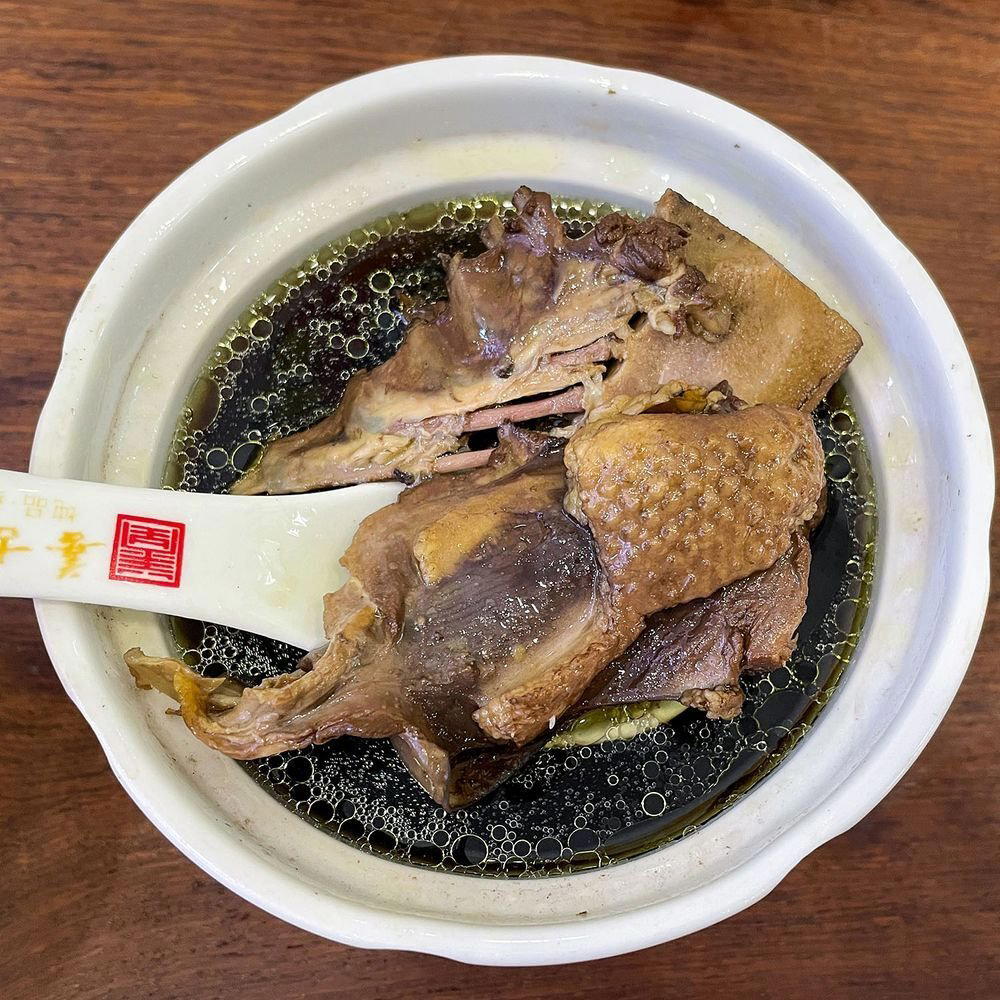
The bowl itself is assembled from several components. Shelled prawns sit alongside prawn balls, lean pork, char siu, pork intestine, and bean sprouts. The range of proteins is typical of Hokkien noodle culture, where a single bowl functions as a complete meal rather than a starter, and where textural variety across the toppings is as considered as the broth itself. For diners less committed to the full build, the prawn ball soup is a separately available option that has developed its own following.
Price tier is the single-digit renminbi range, which in Xiamen’s noodle economy places it in the same bracket as the city’s most accessible sha cha counters. Venues like Wu Lan Sha Cha Mian, Wu Tang Sha Cha Mian, and Yue Hua Sha Cha Mian operate in the same price band with different broth traditions. The point is not that they compete directly, but that Xiamen’s noodle category as a whole offers serious eating at a price floor that most other Chinese cities of comparable culinary ambition cannot match.
Twenty Years in the Same Neighbourhood
Longevity in the Siming District food scene is its own form of credentialling. The old town has seen considerable change over two decades, with rising rents pushing newer operators toward higher-margin formats. A noodle shop that has held its position, its price point, and its customer base across that period is doing something structurally right, whether that’s supplier relationships, operational efficiency, or simply a product that has not been tampered with to chase trends.
This is not a destination on the international tourist circuit in the way that Kulangsu’s heritage listings are; it is a place that Xiamen residents know and return to on a Tuesday morning because they want that specific bowl. That distinction matters when calibrating expectations. The queue is local, the conversation is in Minnan or Mandarin, and the rhythm of the room is shaped by diners who treat this as ordinary rather than exceptional.
Chef Jae Lee oversees the kitchen. In the context of a long-running neighbourhood noodle shop, what the Michelin inspectors are assessing is consistency, value, and product integrity rather than creativity or seasonal menu development. Two consecutive Bib Gourmand entries confirm that the broth and the bowl have held their standard across the inspection period, which is the relevant metric at this level of the dining category.
Xiamen’s Noodle Category in Context
Within Xiamen’s Michelin-recognised noodle tier, Ming Yue Xia Mian operates at the prawn end of the spectrum while the sha cha tradition runs parallel. Across Fujian more broadly, noodle culture reflects the province’s coastal position: seafood stocks, dried shrimp, and shellfish derivatives appear in broths in ways that differ sharply from the wheat-and-pork traditions of northern China or the rice noodle formats of Yunnan. Visitors arriving from A Bing Bao Shan Mian in Hangzhou or A Kun Mian in Taichung will find Xiamen’s prawn noodle tradition genuinely different in base logic, not merely in seasoning.
For Xiamen diners working across the broader local food scene, Lu Niang Zi in Huli represents the city’s Fujian cuisine at a higher price tier, while Fleurs Et Festin (Chao Zhou) moves toward Chaozhou-influenced territory. Further afield in China’s fine dining tier, Xin Rong Ji in Beijing, 102 House in Shanghai, and Chef Tam’s Seasons in Macau occupy an entirely different register, which underlines how much of Chinese dining’s real texture sits at the Bib Gourmand level and below.
Planning a Visit
Ming Yue Xia Mian is at 180 Xiahe Road, Siming District, within reach of the central old-town area on foot or by a short cab ride from Kulangsu ferry terminals. Given that the kitchen operates on a finite quantity of prawn-head broth each day, arriving early in the service window is the practical approach; the bustling dining room described in Michelin’s own notes is a function of consistent demand rather than over-capacity seating. No website or advance booking system is listed, which is standard for this format: you arrive, you queue if necessary, and you order at the counter. Payment is likely cash or domestic QR code (WeChat Pay or Alipay), which covers the vast majority of Xiamen’s street-level operations. For broader trip planning across the city, see our full Xiamen restaurants guide, our full Xiamen hotels guide, our full Xiamen bars guide, our full Xiamen wineries guide, and our full Xiamen experiences guide.
What Regulars Order
What do regulars order at Ming Yue Xia Mian (Xiahe Road)?
The prawn noodle bowl is the anchor order: a combination of shelled prawns, prawn balls, lean pork, char siu, pork intestine, and bean sprouts in the signature tomalley-and-garlic broth. Regulars who want a lighter option gravitate toward the prawn ball soup, which isolates the broth and the hand-formed prawn balls without the full protein array. Both are covered by the Michelin Bib Gourmand citation, which specifically references the broth’s umami depth and the orange oil floating on the surface as defining characteristics. At the price point, ordering one of each across a table of two is not unusual.
Frequently asked questions
What part of town is Ming Yue Xia Mian (Xiahe Road) in?
Ming Yue Xia Mian (Xiahe Road) is located at 180 Xiahe Rd, Siming District, Xiamen, Fujian, China, 361001, Xiamen.
Who runs the kitchen at Ming Yue Xia Mian (Xiahe Road)?
The chef associated with Ming Yue Xia Mian (Xiahe Road) is Jae Lee.
What do regulars order at Ming Yue Xia Mian (Xiahe Road)?
The prawn noodle bowl is the anchor order: shelled prawns, prawn balls, lean pork, char siu, pork intestine, and bean sprouts in the tomalley-based broth with grated garlic and orange oil on top. The prawn ball soup runs a close second, built from the same hundreds-of-prawn-head stock base that earned the shop consecutive Michelin Bib Gourmand recognition in 2024 and 2025. Both dishes sit within the ¥ price tier, which keeps the queue long most mornings.
What cuisine category does Ming Yue Xia Mian (Xiahe Road) fall under?
Cuisine and Recognition
A quick snapshot of similar venues for side-by-side context.
| Venue | Cuisine | Price | Awards | Notes |
|---|---|---|---|---|
| Ming Yue Xia Mian (Xiahe Road)This venue (the venue you are viewing) | Xiamen Prawn Noodles | $1–10 | Michelin Bib Gourmand | Not listed |
| Bai Jia Chun Hao De Lai Jiang Mu Ya (Zhongxing Road) | Traditional Fujian Ginger Duck | Not listed | Michelin Bib Gourmand | Fujian |
| Chic 1699 | Modern Fujian Minnan Seafood | $30–50 | Michelin Bib Gourmand · Black Pearl 1 Diamond | Fujian |
| Dai Tai | Yunnanese Dai Ethnic Home-Style | $20–30 | Michelin Bib Gourmand | Yunnanese |
| Fu Yu Da Tong Ya Rou Zhou | Traditional Chinese Duck Congee | $1–10 | Michelin Bib Gourmand | Congee |
| Hao Shi Lai | Traditional Minnan Seafood | $10–20 | Michelin Bib Gourmand | Seafood |
Recognition history
Dated appearances from independent guides and award organizations, with the underlying list record or original source where available.
Michelin Bib Gourmand
Michelin
Full recognition history (3 entries)
Michelin Bib Gourmand
Michelin
Michelin Bib Gourmand
Michelin