Masala Art
Indian cuisine in Podgorica occupies a narrow niche, and Masala Art holds a recognisable position within it. The restaurant sits in the 81101 postal district of Montenegro's capital, drawing diners who want something outside the Adriatic-heavy local repertoire. Spice-forward cooking in a city shaped by Balkan and Mediterranean traditions makes for an interesting friction worth exploring.
 Discover on Pearl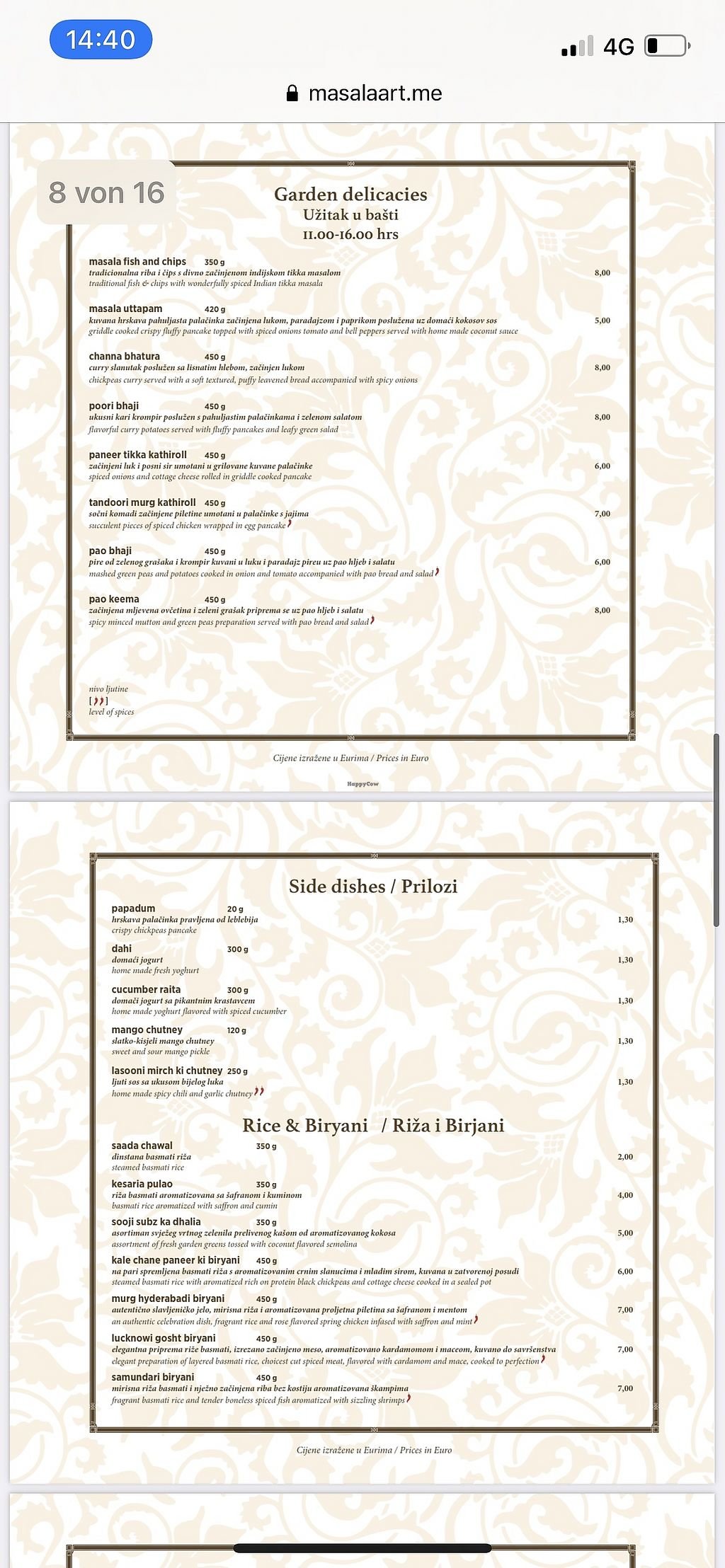
Spice on the Adriatic Edge: Indian Cooking in Podgorica's Restaurant Scene
Podgorica's dining culture has long been anchored in the logic of geography: grilled meats, Adriatic fish, olive oil from the coast, and the slow-cooked lamb dishes that define inland Montenegrin tradition. Against that backdrop, a restaurant committed to the spice architecture of Indian cooking reads as a deliberate counter-programme. Masala Art in Podgorica occupies that position, sitting in a city where the dominant culinary reference points look west toward the Dalmatian coast and north toward Serbia, not east toward the subcontinent.
That geographical tension is worth sitting with for a moment. Montenegro is a small country of roughly 600,000 people, and its capital has only recently begun to develop a restaurant scene diverse enough to sustain cuisines far outside the regional mainstream. Indian restaurants in the Western Balkans remain sparse enough that their presence in a mid-sized capital like Podgorica signals genuine demand rather than trend-chasing. For visitors using the city as a base for day trips to Kotor's bay or the Skadar Lake region, a dinner at a kitchen working with turmeric, coriander, and tamarind offers a meaningful contrast to the grilled fish and ajvar that appear on nearly every other menu in the 81101 district.
The shortlist, unlocked.
Hard-to-book tables, cellar releases, and concierge-planned trips.
Get Exclusive Access →Where Ingredients Travel to Reach the Plate
The sourcing story behind Indian cooking in a landlocked Balkan capital is, by itself, an instructive editorial subject. The spices central to North and South Indian cooking — cardamom, fenugreek, dried chillies, asafoetida — do not grow in Montenegro and are not part of any local supply chain. Getting them to a kitchen in Podgorica requires either direct import relationships with specialist distributors in Belgrade, Zagreb, or further afield, or reliance on the small but growing network of South Asian grocery suppliers operating across the former Yugoslav region.
This matters because ingredient quality is the primary variable separating credible Indian cooking from diluted approximations. Whole spices sourced properly and toasted fresh produce a different aromatic result than pre-ground blends of uncertain age. In cities with established South Asian communities and competition among Indian restaurants, the sourcing baseline is set by peer pressure. In a market like Podgorica, where Indian restaurants are rare enough to face limited direct competition, the kitchen's commitment to sourcing becomes a matter of culinary conviction rather than market necessity. Compare this to the tight import ecosystems that underpin, say, the Korean pantry at Atomix in New York City, where ingredient provenance is both a competitive signal and a marketing language , in Podgorica, the same rigour would need to operate without that external pressure or audience.
Balkan-grown produce, however, does enter the equation in ways that make sense. Montenegro's vegetable farming, particularly around the Zeta plain near Podgorica, yields tomatoes, onions, and peppers that translate naturally into base sauces for subcontinent-influenced dishes. A kitchen that sources its aromatics carefully but uses local Montenegrin tomatoes for its gravies is doing something geographically coherent: mapping Indian technique onto regional raw material, the same way Mediterranean cooking traditions have always absorbed and adapted.
The Atmosphere Indian Restaurants Build in Non-Indian Cities
Indian restaurants operating outside major diaspora cities tend to do one of two things atmospherically. The first is full visual immersion: Mughal-influenced interior details, brass accents, sitar music, the whole constructed environment of subcontinental hospitality transplanted wholesale. The second is deliberate restraint, where the food carries the cultural weight and the room stays neutral enough not to compete. Both are legitimate strategies, and both appear across European capitals where Indian cooking has established a serious foothold.
In a city like Podgorica, where the wider dining scene skews toward the simple and unfussy, the atmospheric register of a place like Masala Art likely sits somewhere between those poles. Montenegro's dining culture does not demand theatrical environments; the country's most respected konobas are typically plain-walled rooms where the food is the entire argument. For context on how atmosphere functions differently across the region, Konoba Perast in Perast and Dalmatinska Konoba Cesarica in Kotor both exemplify that regional preference for substance over setting. Masala Art operates in a different culinary register but in the same cultural context, where diners are accustomed to rooms that do not announce themselves loudly.
Podgorica as a Dining Base: Where Masala Art Fits
Most international visitors to Montenegro bypass Podgorica in favour of the coast, routing through Budva, Tivat, or Kotor without stopping in the capital. That pattern means the city's restaurant scene is written largely for residents and the smaller segment of travellers who stay for business or use it as a transit point. Our full Podgorica restaurants guide covers the range of options in more detail, but within that field, Indian cooking represents a narrow category.
For diners already working through the Montenegrin coast, the contrast Masala Art provides is functionally useful. After a run of grilled fish at La Veranda in Kumbor or the Adriatic-focused menus typical of coastal restaurants, a kitchen operating with different pantry logic offers genuine palate reset. The same principle applies further afield: Bastion 1 in Kotor and Duomo Crna Gora in Becici anchor the upscale end of the coast's dining offer, while Podgorica's Indian option provides a different kind of dining logic entirely.
Those exploring beyond the standard coastal circuit might also consider Kavkaz Restaurant in Enovici for a Caucasian kitchen working with similar principles of diaspora cooking in an unexpected Montenegrin context, and Lee Fast in Budva for a faster-casual counterpoint. The regional picture that emerges is of a small country developing appetite for non-Balkan cooking alongside its traditional strengths.
Planning a Visit
Masala Art is located within the 81101 postal area of Podgorica, Montenegro's capital. The city is served by Podgorica Airport (TGD), approximately 12 kilometres south of the city centre, with connections to a growing number of European hubs. The restaurant does not list a public website or phone number in available directories, so the most reliable approach for current opening hours and reservation availability is to check Google Maps listings or ask at your accommodation, where local staff will typically know the current operating status of restaurants in the area. Walk-in is likely feasible given Podgorica's dining culture, which is less reservation-dependent than major Western European cities, though weekend evenings in summer may warrant checking ahead.
Frequently Asked Questions
- Would Masala Art be comfortable with kids?
- Indian restaurants in smaller European capitals generally run as relaxed, family-oriented spaces, and Podgorica's dining culture as a whole tends toward informality rather than strict adult-only conventions. If the price range and format follow the typical mid-range pattern for Indian restaurants in the Western Balkans, a family visit is unlikely to feel out of place, though confirming current seating arrangements directly is sensible before arriving with young children.
- What should I expect atmosphere-wise at Masala Art?
- Podgorica's restaurant scene is not built around theatrical environments, and Indian restaurants in cities without a large South Asian dining community tend to calibrate their atmosphere toward the local norm rather than full subcontinental immersion. Expect a room that foregrounds the food rather than the setting, consistent with the wider Montenegrin preference for substance over staging. No awards data is currently available to indicate a fine-dining tier, suggesting a mid-register experience accessible to a broad range of diners.
- What's the must-try dish at Masala Art?
- Specific menu and dish information is not available in verified sources for this venue. As a general principle, Indian restaurants operating outside established diaspora cities often anchor their menus around the dishes that travel most reliably: slow-cooked dals, tandoor-based proteins, and sauce-driven curries where the spice sourcing does the most visible work. A kitchen's handling of these foundational dishes gives the clearest read on its seriousness. No chef or award credentials are currently documented for Masala Art.
- Should I book Masala Art in advance?
- Podgorica does not operate with the booking pressure of major capital cities, and Indian restaurants in the Western Balkans rarely require weeks of advance planning outside peak summer weekends. That said, as one of a small number of non-Balkan kitchens in the city, Masala Art may draw a loyal local following that fills the room on Friday and Saturday evenings. Checking current availability via Google Maps or a local contact a day or two ahead is a proportionate precaution.
- Does Masala Art serve vegetarian options, and how does that align with Indian cooking tradition in the region?
- Indian cuisine carries one of the strongest vegetarian traditions of any major cooking culture, and restaurants working within that framework typically offer a substantial proportion of meat-free dishes even where no formal vegetarian menu is published. In the Western Balkans, where vegetable-forward cooking is associated mainly with Lenten or fasting traditions rather than everyday preference, an Indian kitchen naturally fills a gap for plant-based diners. Confirming the current menu range directly is advisable, as no dish-level data is available for this venue, but the culinary tradition strongly supports expecting meaningful vegetarian depth.
Peer Set Snapshot
These are the closest comparables we have in our database for quick context.
| Venue | Cuisine | Price | Awards | Notes |
|---|---|---|---|---|
| Masala Art | This venue | |||
| La Veranda | ||||
| Sabia | ||||
| Bastion 1 | ||||
| Kavkaz Restarant | ||||
| Dalmatinska Konoba Cesarica |
Need a table?
Our members enjoy priority alerts and concierge-led booking support for the world's most difficult tables.
Get Exclusive AccessThe shortlist, unlocked.
Hard-to-book tables, cellar releases, and concierge-planned trips.
Get Exclusive Access →