Mambo Italiano
Our verdict
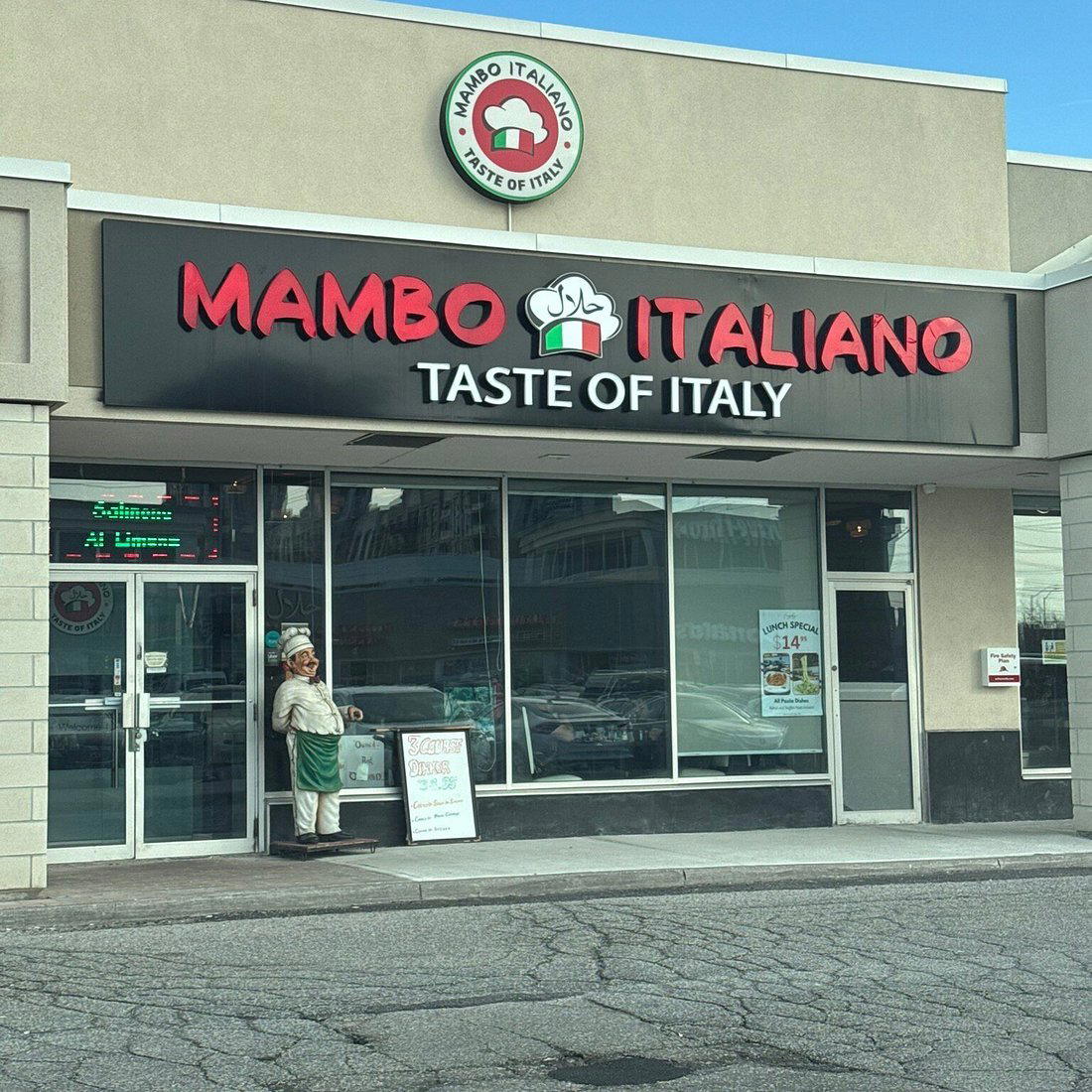
Mambo Italiano sits on Eglinton Avenue West in Mississauga's Hurontario corridor, where Italian-format dining competes against a range of neighbourhood staples and airport-adjacent chains. The address places it within reach of both suburban regulars and travellers moving between Pearson and the city's inner suburbs. For those tracing the local Italian dining scene, it represents one reference point in a wider Mississauga picture.

Pearl is the En Primeur Club membership app — saves, bookings, and concierge access live there. Same editors, same standards.
- Address
- 660 Eglinton Ave W, Mississauga, ON L5R 3V2, Canada
- Phone
- (905) 507-1777
- Hours
- Mon–Thu 11:30 AM–10:30 PMFri–Sat 11:30 AM–11 PMSun 11:30 AM–10:30 PM
- Website
- mamboitalianorestaurant.com
- Directions
- Get directions
- Booking
- Book on OpenTable
The menu
What to order
- La Piadana Margherita
- Farfalle Diavolo with chicken
- Pollo Della Mambo
- Chicken Parmiggiana
Eglinton Avenue and the Italian Dining Corridor
The stretch of Eglinton Avenue West running through Mississauga's Hurontario district is not the kind of address that generates editorial attention from Toronto's dining press. It is, instead, the kind of address where a city actually eats: strip plazas, mid-rise residential, and restaurants serving the population that lives within a five-minute drive rather than a forty-minute subway ride. Italian-format dining has long held a particular position in this corridor. Where downtown Toronto concentrates its Italian fine dining into a handful of tasting-menu rooms and wine-forward osterie, the suburban stretch operates differently — more volume, broader menus, a customer base that skews toward regulars rather than first-timers consulting a reservation app.
Mambo Italiano, at 660 Eglinton Ave W, occupies a specific position in that ecosystem. The name signals a register: casual, familiar, Italian in the popular-culture sense rather than the strictly regional-cuisine sense. In Mississauga's dining map, that positioning places it alongside neighbourhood staples rather than destination restaurants, which is not a criticism so much as a description of what the address is built to do. For context, our full Mississauga restaurants guide covers the wider range of dining formats available across the city.
The Physical Register: What Space Communicates Before the Menu Arrives
Italian restaurants in the suburban Canadian context have developed a recognisable spatial vocabulary: warm lighting pitched below the glare of the strip-plaza exterior, a colour palette that runs from terracotta to deep red, booths or banquettes designed for groups, and a noise level that allows conversation without the studied quiet of a tasting-menu room. These choices are not arbitrary. They communicate something specific about the kind of evening being offered — one where the table stays occupied for two hours, where a second round of bread arrives without being requested, and where the space itself does most of the social work.
That spatial grammar matters because it sets the terms of the experience before food arrives. A room that reads as convivial and unpretentious creates different expectations than one that signals restraint and precision. In the Eglinton corridor, the dominant Italian format reads comfortably and accessibly, which aligns with what the surrounding residential density demands. Operators who have succeeded here have generally understood that the physical container needs to support groups, accommodate different dining occasions, from weeknight family dinners to Saturday celebrations, and do so without requiring the guest to perform any particular level of formality.
This contrasts with the direction that Italian dining has taken at the higher end of the Canadian market. Restaurants like Alo in Toronto have built reputations on tightly controlled spaces, prix-fixe formats, and a physical environment where every element is disciplined toward a specific editorial point. The suburban Italian room operates on the opposite logic: it is designed to be expansive, not edited.
Mississauga's restaurant scene is often assessed against Toronto's, which is not the most useful comparison. The city has its own dining logic, shaped by a car-dependent geography, a large and diverse immigrant population, and a commercial real estate pattern that favours strip plazas and suburban retail corridors over the dense urban blocks where destination dining tends to cluster. Italian restaurants across the city range from the trattoria-style operations serving lunch to the airport-adjacent business dining rooms that Pearson's proximity enables.
Against that backdrop, Mambo Italiano occupies the neighbourhood-anchor tier rather than the destination tier. Comparison venues in the immediate Mississauga context include places like Franico's Ristorante, which operates in a similar format register, and broader-menu casual chains like Jack Astor's, which Mambo Italiano's Italian-specific positioning differentiates it from clearly. At the other end of the local spectrum, operations like Culinaria Restaurant and Aristotles Steak and Seafood serve a more formal occasion-dining function. Mambo Italiano sits between those poles, more specific than a generalist chain, less occasion-coded than the white-tablecloth rooms.
For diners exploring the breadth of what Mississauga's neighbourhood dining offers beyond Italian, Afghan Flame, Bait Sitty, and Alioli Ristorante each represent distinct points on the city's dining map, covering different cuisine registers and price tiers.
Italian Dining in Canada: The Suburban Lineage
The Italian restaurant has a longer and more complex history in Canadian suburbia than the fine-dining conversation tends to acknowledge. Italian immigration to cities like Toronto and Mississauga through the mid-twentieth century established a restaurant culture that was community-facing and built for volume, Sunday family dinners, pre-theatre pasta, the kind of meal that operates as social infrastructure rather than cultural performance. That tradition produced a durable format: large portions, accessible wine lists, menus that cover pasta, veal, and seafood without committing to the kind of regional specificity that contemporary Italian fine dining prizes.
The more recent wave of Canadian fine dining has moved deliberately away from that tradition. Restaurants earning attention in publications covering the national scene, including tasting-menu rooms like Tanière³ in Quebec City or destination properties like Eigensinn Farm in Singhampton, have built their identities around precisely the opposite values: small capacity, high precision, menus that change with supply. Even within Ontario's regional dining scene, places like Restaurant Pearl Morissette in Lincoln and The Pine in Creemore signal a shift toward restraint and local sourcing that reads as a direct counterpoint to the suburban Italian tradition.
Neither model is wrong. They serve different dining populations and different dining occasions. The suburban Italian room that has survived decades of competition has done so by being genuinely useful to the people who live nearby, a standard that destination restaurants rarely need to meet.
Planning a Visit: What to Know
Mambo Italiano is located at 660 Eglinton Ave W in Mississauga, accessible by car from the Hurontario corridor and within a short drive of Pearson International Airport. Given the neighbourhood-anchor format, walk-in dining is likely more viable here than at high-demand destination rooms, though confirming hours and reservation options directly with the venue before visiting is advisable, as specific booking details are not published through third-party platforms at time of writing. Weeknight visits typically carry less pressure than weekend evenings in this format tier, where family-group and celebration dining drives Saturday demand. For travellers using Mississauga as a base, the Eglinton corridor sits between the airport and the city's inner suburbs, making it a practical option for a dinner that doesn't require heading into downtown Toronto.
Those travelling through the broader Greater Toronto Area and looking for higher-tier Italian or European-influenced dining options have several reference points: Jérôme Ferrer - Europea in Montreal and Le Bernardin in New York City represent the upper end of the formal European dining register on this side of the Atlantic, while Atomix in New York City and AnnaLena in Vancouver illustrate where the contemporary fine-dining conversation has moved. Barra Fion in Burlington, Narval in Rimouski, and Aux Anciens Canadiens in Quebec each anchor distinct regional dining traditions worth tracking across the country.
Frequently asked questions
What's Mambo Italiano's location?
Mambo Italiano is located at 660 Eglinton Ave W, Mississauga, ON L5R 3V2, Canada, Mississauga.
Is Mambo Italiano a good option for Italian dining near Pearson International Airport in Mississauga?
Mambo Italiano sits at 660 Eglinton Ave W in Mississauga, placing it within a short drive of Pearson International Airport via the Hurontario corridor. For travellers or visitors looking for Italian dining in the area without committing to the full drive into Toronto, it sits in a part of Mississauga with an established Italian-Canadian restaurant presence. Confirming hours directly before visiting is advisable, as published operating schedules are not available through verified channels.
What's the best thing to order at Mambo Italiano?
Italian restaurants along the Eglinton Ave W corridor in Mississauga typically anchor their menus around pasta, wood-fired preparations, and regional Italian staples — ask the kitchen directly about current signature dishes when booking. Calling ahead or checking at the 660 Eglinton Ave W location will get you the clearest picture of what's featured that evening.
How far ahead should I plan for Mambo Italiano?
No booking window data is publicly documented for Mambo Italiano at 660 Eglinton Ave W in Mississauga. For Italian restaurants serving the Hurontario corridor on weekends, a reservation placed two to five days in advance is a reasonable baseline. For Friday and Saturday evenings, erring toward a week ahead reduces the risk of a wait.
What's the standout thing about Mambo Italiano?
Mambo Italiano occupies a stretch of Eglinton Ave W that has functioned as a working Italian dining corridor for years, drawing a local clientele rather than destination traffic. It is a neighbourhood institution in a district where Italian-Canadian dining culture has genuine historical roots.
The Short List
Comparable venues nearby, for context on price, style, and recognition.
| Venue | Cuisine | Price | Notes |
|---|---|---|---|
| Mambo ItalianoThis venue — the venue you are viewing | Authentic Italian with Halal Certification | $20–30 | Not listed |
| Hello Bangkok Mississauga | Authentic Bangkok-Style Thai | $20–30 | Port Credit, Authentic Bangkok-Style Thai |
| Urban Crave | Global comfort food with hearty breakfast | $20–30 | Toronto Pearson International Airport, Global Street Food Fusion |
| Posta Italbar Cucina | Modern Italian Pastificio & Pizzeria | $20–30 | Port Credit, Modern Italian Pastificio & Pizzeria |
| Afghan Flame | Traditional Afghan | $20–30 | Erin Mills, Traditional Afghan |
| IL FORNELLO Sherwood Village | Modern Italian Neapolitan Pizza & Pasta | $30–50 | Sherwood Village, Modern Italian Neapolitan Pizza & Pasta |
Continue exploring
More in Mississauga
Restaurants in Mississauga
Browse all →
Bars in Mississauga
Browse all →

Hotels in Mississauga
Browse all →

Wineries in Mississauga
Browse all →
Details
- Casual
- Elegant
- Date Night
- Group Dining
- Family
- Casual Hangout
- Standalone
- A La Carte
- Halal
- Vegetarian Friendly
Current opening hours
- Monday
- 11:30 AM–10:30 PM
- Tuesday
- 11:30 AM–10:30 PM
- Wednesday
- 11:30 AM–10:30 PM
- Thursday
- 11:30 AM–10:30 PM
- Friday
- 11:30 AM–11 PM
- Saturday
- 11:30 AM–11 PM
- Sunday
- 11:30 AM–10:30 PM
Hours can change for holidays and private events. Last verified .
Casual-elegant atmosphere with attentive service, welcoming for both intimate dinners and group gatherings.