Maltacina

Three Michelin-starred chefs, one stone village house on the Plateau Matheysin, and a mystery menu built around southern Isère produce. Maltacina operates at the intersection of rural French terroir and technically precise modern cuisine, with a vaulted dining room and glassed-in wine cellar that set the register before the first course arrives. For creative vegetable-led cooking in an unexpected alpine-plateau setting, this is a serious address.
Pearl is the En Primeur Club membership app — saves, bookings, and concierge access live there. Same editors, same standards.
- Address
- 443 route du 45ème-Parallèle
- Phone
- +33 4 76 30 34 45
- Website
- maltacina.com
- Directions
- Get directions
 Saves & bookings on Pearl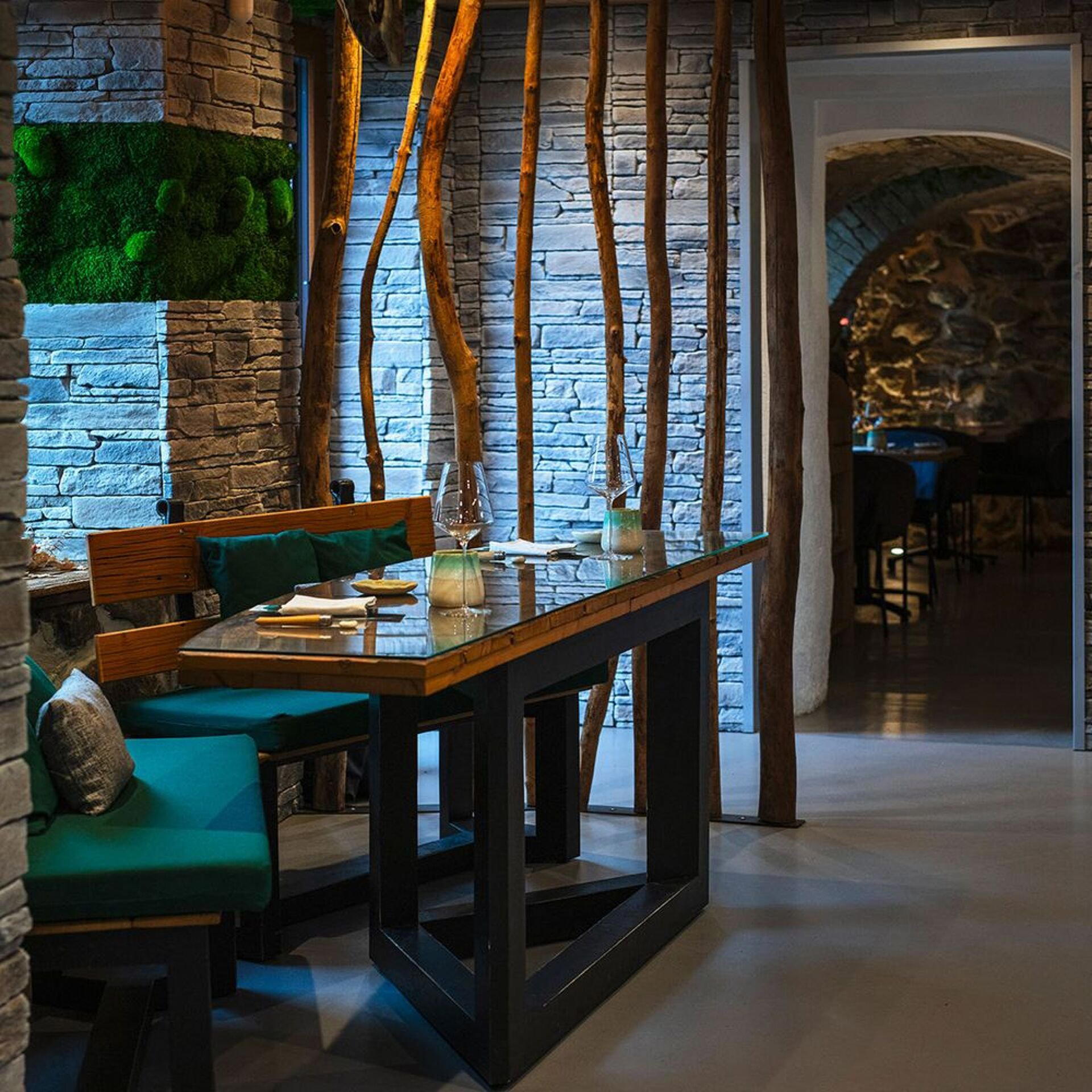
Stone, Vault, and the Southern Isère Plateau
The road that runs along the 45th parallel between Lac de Laffrey and Lac de Petichet does not suggest fine dining. The Plateau Matheysin sits at altitude, its landscape shaped more by agriculture and water than by the kind of visible culinary infrastructure that surrounds restaurants in Grenoble or Lyon. That is precisely the point. Maltacina is a restaurant in Saint-Théoffrey serving Modern French Farm-to-Table cooking at about $95 per person. Maltacina occupies a stone village house at 443 route du 45ème-Parallèle in Saint-Théoffrey, and the building's exterior gives little away. Inside, the progression from the large open kitchen to the vaulted dining room is deliberate: you pass the engine before you reach the table. The dining room itself is lit from the floor, a detail that shapes the mood considerably, and a glassed-in wine cellar anchors one end of the space. The handful of tables, including a table d'hôte, keep numbers intimate. Scale is part of the philosophy here, in the same way that scale defines the specialist end of the French restaurant spectrum, from Bras in Laguiole to Auberge du Vieux Puits in Fontjoncouse: remote placement, intimate capacity, and total commitment to a defined territory.
Where the Food Comes From, and Why That Shapes Everything
Southern Isère is not a name that appears frequently in French gastronomy's national conversation, which is dominated by the produce networks of Brittany, the Rhône valley, and the Mediterranean coast. That relative obscurity is a productive condition for a kitchen that treats the local as a constraint and a creative brief simultaneously. The three chefs at Maltacina, Kevin Mangione, Lunis Chaïb, and Théo Doumecq, all carry Michelin recognition earned elsewhere, most notably at restaurant Lamartine, and their collective training operates in service of a single sourcing principle: the terroir of southern Isère, expressed through vegetable-led cooking.
Vegetable-forward menus have become a credible category across French haute cuisine over the past decade, visible in the seasonal precision of Mirazur in Menton and the ingredient-first logic of Flocons de Sel in Megève. What distinguishes Maltacina's position within that movement is geography. The Plateau Matheysin's altitude, its proximity to alpine meadows, and its remove from southern French growing conditions produce ingredients with specific characteristics: shorter seasons, more concentrated flavours in certain root vegetables and alliums, a different relationship between cultivation and climate than you find in coastal or valley kitchens. A kitchen that commits to local sourcing in this environment is not making an easy claim. The ingredient supply is narrower, the growing calendar less forgiving, and the requirement for precision in preparation higher, because the produce cannot be supplemented easily from outside the region without undermining the premise.
This is the logic behind the mystery menu format. Offering a single evolving menu with no advance specification of dishes is a structure that only works when the kitchen trusts its sourcing completely. It positions the restaurant firmly in the same structural tier as addresses like Alléno Paris au Pavillon Ledoyen or Assiette Champenoise in Reims in terms of creative ambition, even if the register is deliberately more rural and the price tier is about $95 per person.
Three Kitchens, One Address
The collaborative model at Maltacina is worth considering as a structural fact rather than a biographical anecdote. Three chefs with individual Michelin recognition operating a single kitchen together is rare in France, where the starred restaurant is almost always built around a single named figure. The model at Paul Bocuse or Troisgros established the template of the chef-as-institution. Maltacina inverts that convention by distributing creative authority across three equal contributors who share a formative reference point in restaurant Lamartine. The result, described by Michelin as creative modern cuisine with harmonious flavours and a rustic-meets-modern character, suggests that the shared reference has produced coherence rather than compromise. Whether that coherence holds across seasons, and how the three-way dynamic shapes the evolution of the menu over time, is the more interesting editorial question that only sustained visits would resolve. What Michelin's recognition signals is that the collaboration has already produced food of a standard that the guide considers worthy of recognition.
The Rural Address as Strategic Choice
France has a consistent tradition of destination restaurants in unlikely geography. Auberge de l'Ill in Illhaeusern sits in Alsace farmland. Au Crocodile in Strasbourg draws from a regional city context. Bras in Laguiole placed itself on the Aubrac plateau and made that remove central to its identity. Maltacina's position on the Plateau Matheysin places it within this lineage, though at an earlier stage of institutional recognition. Saint-Théoffrey is not a restaurant destination in the way that Laguiole or Illhaeusern have become. That creates a practical consideration for planning: the journey is part of the proposition, and visitors arriving from Grenoble, approximately 30 kilometres to the north, should treat the drive along the lakes as preparation rather than inconvenience. Accommodation options in the immediate area are limited, which makes the planning dimension of a visit more demanding than arriving at an urban address. Checking our Saint-Théoffrey hotels guide before booking is advisable, as is booking the restaurant well in advance given the small number of covers available.
Planning Your Visit
Maltacina's address at 443 route du 45ème-Parallèle in Saint-Théoffrey is reachable by car from Grenoble, with the route passing the two lakes that frame the plateau. Travellers drawn to ambitious regional French cooking elsewhere, from AM par Alexandre Mazzia in Marseille to Paul Bocuse's Auberge du Pont de Collonges and internationally at Le Bernardin in New York City or Emeril's in New Orleans, will find the register at Maltacina distinct: quieter, more rooted in a specific plateau, and built around the particular constraint of cooking what the southern Isère produces rather than what the market can supply.
Fast Comparison
Comparable venues nearby, for context on price, style, and recognition.
| Venue | Cuisine | Price | Awards | Notes |
|---|---|---|---|---|
| MaltacinaThis venue — the venue you are viewing | Modern French Farm-to-Table | $$$ | Michelin Plate | Not listed |
| Au Chamois d'Or | Alpine French Bistro | $$$ | Michelin Plate | L'Alpe d'Huez |
| La Baratte | Classic French Bistro | $$$ | Michelin Plate | Tourcoing |
| Les Hospitaliers | Modern French Regional | $$$ | Michelin Plate | Le Poët-Laval |
| Garrigue | Modern French Fine Dining | $$$ | Michelin Plate | Ansouis |
| La Table d'Émilie | Contemporary French Bistro | $$$ | Michelin Plate | Viuz-en-Sallaz |
Recognition history
Dated appearances from independent guides and award organizations, with the underlying list record or original source where available.
Michelin 1 Star
Michelin
Continue exploring
More in Saint-Théoffrey
Restaurants in Saint-Théoffrey
Browse all →
Bars in Saint-Théoffrey
Browse all →
Hotels in Saint-Théoffrey
Browse all →
Wineries in Saint-Théoffrey
Browse all →
At a Glance
- Elegant
- Intimate
- Rustic
- Cozy
- Sophisticated
- Date Night
- Special Occasion
- Celebration
- Open Kitchen
- Wine Cellar
- Terrace
- Panoramic View
- Natural Wine
- Sommelier Led
- Farm To Table
- Organic
- Local Sourcing
- Zero Waste
- Mountain
- Waterfront
Current opening hours
- Monday
- 12–3 PM, 7–10:30 PM
- Tuesday
- Closed
- Wednesday
- Closed
- Thursday
- 12–3 PM, 7–11 PM
- Friday
- 12–3 PM, 7–11 PM
- Saturday
- 12–3 PM, 7–11 PM
- Sunday
- 12–3 PM, 7–10:30 PM
Hours can change for holidays and private events. Last verified .
Warm and cozy stone vaulted dining room with floor lighting, glassed-in wine cellar, and intimate table spacing; guests pass through the open kitchen to enter the dining area, creating an immersive culinary theater experience.