Our verdict
love.fish occupies a prime address on Barangaroo's Wulugul Walk, where Sydney's harbour foreshore has become a proving ground for seafood-led dining. The restaurant leans into ingredient provenance as its editorial statement, placing Australian coastal sourcing at the centre of a menu designed for the city's most commercially active waterfront precinct.

Pearl is the En Primeur Club membership app — saves, bookings, and concierge access live there. Same editors, same standards.
- Address
- 7/23 Barangaroo Avenue, Wulugul Walk, Barangaroo NSW 2000, Australia
- Phone
- +61280773700
- Hours
- Mon–Wed 11:30 AM–3 PM, 5–9 PMThu–Fri 11:30 AM–3 PM, 5–9:30 PMSat 11:30 AM–3 PM, 5–9:45 PMSun 11:30 AM–8 PM
- Website
- lovefish.com.au
- Directions
- Get directions
- Booking
- Book on the venue's website
The menu
What to order
- Sydney rock oysters
- Barramundi
- Love.fish salt + pepper calamari
Barangaroo's Waterfront and the Seafood Sourcing Story
Sydney's relationship with its harbour has never been simple. For most of the twentieth century, the foreshore was industrial infrastructure: working wharves, container yards, bond stores. The transformation of Barangaroo from port land into a mixed precinct of finance towers, public parkland, and dining has created one of the city's more contested dining corridors, where the proximity to water promises provenance but doesn't always deliver it. The restaurants that have built credibility here tend to be those that treat the harbour as a sourcing context rather than a backdrop, letting the origin of the catch drive the menu rather than the view drive the pricing.
love.fish sits at 7/23 Barangaroo Avenue on Wulugul Walk, the pedestrian path that traces the western edge of the precinct along the harbour. Wulugul Walk takes its name from the Gadigal language, and the precinct's public spaces carry that acknowledgement of Country throughout. For a seafood-focused restaurant in this location, that framing matters: it places the food in a continuum of relationship with the water rather than treating the harbour as an aesthetic amenity.
Ingredient Provenance as Editorial Position
Australian seafood sourcing has become one of the country's more substantive dining conversations in the past decade, driven in part by kitchens that have pushed back against the generic frozen-fish model that dominated casual dining. The argument made by restaurants at the sharper end of this conversation, places like Saint Peter in Paddington, is that Australian waters produce an extraordinary range of underutilised species, and that a genuinely seasonal seafood menu looks quite different from a menu anchored to a handful of commercially safe fillets. Saint Peter's approach, which has influenced how Sydney thinks about fish cookery, centres on whole-beast utilisation and species that most kitchens ignore entirely.
love.fish operates in a different register, serving a precinct where the lunch trade is dominated by financial-district workers and the dinner crowd includes tourists and residents of the adjacent apartment towers. The sourcing conversation at this address is therefore more practically anchored: what comes from Australian coastal fisheries, what is seasonal, what is day-boat versus cold-storage. These are the distinctions that separate a seafood restaurant with genuine ingredient commitment from one that simply occupies a waterfront address. In Sydney's current dining environment, where provenance claims are common and verification is patchy, the geography of a sourcing program matters as much as the claim itself.
For broader context on how Australian restaurants have approached provenance-led cooking, the work at Brae in Birregurra and Attica in Melbourne represents the most developed farm-to-table frameworks in the country, with Brae in particular building its entire identity around what can be grown or sourced within a defined radius. The seafood equivalent of that discipline is harder to operationalise in a city restaurant, but it is the benchmark against which serious ingredient-led seafood programs are measured.
Barangaroo as a Dining Precinct
Barangaroo's dining strip has settled into a reasonably clear hierarchy. Below that sits a mid-tier of independent and small-group restaurants along Wulugul Walk and the surrounding streets, where love.fish operates alongside other waterfront addresses targeting the lunch-and-dinner generalist market.
The comparison set for love.fish at the Sydney level includes the broader neighbourhood of seafood-focused restaurants that have defined the city's fish dining identity. Rockpool established the template for premium Australian produce handled with technical precision, while Saint Peter has pushed the conversation toward species diversity and whole-fish utilisation. love.fish's Barangaroo address places it in conversation with both traditions without occupying either extreme: it is a waterfront neighbourhood restaurant that benefits from proximity to the harbour and the sourcing credibility that location implies.
Elsewhere in Sydney, comparable neighbourhood dining with a strong local sourcing ethic can be found at Bayly's Bistro in Kirribilli and at bills in Bondi Beach, both of which anchor their menus in Australian produce without operating at the premium end of the market. The Barangaroo location gives love.fish a different customer base: less local-neighbourhood, more destination and corporate, which shapes both the menu's accessibility and its pricing expectations.
The Wulugul Walk Setting
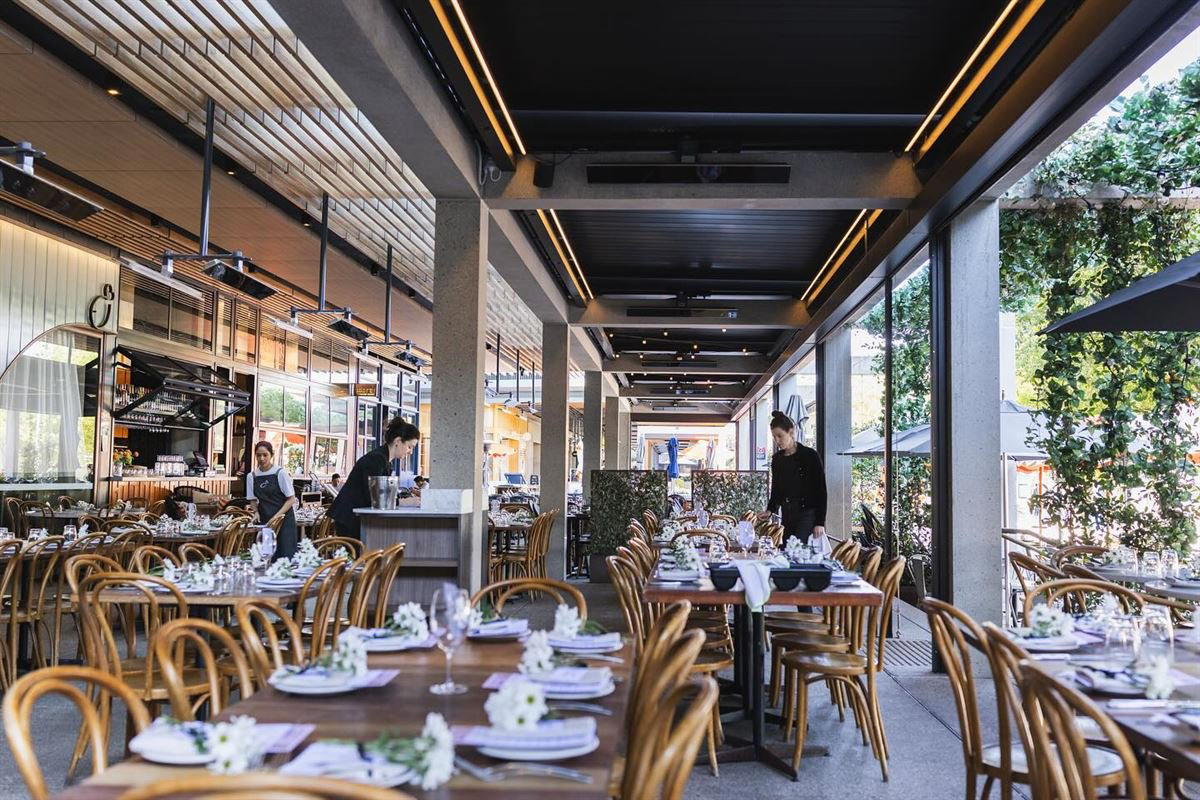
Approaching from the southern end of Wulugul Walk, the precinct reads as a planned public space that has matured into something more lived-in than its origins suggested. The sandstone-toned paving, the views across the harbour toward Balmain and Rozelle, and the working rhythm of the foreshore pedestrian traffic give the strip a quality that distinguishes it from the more hermetic luxury of nearby Crown. Restaurants here open onto the walk itself, with the water visible from most outdoor tables. The light off the harbour in the afternoon shifts the entire setting, which is the practical reason why sunset reservations along this strip are taken first.
For visitors to Sydney building a broader dining itinerary, Barangaroo sits at the northwest edge of the CBD, walkable from the Wynyard and Barangaroo metro stations and connected to the ferry network at Barangaroo Wharf. The surrounding precinct includes a concentration of wine-focused restaurants and bars, and visitors who want to extend into other Sydney dining neighbourhoods would find useful comparisons in the 10 William St model in Paddington, the more eclectic offer at 1021 Mediterranean, or the casual-end of the market represented by 10 Pounds. Our full Sydney restaurants guide maps the city's dining neighbourhoods in more detail.
Planning Your Visit
Location: 7/23 Barangaroo Avenue, Wulugul Walk, Barangaroo NSW 2000. Getting there: Barangaroo metro station is the closest rail access; Barangaroo Wharf connects to the Parramatta River and inner-harbour ferry routes. Reservations: Dress: No confirmed dress code; the precinct's tone is smart casual. Budget:
Frequently asked questions
What's the address for love.fish?
love.fish is located at 7/23 Barangaroo Avenue, Wulugul Walk, Barangaroo NSW 2000, Australia, Sydney.
Is love.fish in Barangaroo suitable for a business lunch near the Sydney CBD?
The Barangaroo Avenue address places love.fish within walking distance of Sydney's financial district, making it a practical option for a midday sit-down that doesn't require crossing the city. Barangaroo metro station provides direct rail access, and Barangaroo Wharf connects ferry routes from other harbour points. The waterfront Wulugul Walk setting separates it from the more corporate interiors found further up the precinct toward Crown Sydney.
What's the must-try dish at love.fish?
love.fish positions itself around seafood sourcing rather than a fixed signature plate, so the menu follows what Australian waters are producing at any given time. The Barangaroo address puts it within a precinct where ingredient provenance is an editorial position, not a marketing footnote. Specific current dishes are best confirmed directly with the venue before visiting.
Can I walk in to love.fish?
love.fish sits on Wulugul Walk at 7/23 Barangaroo Avenue, a strip that draws consistent foot traffic from the surrounding precinct and Crown Sydney. Walk-in availability at waterfront Barangaroo venues varies considerably by day and session, particularly on weekends. Checking ahead is advisable rather than arriving without a booking.
What's love.fish best at?
The venue's defining position within Barangaroo's dining hierarchy is seafood with a clear sourcing orientation, operating at the waterfront end of Wulugul Walk where the harbour context is immediate rather than decorative. Sydney's broader seafood dining conversation over the past decade has rewarded kitchens that treat provenance as a core commitment, and love.fish occupies that space within the Barangaroo precinct.
Cuisine Lens
Comparable venues nearby, for context on price, style, and recognition.
| Venue | Cuisine | Price | Notes |
|---|---|---|---|
| love.fishThis venue — the venue you are viewing | Australian Seafood | $50–100 | Not listed |
| Aces Ocean Foods | Fresh Seafood and Pizza | $20–30 | Padstow |
| Opera Bar | Modern Australian Seafood with Global Flavours | $30–50 | Sydney |
| Garfish | Modern Australian Seafood | $50–100 | Crows Nest |
| Devon Cafe Barangaroo | Asian-Infused Australian Brunch Café | $20–30 | Barangaroo |
| Baptist Street Rec Club | Thai-inspired bar snacks in a retro cocktail bar | $30–50 | Redfern |