.png)
A fifth-generation family trattoria operating in Cogne since 1966, Lou Ressignon holds a 2025 Michelin Plate for its faithful rendition of Aosta Valley cooking. Valpellinese soup, tripe with borlotti beans, and a historic ground-floor taverna anchor the experience. Four guestrooms sit above the dining room for those who want to stay the night in one of Italy's most remote alpine villages.
 Discover on Pearl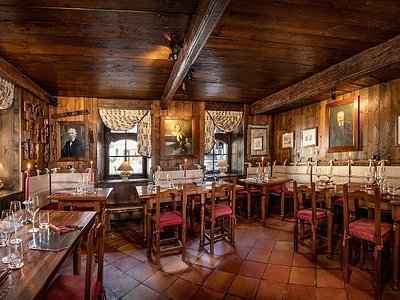
A Village at the End of the Road
Cogne sits at the southern edge of Gran Paradiso National Park, reachable by a single road that winds up from Aosta through the Cogne valley and then simply stops. There is nowhere further to go. That geographical fact shapes everything about eating here: the produce arrives from local farms and high pastures, not distribution networks, and the restaurants that have survived across generations are the ones that understood the valley's own culinary logic rather than importing one from elsewhere. Lou Ressignon, on the Rue Mines de Cogne, is the clearest expression of that logic in the village.
The trattoria format that dominates alpine Italy differs from the urban osteria or the coastal seafood house in one fundamental way: longevity is the credential, not novelty. A kitchen open since 1966, now in its fifth generation of family ownership, carries a kind of institutional knowledge that no amount of ambition can replicate quickly. In Cogne, where the dining scene is compact — a handful of addresses ranging from the Bar à Fromage at €€ to the Le Petit Bellevue at the contemporary end and Coeur de Bois at the mid-premium tier — Lou Ressignon occupies the anchor position: the place locals measure others against.
What the Name Tells You
The name Lou Ressignon translates from the local Franco-Provençal dialect as "the night snack." That etymology is more informative than any tagline. It points to a tradition of late-evening eating after a day of physical work in the mountains, food designed for appetite and warmth rather than for contemplation. The cooking here belongs to that tradition: solid, ingredient-led, and calibrated to the cold. Aosta Valley cuisine is one of Italy's less-discussed regional kitchens, partly because the region itself is small and partly because its reference points , fontina cheese, mountain herbs, polenta, cured meats from Valdostana cattle , don't translate easily into the codes of fashionable Italian dining. That distance from trend is precisely what makes it interesting.
Across the broader Aosta Valley, restaurants like Vecchio Ristoro in Aosta and Café Quinson in Morgex approach the same regional tradition from different angles. Lou Ressignon's version is the most explicitly trattoria-format among them: multi-generational, fixed in its identity, and operating at a €€ price point that keeps it accessible rather than aspirational.
The Cooking
The Michelin Plate awarded in 2025 signals cooking that meets a consistent technical standard without reaching toward the star tier. In Italian Michelin terms, that positioning places Lou Ressignon alongside trattorias and family kitchens that Michelin inspectors acknowledge for quality and authenticity rather than creativity. The distinction matters: this is not a kitchen that interprets tradition, it is one that transmits it.
Valpellinese soup is the dish most closely associated with the restaurant and with the valley's culinary identity. The preparation, involving day-old black bread, Valdostana fontina, and beef broth , sometimes with cabbage, depending on the household , is one of those slow, oven-finished dishes that reveals the quality of its components immediately. The tripe with borlotti beans and polentina sits in the same register: strong in structure, dependent on good sourcing, and representative of an Italian peasant-cooking tradition that has largely disappeared from urban menus. Chefs Francesco Torcasio and Giuseppe Pezzella operate within a culinary framework set by generations before them. Their role is precision and continuity, not authorship.
For those following Italy's Michelin-starred scene across the country, the contrast with addresses like Osteria Francescana in Modena, Enoteca Pinchiorri in Florence, or Enrico Bartolini in Milan is instructive. Lou Ressignon is not competing in that conversation. Its peer set is defined by fidelity and place, not by technique or progression. Closer regional comparisons , Atelier Moessmer Norbert Niederkofler in Brunico for alpine ingredients at the haute end, or coastal Italian cooking at Uliassi in Senigallia or Quattro Passi in Marina del Cantone , share a regional commitment but operate in different formats and at different price levels. Dal Pescatore in Runate is perhaps the closest structural parallel: a family kitchen across multiple generations, maintaining a traditional repertoire with Michelin recognition.
The Room and the Taverna
The physical layout of Lou Ressignon is worth noting. The first-floor dining room handles the main service, but the historic taverna at ground level is a different proposition , lower-ceilinged, older in character, the kind of space that makes the meal feel less like a restaurant visit and more like eating inside the building's own history. Alpine restaurant design has split in Cogne between the polished hotel-restaurant format (see Le Restaurant Bellevue for the full-service hotel context) and the trattoria model that retains the marks of its own age. Lou Ressignon falls into the latter. The room does not compete with the food for attention.
Staying Over
Four guestrooms above the dining space offer an option that fits a particular kind of alpine itinerary: arrive in Cogne, eat well, stay the night, walk Gran Paradiso the following morning. The accommodation is functional rather than designed, which is appropriate for a trattoria that has been feeding travellers and locals since 1966. For visitors building a fuller picture of where to stay in Cogne, our full Cogne hotels guide covers the range of options across the village.
Planning Your Visit
Lou Ressignon sits on the Rue Mines de Cogne, the main street running through the village centre, which makes it easy to locate on foot. The €€ price point places it among Cogne's more accessible addresses , comparable to Bar à Fromage on price, though different in format and ambition. Given the Google review volume of over 1,000 ratings at 4.7, the restaurant attracts consistent traffic from both visitors to the national park and skiers during winter months. A table in high season , July and August for hikers, December through March for the ski and snowshoe crowd , is not something to leave unbooked. The modest size of a trattoria at this profile level means demand regularly exceeds available covers during peak periods. Booking ahead is the direct approach regardless of season.
For anyone building an itinerary around Cogne's food and drink scene beyond a single dinner, our full Cogne restaurants guide maps the village's options across formats and price tiers. The Cogne bars guide, wineries guide, and experiences guide cover the rest of what the valley offers for a longer stay.
Frequently Asked Questions
Recognition Snapshot
A short peer set to help you calibrate price, style, and recognition.
| Venue | Awards | Cuisine | Notes |
|---|---|---|---|
| Lou Ressignon | Founded in 1966 and now run by the fifth generation, the Lou Ressignon family tr… | Cuisine from the Aosta Valley | This venue |
| Bar à Fromage | Cuisine from the Aosta Valley | Cuisine from the Aosta Valley, €€ | |
| Coeur de Bois | Cuisine from the Aosta Valley | Cuisine from the Aosta Valley, €€€ | |
| Le Petit Bellevue | Italian Contemporary | Italian Contemporary, €€€€ | |
| Le Restaurant Bellevue | Italian Alpine | Italian Alpine |
Need a table?
Our members enjoy priority alerts and concierge-led booking support for the world's most difficult tables.
Get Exclusive Access