Our verdict
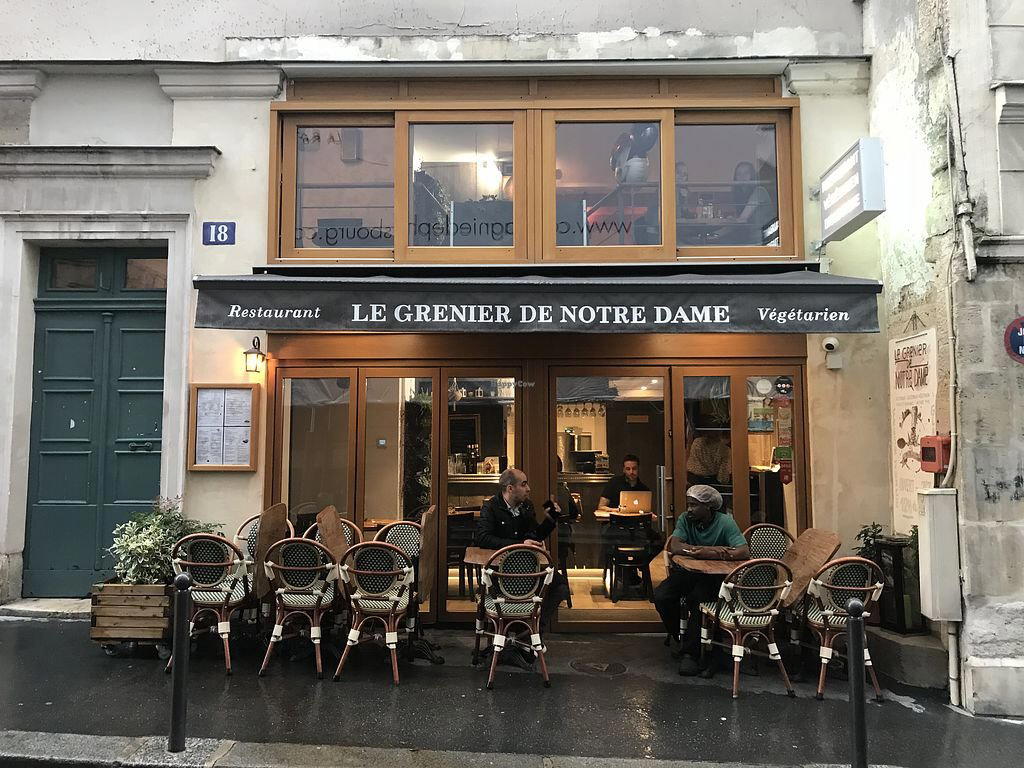
On the Left Bank opposite Notre-Dame, Le Grenier de Notre-Dame occupies a position in Paris's most historically dense dining corridor, the kind of address that draws on neighbourhood weight as much as what's on the plate. The restaurant sits within the 5th arrondissement's long-established vegetarian and natural-food tradition, placing it in a distinct tier among Paris's rue de la Bûcherie establishments.

Pearl is the En Primeur Club membership app, where members save venues, book tables and use the concierge.
The menu
What to order
- Vegan cassoulet
- Chickpea and rice pancakes
- Chocolate mousse
- Gratinée de légumes
The Street That Predates the Trend
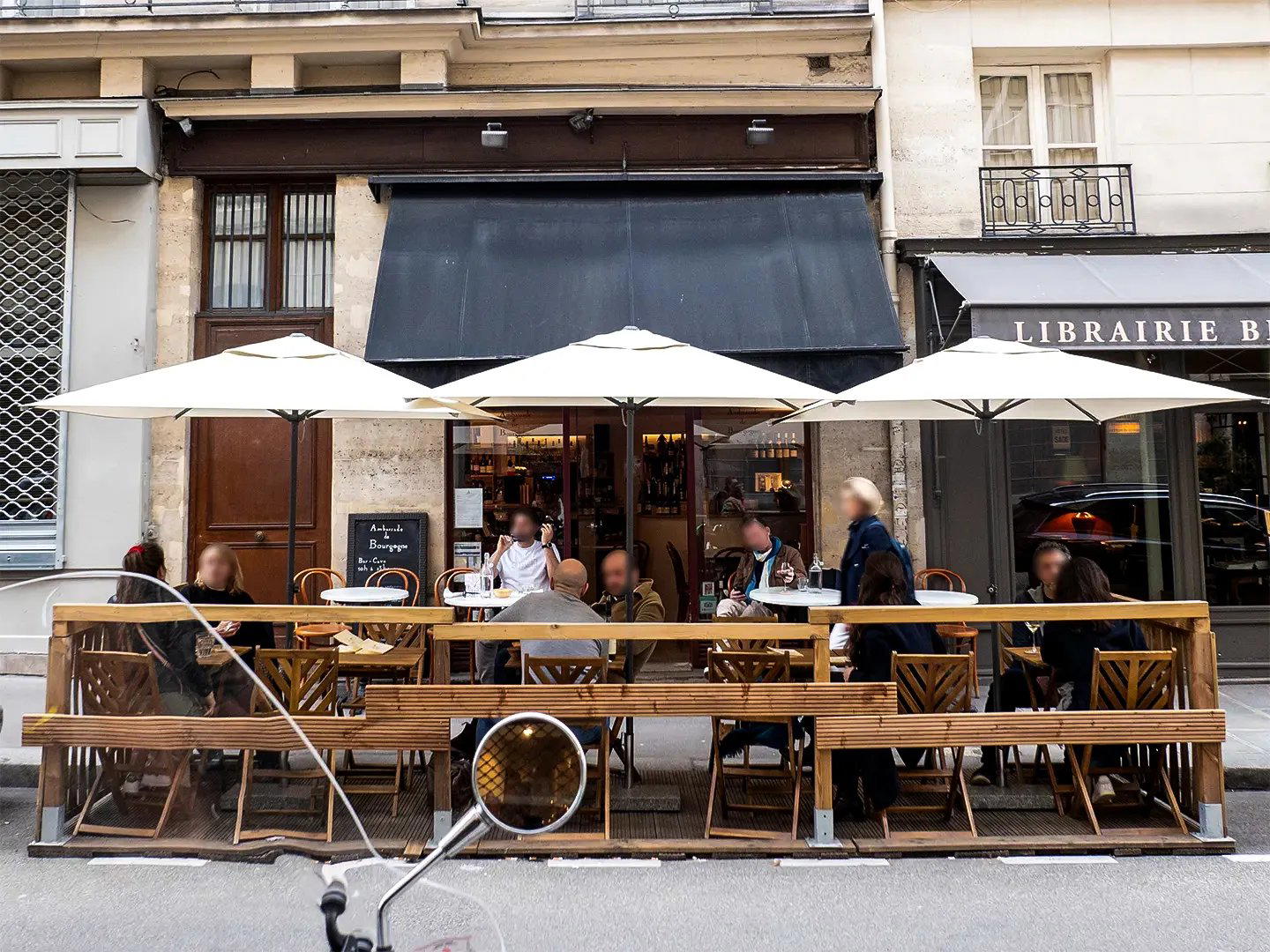
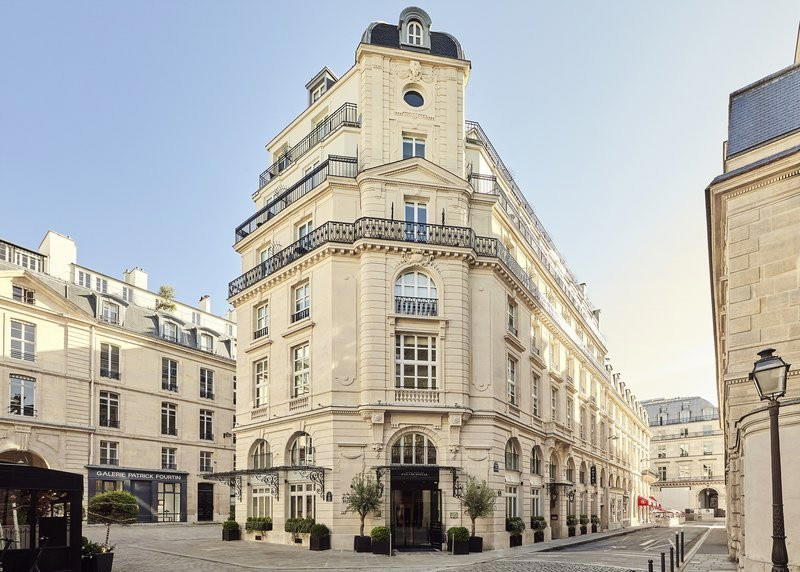
Rue de la Bûcherie runs along the Seine's left bank with Notre-Dame's towers as its north-facing backdrop. The street is short, narrow, and historically dense, it housed one of Paris's earliest medical schools and has attracted countercultural and independent operators for decades. Le Grenier de Notre-Dame, at number 18, sits within this continuum rather than apart from it. The physical approach is as the address implies: old stone, a compact frontage, the low ambient noise of the Latin Quarter's quieter passages rather than its busier tourist arteries.
Paris's 5th arrondissement carries a specific culinary identity that separates it from the grand-institution dining of the 8th or the experimental small-plates scene of the 11th. Its dominant register is independent, often long-established, and weighted toward what might now be called value-conscious classical eating. Le Grenier de Notre-Dame operates within that register and has done so long enough to be considered a reference point in the neighbourhood rather than a newcomer pressing for attention.
Vegetarian Paris, in Context
Paris has been slower than London, Berlin, or Copenhagen to build a dense, serious vegetarian and plant-focused restaurant scene at every price tier. The city's culinary institutions, the kind that define its international reputation, from L'Ambroisie in the Marais to Le Cinq at the Four Seasons George V, have historically built menus around animal protein as structural anchor. Even chefs working in more experimental registers, such as those at Alléno Paris au Pavillon Ledoyen or Arpège, have approached plant-forward cooking as a creative expansion rather than a founding premise.
Le Grenier de Notre-Dame predates the current wave of plant-based dining by enough years to represent something different: not a restaurant that pivoted toward vegetables as a market opportunity, but one that built its identity around that position from the outset. In the 5th, where the natural food movement found early Parisian roots in the 1970s and 1980s, this longevity carries genuine weight. The restaurant's position on rue de la Bûcherie places it in a micro-corridor that has consistently attracted operators with a similar orientation, lending it a neighbourhood context that newer plant-forward addresses in the Marais or Canal Saint-Martin lack.
Service as Structural Element
The editorial angle assigned to this venue, the dynamic between kitchen, floor, and front-of-house as an integrated system, reflects something broadly true about smaller independent restaurants in Paris. At the Michelin-starred level, the division of labor between chef, sommelier, and maître d' is formalised and often publicly documented. At addresses like Le Grenier de Notre-Dame, the equivalent dynamic operates more fluidly, with front-of-house staff frequently carrying both service and advisory roles.
In vegetarian and plant-forward restaurants specifically, the sommelier or floor team's contribution to the experience tends to be weighted differently than in conventional tasting-menu contexts. Wine pairing with a meat-free menu requires different reasoning: the structural reference points of tannin management and fat coating that guide conventional pairings give way to a greater focus on acidity, minerality, and aromatic alignment with vegetable preparations. How a floor team narrates that difference, whether they explain it with authority or default to generic recommendation, is a meaningful signal of a restaurant's actual investment in the format.
Across France's broader plant-forward scene, the restaurants that have built durable reputations have tended to be those where kitchen and floor operate with shared language. The kind of collaboration visible at more remote French addresses, at Bras in Laguiole, where the team's commitment to the Aubrac terroir extends through every service touchpoint, or at Flocons de Sel in Megève, where mountain provenance shapes both kitchen and communication, is the model that independent Paris addresses aspire toward at smaller scale.
Placing Le Grenier in the Paris Conversation
Paris's dining conversation tends to concentrate on a handful of arrondissements: the 1st and 8th for grand classical institutions, the 11th and 10th for the natural wine and bistronomie wave, the 6th for established neighbourhood dining. The 5th occupies a quieter register in that conversation, which partly explains why some of its longer-operating independents receive less critical bandwidth than their longevity might suggest.
The comparison set for Le Grenier de Notre-Dame is not Kei or the other starred addresses working in contemporary French idiom. It sits in a different competitive tier, more accessible by price point, more neighbourhood in orientation, and operating within a specific ideological and culinary tradition that the Paris fine-dining circuit has historically left to one side. That positioning is not a weakness. It reflects a consistent choice about what kind of restaurant to be.
France's most formally decorated addresses, from Paul Bocuse in Collonges-au-Mont-d'Or to Auberge de l'Ill in Illhaeusern, occupy the upper end of a national dining hierarchy that values continuity, craft, and regional specificity. Le Grenier de Notre-Dame operates in a different register within that same culture: smaller scale, specific conviction, and a neighbourhood address that has earned its own kind of loyalty. Other French addresses that have built durable independent identities through specific terroir commitment, Auberge du Vieux Puits in Fontjoncouse, Au Crocodile in Strasbourg, Assiette Champenoise in Reims, demonstrate that durability in French dining is rarely accidental.
For visitors approaching Paris with a serious interest in the city's dining range, the 5th arrondissement rewards attention beyond its most photographed corner. Our full Paris restaurants guide covers the city's dining scene at neighbourhood level, including which arrondissements to target by cuisine type and price tier. Internationally, plant-forward cooking at the highest registers, at Mirazur in Menton, or in entirely different culinary systems at Atomix in New York or AM par Alexandre Mazzia in Marseille, has validated vegetable-centric menus as a serious culinary format. Le Grenier de Notre-Dame arrived at that position earlier and at smaller scale.
Planning Your Visit
| Venue | Price tier | Format | Arrondissement |
|---|---|---|---|
| Le Grenier de Notre-Dame | €–€€ | Vegetarian, sit-down | 5th |
| L'Ambroisie | €€€€ | Classic French, tasting | 4th |
| Kei | €€€€ | Contemporary French-Japanese | 1st |
| Alléno Paris au Pavillon Ledoyen | €€€€ | Creative tasting menu | 8th |
| Le Cinq | €€€€ | French Modern, hotel dining | 8th |
Rue de la Bûcherie is walkable from Saint-Michel RER and Maubert-Mutualité Métro (Line 10). The street runs parallel to the Seine embankment and is most easily approached on foot from the Pont au Double. Evening reservations in the Latin Quarter generally book earlier than comparable addresses in the 11th or 10th, where later dining culture predominates, plan accordingly if visiting on a weekend.
Frequently asked questions
What's the address for Le Grenier de Notre-Dame?
Le Grenier de Notre-Dame is located at 18 Rue de la Bûcherie, 75005 Paris, France, Paris.
How does Le Grenier de Notre-Dame compare to other vegetarian restaurants in Paris's 5th arrondissement?
The 5th arrondissement has historically offered fewer dedicated vegetarian addresses than the city's more food-experimental districts like the 11th or 10th, making Rue de la Bûcherie an atypical location for this kind of kitchen. Le Grenier de Notre-Dame's longevity in that context is itself a credential, Paris's vegetarian scene has been slower to consolidate than London's or Copenhagen's, and venues that have held a position there across multiple years carry a different weight than newer openings.
What's the best thing to order at Le Grenier de Notre-Dame?
Given its position as one of Paris's longer-standing vegetarian addresses on Rue de la Bûcherie, asking the floor staff for the current kitchen focus is the most reliable approach, French vegetarian cooking at this level tends to centre on technique with legumes, grains, and seasonal produce rather than meat substitutes.
Is Le Grenier de Notre-Dame reservation-only?
The 5th arrondissement draws consistent foot traffic from the Notre-Dame quarter, particularly in peak tourist months, so contacting the venue directly before visiting is advisable. Walk-in availability will vary by day and time.
What's the defining dish or idea at Le Grenier de Notre-Dame?
The defining idea is structural rather than dish-specific: Le Grenier de Notre-Dame operates as a vegetarian kitchen in a city where plant-focused restaurants at a serious culinary level remain sparser than in London or Berlin. Its location on Rue de la Bûcherie, within sight of Notre-Dame on the Left Bank, places it in one of Paris's most historically dense neighbourhoods, which shapes both its clientele and its identity within the Paris dining conversation.
Comparison Snapshot
Comparable venues nearby, for context on price, style, and recognition.
| Venue | Cuisine | Price | Notes |
|---|---|---|---|
| Le Grenier de Notre-DameThis venue (the venue you are viewing) | Organic French Vegetarian | $20–30 | Not listed |
| Bibimbap | Korean Bibimbap | $20–30 | 5th Arr. - Panthéon |
| Chez Janou | Provençal Bistro | $30–50 | Le Marais |
| Cinq-Mars | Traditional French Bistro | $20–30 | 7th Arr. (Palais-Bourbon) |
| PICCOLA TOSCANA | Authentic Southern Italian Trattoria | $30–50 | 9th Arrondissement (Opéra) |
| Ito Izakaya | Seasonal Japanese Izakaya | Not listed | Saint-Georges |