
A Michelin Plate holder for two consecutive years (2024 and 2025), Le Cotte Rôti brings modern cuisine to the 12th arrondissement's Rue de Cotte at an accessible price point that puts it well below the city's starred tier. Its. This is neighbourhood-rooted cooking with verifiable recognition behind it.
Pearl is the En Primeur Club membership app — saves, bookings, and concierge access live there. Same editors, same standards.
- Address
- 1 Rue de Cotte, 75012 Paris, France
- Phone
- +33 1 43 45 06 37
- Website
- lecotteroti.fr
- Directions
- Get directions
 Saves & bookings on Pearl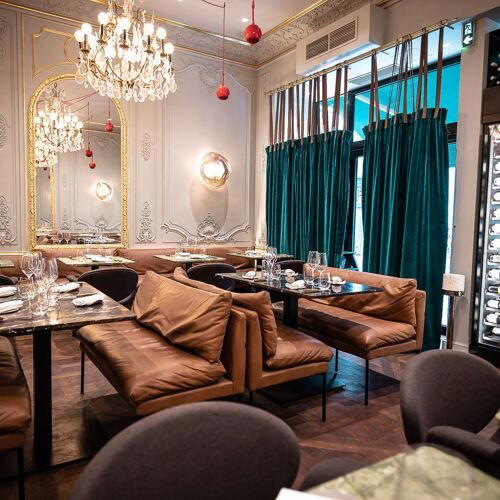
The 12th Arrondissement and the Case for Eating East
Paris dining conversations still tilt westward by default, toward the grand brasseries of Saint-Germain, the palace restaurants of the 8th, and the clustered ambition of the 6th. The 12th arrondissement has long operated outside that gravitational pull. Built around the Viaduc des Arts, the Promenade Plantée, and the market life of Rue de Cotte, it is a residential quartier where restaurants earn their reputation through repetition rather than occasion. A table here fills because the neighbourhood comes back. That dynamic shapes the kind of cooking that works: precise enough to justify the trip across town, grounded enough to sustain weekly loyalty.
Le Cotte Rôti sits on Rue de Cotte, the street that feeds into the Marché d'Aligre, one of Paris's most active daily markets. That address is not incidental. Markets like Aligre have historically operated as a direct line between producers and cooks, compressing the supply chain in ways that matter to anyone thinking about sourcing ethics, seasonal fidelity, and food waste reduction. Proximity to a market of this type is a structural advantage for a kitchen working at the €€ price point: shorter supply chains lower cost, but they also lower the distance between field and plate in ways that affect both quality and environmental footprint.
Michelin Recognition in Context
Le Cotte Rôti holds a Michelin Plate for both 2024 and 2025, a designation that signals the Guide's assessment of consistent quality without the starred tier's expectation of architectural plating or multi-hour tasting formats. In the current Paris edition, Michelin Plate holders at the €€ price point occupy a specific and useful space: they deliver the credential of Guide recognition with the informality and accessibility that defines neighbourhood dining. For comparison, the city's starred modern cuisine restaurants, including Accents Table Bourse and Kei, operate at price brackets that price out most regular diners. The Plate tier is where the Guide acknowledges that quality cooking does not require a grand dining room or a three-figure cover charge.
Consecutive Plate recognition across two years also carries a specific meaning: the kitchen is not coasting on an opening-year surge.. That volume of reviews at that score indicates a pattern rather than a spike, and it positions Le Cotte Rôti within a cluster of reliably performing neighbourhood addresses in eastern Paris.
Modern Cuisine and the Ethics of the Supply Chain
The broad category of Modern French Bistro, as applied to mid-range Parisian restaurants, covers a range of approaches, but the direction of travel in this tier over the past decade has been consistently toward shorter supply chains, smaller producer networks, and menus that reflect availability rather than impose a fixed format across seasons. This is partly an aesthetic shift, but it is also an economic and ethical one. Restaurants working at the €€ level cannot absorb the cost of premium imported ingredients; the financial logic of the price point pushes kitchens toward local sourcing almost by necessity. The result, in practice, is a model that reduces food miles, supports smaller French producers, and reduces waste by building menus around what is actually available rather than what a fixed menu demands.
Across France, this philosophy has been formalised at the highest levels. Restaurants like Bras in Laguiole and Flocons de Sel in Megève have built their reputations in part on deep engagement with regional terroir and minimal-waste kitchen practices. The principles filter down. At the neighbourhood level, the same commitment to seasonal, producer-led cooking appears in a less theatrical form, but the structural logic is identical: cook what is ready, use it fully, and let the supply chain define the menu rather than the other way around.
Other Paris addresses working modern cuisine at adjacent price points and with similar sourcing orientations include Anona and Amâlia, both of which have built followings through consistent product focus rather than format spectacle. The comparable set for Le Cotte Rôti is this tier: Guide-recognised, neighbourhood-rooted, cooking that earns loyalty through ingredient fidelity rather than occasion-dining theatrics.
Eastern Paris as a Dining Zone
The 12th is part of a broader eastward shift in Paris dining that has been underway for more than a decade. The 10th, 11th, and 12th arrondissements now hold a concentration of independently owned restaurants that has no direct equivalent in the western arrondissements, where real estate costs and tourist-driven footfall have reshaped the economics of running a small kitchen. The east operates differently. Lower rents support longer-term experimentation. A loyal local base sustains quieter seasons. The market infrastructure of streets like Rue de Cotte and nearby Rue d'Aligre keeps ingredient sourcing anchored in the immediate geography.
For a visitor approaching Paris through its restaurants rather than its monuments, this zone repays attention. The palace-tier addresses, from Le Cinq at the Four Seasons George V to 114, Faubourg, deliver a specific kind of experience oriented around occasion, grandeur, and technical ambition. The 12th delivers something different and in many respects harder to replicate: cooking rooted in daily market life, priced for repetition, and recognised by Michelin for precisely that consistency.
How Le Cotte Rôti Compares Across France and Beyond
France's highest-profile modern cuisine addresses, including Mirazur in Menton, Troisgros in Ouches, and the institutional weight of Paul Bocuse in Collonges-au-Mont-d'Or, operate as reference points for French culinary tradition. The distance between those addresses and a neighbourhood table on Rue de Cotte is substantial by every metric: price, format, ambition, and occasion type. The comparison is instructive precisely because it is not competitive. The restaurant does not aim at that tier. It aims at the problem of feeding a neighbourhood well, within a price envelope that supports return visits, with ingredients sourced close enough to arrive in good condition. That is a different kind of achievement, and the Michelin Plate is the appropriate recognition for it.
Internationally, modern cuisine restaurants working similar producer-first philosophies include Frantzén in Stockholm, where seasonal Nordic sourcing has been central to the restaurant's identity since opening, and FZN by Björn Frantzén in Dubai, which extends that framework into a different supply-chain context. At the other end of the scale, the neighbourhood approach at the restaurant connects to a wider European pattern: Michelin-recognised restaurants that treat the supply chain itself as a design decision, not an afterthought.
FAQ: What's the Leading Thing to Order at Le Cotte Rôti?
The restaurant holds consecutive Michelin Plate recognition at a €€ price point on a street adjacent to the Marché d'Aligre. That combination suggests a menu structured around market availability and seasonal rotation rather than a fixed signature-dish format. The practical implication is that one reliable approach is to trust the current menu rather than arriving with a specific dish in mind, and to ask the room what is performing well on the day. At this tier and with this sourcing model, the kitchen's judgment about what is ready is more useful than any advance recommendation based on outdated information.
Peers You’d Cross-Shop
Comparable venues nearby, for context on price, style, and recognition.
| Venue | Cuisine | Price | Notes |
|---|---|---|---|
| Le Cotte RôtiThis venue — the venue you are viewing | Modern French Bistro | $$$ | Not listed |
| Des Terres | Modern French Seasonal Bistro | $$$ | 20th arrondissement |
| Mâche | Modern French Creative | $$$ | Poissonnière |
| Semilla | Modern French Bistro | $$$ | Saint-Germain-des-Prés |
| 24 - Le Restaurant | Modern French Bistro | $$$ | 8th Arr. - Élysée |
| Bistro Là-Haut | Contemporary French Bistro | $$$ | Suresnes |
Recognition history
Dated appearances from independent guides and award organizations, with the underlying list record or original source where available.
Michelin Plate
Michelin
Michelin Plate
Michelin
Michelin Plate
Michelin
Continue exploring
More in Paris
Restaurants in Paris
Browse all →
Bars in Paris
Browse all →
Hotels in Paris
Browse all →


At a Glance
- Cozy
- Elegant
- Classic
- Date Night
- Special Occasion
- Open Kitchen
- Extensive Wine List
Current opening hours
- Monday
- 7:30–10:30 PM
- Tuesday
- 12–2 PM, 7:30–10:30 PM
- Wednesday
- 12–2 PM, 7:30–10:30 PM
- Thursday
- 12–2 PM, 7:30–10:30 PM
- Friday
- 12–2 PM, 7:30–10:30 PM
- Saturday
- Closed
- Sunday
- Closed
Hours can change for holidays and private events. Last verified .
Warm relaxed atmosphere in a clean elegantly decorated dining room with cozy calm setting.