Le Chatillon
Our verdict
Le Chatillon sits at 6 Rue Charles Tellier in the heart of Boulogne-sur-Mer, a port city whose fishing heritage shapes the rhythm of the table. The address places it within the broader tradition of northern French coastal dining, where the ritual of the meal matters as much as what arrives on the plate. For visitors exploring the Côte d'Opale's dining scene, it represents a reference point worth understanding before you book.

Pearl is the En Primeur Club membership app — saves, bookings, and concierge access live there. Same editors, same standards.
- Address
- 6 Rue Charles Tellier, 62200 Boulogne-sur-Mer, France
- Phone
- +33321314395
- Hours
- Mon–Tue 5:30 AM–4:30 PMWed 4:30 AM–4:30 PMThu 5:30 AM–4:30 PMFri 4:30 AM–4:30 PMSat 5:30–11:30 AMSun Closed
- Website
- le-chatillon.com
- Directions
- Get directions
The menu
What to order
- Skate with brown butter
- Boulonnaise platter
- Seafood platter
The Ritual of the Northern French Table
There is a particular pace to dining along France's northern Opal Coast that visitors arriving from Paris or further afield often underestimate. This is not the region of three-hour Burgundian lunches built around grand crus, nor the theatrical plating of the Mediterranean seaboard. In Boulogne-sur-Mer — France's most active fishing port by historic measure — the meal is organised around the harbour's logic: what came in, when, and how leading to honour it without obstruction. Le Chatillon, at 6 Rue Charles Tellier, sits within that tradition.
The address places the restaurant in a part of the lower town that has long served the working and commercial fabric of the port. Rue Charles Tellier is not a tourist-facing street by design; it is the kind of address that rewards the reader who does a little research before arrival, rather than the one who follows the nearest hotel concierge recommendation. That positioning, whether deliberate or simply inherited, shapes the experience before you push open the door.
What the Coastal Dining Tradition Demands
Northern French coastal cooking operates under a set of conventions that differ meaningfully from the French fine dining codes most international visitors carry as reference. In this part of the country, from the Pas-de-Calais south through Normandy, the meal tends to be structured and unhurried without being ceremonial. Courses arrive with purpose. Bread is present. The wine list, where serious, leans toward whites and often toward the Loire or Burgundy rather than the Rhône. The rhythm signals that you are expected to stay, not to process through quickly.
Boulogne-sur-Mer's dining scene occupies an interesting position nationally: it is not a destination city in the way that Reims (home to Assiette Champenoise in Reims) or Strasbourg (where Au Crocodile in Strasbourg anchors the Alsatian tradition) command attention. But it has a genuine culinary identity rooted in proximity to the sea that places it in a different conversation from inland French cities. The fish that arrives in Boulogne each morning is not a marketing claim, the port handles more than 40,000 tonnes of seafood annually.
For context on how coastal specificity shapes French restaurant culture at its most ambitious, Christopher Coutanceau in La Rochelle offers a useful comparison point further down the Atlantic coast, as does the broader question of how French regional kitchens position themselves against the Paris fine dining axis represented by Alléno Paris au Pavillon Ledoyen in Paris.
Entering the Room
The name Chatillon carries a particular resonance in French civic and culinary vocabulary: it suggests something grounded, perhaps slightly formal, with associations to traditional service codes rather than contemporary casual formats. Restaurants that carry such names along the northern coast tend to position themselves as the kind of place a local family uses for a Sunday lunch of consequence, a birthday, a business meal, a reunion, rather than a destination built for travelling food journalists. That positioning carries practical implications for the visitor: the room will have regulars, the staff will have a rhythm already in motion, and arriving without some advance knowledge of what is expected will be noticeable.
The local dining scene offers several alternatives for comparison when planning an itinerary. Le Bistro Du Vingt and Restaurant de la Haute Ville represent different registers within the city's restaurant offer, and our full Boulogne Sur Mer restaurants guide maps the options with more granularity.
The Meal as a Regional Document
Where Boulogne's table differs from, say, the mountain cooking at Flocons de Sel in Megève or the herb-and-altitude precision of Mirazur in Menton is in its relationship to raw material. The Opal Coast kitchen does not compete on conceptual invention or terroir abstraction. It competes on access: the distance from harbour to kitchen is among the shortest of any French restaurant region, and that fact is either exploited intelligently or wasted. Restaurants that understand the tradition, from the family houses of Normandy to the brasseries of the Pas-de-Calais, know that their authority rests on that supply chain, not on saucing technique alone.
This places northern French coastal cooking in an interesting tension with the grand tradition represented elsewhere: the century-long family continuity of Auberge de l'Ill in Illhaeusern, the landscape-rooted philosophy of Bras in Laguiole, or the Loire-valley classicism associated with institutions like Georges Blanc in Vonnas. These are kitchens whose authority is inseparable from a specific geography, a fact that the leading northern French cooks understand applies equally to their own context.
For readers whose reference points are international, Le Bernardin in New York City is instructive: it built its reputation on applying French coastal rigour to the fish question with the same seriousness that Boulogne's better kitchens bring to their local catch. The comparison is not in scale or ambition but in the underlying logic that the sea sets the terms.
Planning a Visit
Le Chatillon's address, 6 Rue Charles Tellier, 62200 Boulogne-sur-Mer, is direct to locate in the lower town, within walking distance of the waterfront. Boulogne-sur-Mer is accessible by Eurostar from London via Lille, or by a short drive from Calais. The city is also a common stop for travellers moving between the Channel ports and destinations further south along the French coast. Given the absence of public booking data, confirmed hours, or a listed website in EP Club's records at the time of writing, contacting the restaurant directly in advance of any visit is advisable; northern French establishments in this category frequently keep hours tied to the rhythm of weekend trade rather than extended daily service. Those planning a broader French restaurant itinerary might also consider the regional range covered by venues including Troisgros - Le Bois sans Feuilles in Ouches, AM par Alexandre Mazzia in Marseille, Auberge du Vieux Puits in Fontjoncouse, and Paul Bocuse - L'Auberge du Pont de Collonges in Collonges-au-Mont-d'Or to understand the full register of French regional dining before focusing on the north. If your interest extends beyond Europe, Atomix in New York City offers a useful counter-reference on how rigorous tasting-counter culture operates at the opposite end of the format spectrum.
Frequently asked questions
What's Le Chatillon's location?
Le Chatillon is located at 6 Rue Charles Tellier, 62200 Boulogne-sur-Mer, France, Boulogne Sur Mer.
Is Le Chatillon a good option for visitors coming from Calais or the Channel Tunnel?
Boulogne-sur-Mer sits roughly 30 kilometres south of Calais, making Le Chatillon at 6 Rue Charles Tellier a practical first or last meal for travellers crossing via the Channel Tunnel or ferry. The lower-town location is walkable from the port area, which removes the need for a car after arrival. Northern French coastal cooking in this city leans toward the substantive rather than the precious — a sensibility that suits a cross-Channel stop rather than a destination-only detour.
What dish is Le Chatillon famous for?
Boulogne is France's largest fresh-fish port, which shapes what appears on plates in the lower town where Le Chatillon is located at 6 Rue Charles Tellier.
Can I walk in to Le Chatillon?
For a coastal address in Boulogne-sur-Mer drawing on a port town with seasonal visitor traffic, arriving without a reservation carries real risk, particularly on weekends. Contacting the restaurant directly via their address at 6 Rue Charles Tellier before your visit is the safer approach.
Cuisine Lens
Comparable venues nearby, for context on price, style, and recognition.
| Venue | Cuisine | Price | Awards | Notes |
|---|---|---|---|---|
| Le ChatillonThis venue — the venue you are viewing | Traditional French Seafood | $30–50 | Not listed | Not listed |
| Restaurant de la Haute Ville | Semi-Gastronomic French Bistro | $30–50 | Not listed | vieille ville |
| Le Bistro Du Vingt | Traditional French Bistro | $20–30 | Not listed | centre-ville |
| La Matelote | Modern French Seafood | $100–150 | Michelin Plate | city center |
| L'Îlot Vert | Modern French Bistro | $30–50 | Michelin Plate | Ville fortifiée |
| Restaurant de la Plage | French Seafood | Not listed | Michelin Plate | Boulogne-sur-Mer |
Continue exploring
More in Boulogne-sur-Mer
Restaurants in Boulogne-sur-Mer
Browse all →
Bars in Boulogne-sur-Mer
Browse all →
Hotels in Boulogne-sur-Mer
Browse all →
Wineries in Boulogne-sur-Mer
Browse all →
Details
- Cozy
- Classic
- Lively
- Casual Hangout
- Historic Building
- Local Sourcing
- Waterfront
- A La Carte
- Gluten Free Options
Current opening hours
- Monday
- 5:30 AM–4:30 PM
- Tuesday
- 5:30 AM–4:30 PM
- Wednesday
- 4:30 AM–4:30 PM
- Thursday
- 5:30 AM–4:30 PM
- Friday
- 4:30 AM–4:30 PM
- Saturday
- 5:30–11:30 AM
- Sunday
- Closed
Hours can change for holidays and private events. Last verified .
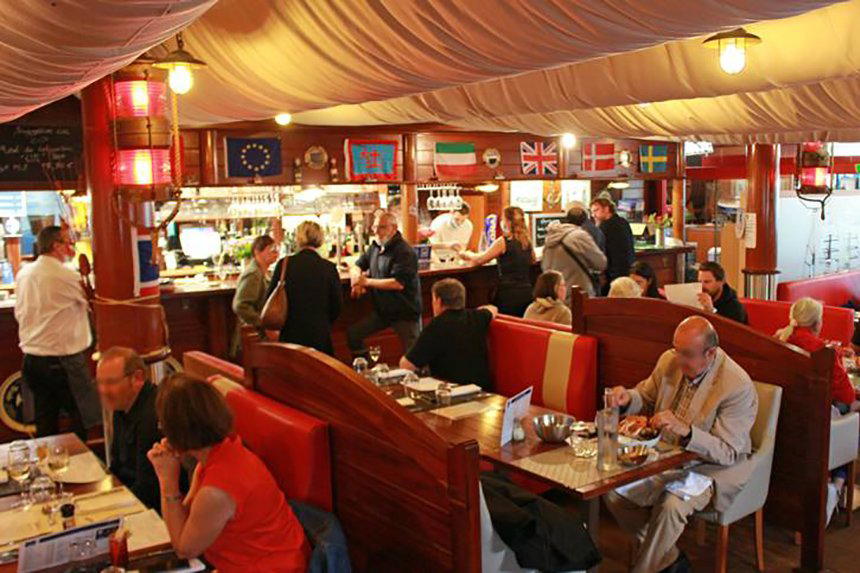
Bubbling ground floor evokes an antique fishing vessel with wooden bar, old Boulogne pictures, and copper details; serene upstairs space.