Tucked into the 1st arrondissement on Rue Chavanne, Le Casse Museau occupies the kind of address that rewards those who pay attention to Lyon's neighbourhood-level dining geography. The street sits within easy reach of the Presqu'île's market culture and its informal bistro tradition, placing this address in a part of the city where local credentials matter more than dining-room spectacle.
Pearl is the En Primeur Club membership app — saves, bookings, and concierge access live there. Same editors, same standards.
- Address
- 2 Rue Chavanne, 69001 Lyon, France
- Phone
- +33478326442
- Website
- lecassemuseau.com
- Directions
- Get directions
 Saves & bookings on Pearl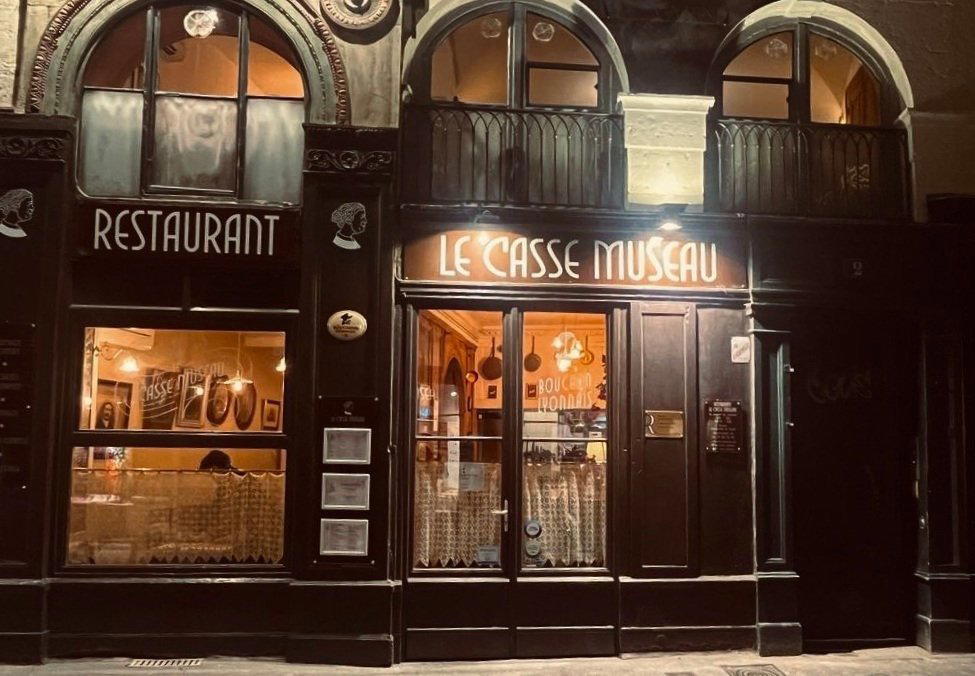
The Street Before the Table
Lyon's 1st arrondissement operates on a different register to the city's more celebrated dining corridors. Where the 2nd arrondissement along the Presqu'île draws the headline names, addresses like La Mère Brazier and the ambitious modern French rooms that have accumulated Michelin recognition over the past decade, the streets around Rue Chavanne tend to filter out visitors without local orientation. That self-selection is part of what defines the dining character here. The 1st is not an area that markets itself. It contains Lyon's working food culture: morning markets, neighbourhood bouchons, and the kind of restaurants that rely on returning residents rather than tourist throughput.
Le Casse Museau sits at 2 Rue Chavanne, inside that geography. The name itself signals something about register: a casse-museau is an old French term for a hard, face-breaking biscuit, the kind of rough-edged language that belongs to Lyon's tradition of direct, unsentimental eating. That tradition runs from the old mères lyonnaises through the canonical bouchon format and into the present, where it coexists with addresses like Le Neuvième Art and Takao Takano at the contemporary end of the city's dining range.
What the Presqu'île Does to a Restaurant
Location inside Lyon's 1st arrondissement carries specific implications for how a restaurant functions. The neighbourhood sits at the northern end of the Presqu'île, the peninsula formed between the Rhône and the Saône, and it has historically been a zone of craft trades, small workshops, and the kind of dense, pedestrian urban fabric that sustains local restaurants rather than destination dining. Proximity to the Quai Saint-Vincent market axis and the streets feeding up toward the Croix-Rousse plateau means the supply chain for serious cooking runs through this part of the city in a literal, daily sense. Producers who sell at Lyon's covered markets are minutes away rather than a delivery away.
That geography shapes what restaurants in this tier of the 1st tend to do with their menus: shorter, more market-responsive formats, where the dish list on a given Tuesday reflects what arrived that morning rather than a fixed seasonal programme printed weeks in advance. It also shapes the room dynamic. These are not addresses built around destination occasion dining of the kind associated with, say, Au 14 Février or Burgundy by Matthieu. They are neighbourhood restaurants in the precise, European sense: places where the same tables fill with the same people across weeks and months, and where the measure of success is that continuity rather than column inches.
Lyon's Bistro Tier in Context
Within Lyon's dining hierarchy, the informal bistro and bouchon tier occupies a position that has no real equivalent in most other French cities. The bouchon specifically is a Lyon creation: a format built around offal-forward Lyonnais specialities, carafes of Beaujolais or Côtes du Rhône, checked tablecloths, and a pace that does not rush. The Interprofession des Bouchons Lyonnais certifies a small number of addresses as authentic, and the certified list skews toward the 1st and 5th arrondissements. But beyond the certified bouchons, there exists a wider bracket of bistros and small restaurants that share the bouchon's values without adhering strictly to its format: pork-heavy starters, quenelles, gratin dauphinois, andouillette, and the kind of wine list that prices by the pot rather than by prestige label.
Le Casse Museau's address places it inside that broader conversation. The name's vernacular weight and the Rue Chavanne location both point toward the informal end of the local dining spectrum, where the point is not to compete with the city's Michelin-tracked rooms but to hold a different kind of position: the local constant, the address a Lyonnais brings an out-of-town friend to demonstrate that the city's serious eating is not confined to white tablecloths. For the wider context of Lyon's dining range, from the historic through to the contemporary, our full Lyon restaurants guide maps the full picture.
France's Broader Bistro Tradition as Reference Point
The informal French restaurant, neither brasserie nor fine dining, operating in a zone defined by technique applied without ceremony, has proven durable across the country's dining evolution. Addresses that represent different registers of that tradition include Auberge de l'Ill in Illhaeusern and Bras in Laguiole at the destination end, or Troisgros in Ouches as an example of a kitchen that bridges deep regional identity with contemporary ambition. Lyon's contribution to this national conversation has been to produce a city where informal eating is not a concession to affordability but a considered preference held even by people who could eat elsewhere. The bouchon persists not because Lyon lacks sophistication but because the city has decided, over generations, that a certain kind of honest, product-led cooking deserves its own institutions.
That context matters when reading an address like Le Casse Museau. The comparison set is not the three-star rooms of Paul Bocuse at Collonges or the creative ambition of Alléno Paris. It sits closer to the informal-but-serious tier that Lyon's 1st arrondissement has sustained across decades, a tier that also has resonances in cities as different as Marseille and Strasbourg, where regional identity shapes the informal register as much as it shapes the fine dining one. For reference points further afield in technical precision applied without formality, Le Bernardin in New York and Atomix represent how different cities handle the question of seriousness without stiffness, while alpine France's approach can be read through Flocons de Sel in Megève and the Mediterranean edge through Mirazur in Menton and Assiette Champenoise in Reims.
Planning a Visit
Le Casse Museau is at 2 Rue Chavanne in Lyon's 1st arrondissement, a short walk from the Hôtel de Ville metro station and within the Presqu'île's walkable core. Given the venue's neighbourhood character and informal register, arriving without a reservation during peak lunch or dinner service carries risk, particularly on weekdays when local regulars tend to fill the room. Contacting the restaurant directly before visiting is the practical approach, especially for groups. The restaurant is recommended for reservations and follows regular service from Tuesday to Saturday, with lunch from 12 to 2 PM and dinner from 7 to 10 PM. It is closed on Monday and Sunday.
Category Peers
Comparable venues nearby, for context on price, style, and recognition.
| Venue | Cuisine | Price | Notes |
|---|---|---|---|
| Le Casse MuseauThis venue — the venue you are viewing | Bouchon Lyonnais | $$ | Not listed |
| Breizh Café - Lyon | Authentic Breton Crêperie & Galettes | $$ | Quartier Bas des Pentes Presqu'île |
| L'arquebuse | Modern French Bistronomic | $$ | Quartier Bas des Pentes Presqu'île |
| Le Bouchon des Filles | Modern Lyonnaise Bouchon | $$ | Quartier Ouest des Pentes |
| Arsenic | Modern French Gastropub | $$ | Quartier Mutualité Préfecture Moncey |
| La Gargotte | French Bistronomie | $$ | Quartier Bas des Pentes Presqu'île |
Continue exploring
More in Lyon
Restaurants in Lyon
Browse all →
Bars in Lyon
Browse all →
Hotels in Lyon
Browse all →

At a Glance
- Classic
- Cozy
- Historic
- Family
- Group Dining
- Business Dinner
- Special Occasion
- Historic Building
- Local Sourcing
- Street Scene
Current opening hours
- Monday
- Closed
- Tuesday
- 12–2 PM, 7–10 PM
- Wednesday
- 12–2 PM, 7–10 PM
- Thursday
- 12–2 PM, 7–10 PM
- Friday
- 12–2 PM, 7–10 PM
- Saturday
- 12–2 PM, 7–10 PM
- Sunday
- Closed
Hours can change for holidays and private events. Last verified .
Subdued and feutrée atmosphere in air-conditioned rooms with a warm, historic charm.