La Valé Normande
Our verdict
La Valé Normande sits on the Place de la Libération in Sotteville-sur-Mer, a small coastal village on the Normandy chalk-cliff coast where the surrounding landscape has long shaped what ends up on the plate. In a region where dairy, apple orchards, and the English Channel define the pantry, this is a dining room that draws its identity from its address rather than from imported trends. It belongs to a tradition of French provincial cooking that remains thoroughly rooted in place.

Pearl is the En Primeur Club membership app — saves, bookings, and concierge access live there. Same editors, same standards.
- Address
- 4 Pl. de la Libération, 76740 Sotteville-sur-Mer, France
- Phone
- +33667864527
- Hours
- Mon–Tue ClosedWed–Thu 12–2 PM, 7–8:30 PMFri–Sun 12–2 PM, 7–9 PM
- Website
- facebook.com
- Directions
- Get directions
The menu
What to order
- Moules au fromage Neufchâtel
- Bulots mayonnaise
- Huîtres de Veules
- Turbot beurre blanc
A Village Square on the Norman Coast
Sotteville-sur-Mer sits on the Alabaster Coast, the stretch of Normandy between Dieppe and Fécamp where chalk cliffs drop sharply to narrow shingle beaches and the horizon is almost always grey-green with the English Channel. The village itself is small enough that Place de la Libération, the central square where La Valé Normande holds its address at number 4, functions less as a civic hub and more as a meeting point for the surrounding farmland and the sea beyond it. Approaching the square from the cliff-leading path, the sense is of a place that has not recalibrated itself for visitors: the rhythm is agricultural and tidal, not tourist. That context matters when thinking about what French provincial dining in a setting like this can mean, and why it differs so structurally from what Alléno Paris au Pavillon Ledoyen or Mirazur in Menton represent at the other end of the French dining spectrum.
What the Normandy Pantry Actually Means
The editorial framing of Normandy as a food region tends to collapse into shorthand: cream, butter, apples, Camembert. That shorthand is not wrong, but it flattens a more specific geography. The Pays de Caux, the plateau above the Alabaster Coast, is one of the most productive agricultural zones in northern France: wheat, sugar beet, and dairy cattle at scale, with apple orchards concentrated in the river valleys running perpendicular to the coast. The Channel itself supplies fish and shellfish that travel very short distances to reach kitchens in villages like Sotteville. The result, in restaurants that take their sourcing seriously, is a pantry defined by proximity rather than prestige: flat-oyster beds from nearby estuaries, sole and turbot landed at Dieppe, cream from farms within a short drive, calvados from orchards rather than supermarket shelves.
This sourcing logic runs counter to the model at destination restaurants such as Flocons de Sel in Megève or Bras in Laguiole, where the kitchen's relationship with its landscape is a documented, award-recognised program. In a small village like Sotteville, the sourcing is often structural rather than philosophical: you cook what is here because it is here. That distinction produces a different register of cooking, one where the ingredient is less likely to be framed and more likely to simply appear.
The Normand Auberge Tradition
The auberge form, a dining room attached to or associated with a square or crossroads in a French village, has survived longer in Normandy than in many other French regions. The format predates the autoroute and the destination-dining economy: it developed when the main traffic through a village was agricultural and commercial rather than leisure-driven, and the kitchen fed travellers and locals on roughly the same terms. What distinguishes the surviving examples of this form from period-piece nostalgia is whether the cooking reflects the actual contemporary supply of the region or whether it has drifted toward a generalised idea of French provincial cuisine detached from specific place.
La Valé Normande, positioned on the Place de la Libération in one of the quieter villages on the Alabaster Coast, sits within this tradition. Its address places it in a peer group that includes coastal auberges and village bistros across the Haute-Normandie, rather than in the competitive set occupied by Auberge de l'Ill in Illhaeusern or Paul Bocuse's Auberge du Pont de Collonges, both of which have absorbed destination-dining expectations into what began as regional formats.
Coastal France Beyond the Destination Circuit
French coastal dining at the awarded end of the spectrum tends to concentrate at specific points: La Rochelle, where Christopher Coutanceau has built a documented seafood program; Noirmoutier, where La Marine applies a precise, ingredient-led approach to Atlantic produce; and at the southern extreme, Menton. The Normandy coast has not produced an equivalent destination anchor in recent decades, which means the better cooking in villages like Sotteville circulates primarily by local reputation rather than by award or editorial coverage.
That absence of coverage does not indicate an absence of quality. It reflects the structural economics of recognition: Michelin and the major guides concentrate their attention where the density of restaurants justifies sustained inspection circuits, and a village of a few hundred residents on a chalk cliff above a shingle beach does not fit that model. The cooking that exists in these gaps between the inspection circuits is often the most direct expression of what a French region actually tastes like, stripped of the pressures that come with formal recognition. For comparison, the recognised end of French regional cooking, represented by tables such as Troisgros in Ouches, Auberge du Vieux Puits in Fontjoncouse, or Assiette Champenoise in Reims, operates under very different conditions of expectation and resource. The village dining room is a different genre entirely.
Planning a Visit to Sotteville-sur-Mer
Sotteville-sur-Mer is accessible from Dieppe, roughly 25 kilometres to the northeast, and from Rouen, the regional capital, which sits approximately 60 kilometres inland via the D925. Public transport connections to the village are limited, making a car the practical choice for most visitors coming from outside the immediate area. The village itself is a seasonal destination: the Alabaster Coast draws walkers and cyclists in spring and early summer, and the clifftop paths are most manageable between April and October. Visitors combining La Valé Normande with the broader Normandy circuit, which might include the markets at Dieppe or the abbey at Fécamp, will find the village a logical stopping point rather than a standalone destination requiring dedicated travel. For context on the wider Sotteville-sur-Mer dining picture, see our full Sotteville-sur-Mer restaurants guide.
Frequently asked questions
Is La Valé Normande good for families?
The village-square setting on Place de la Libération in Sotteville-sur-Mer points toward a relaxed, community-rooted format rather than a high-formality dining room. Visiting outside peak summer weekends will give families more room and a calmer pace on the square.
Is La Valé Normande better for a quiet night or a lively one?
Sotteville-sur-Mer is a small Alabaster Coast village with a permanent population in the hundreds, so La Valé Normande's position on the central square is more likely to produce convivial neighbourhood energy than late-night noise. Summer evenings, when the coast draws visitors from Dieppe and Rouen, will be the most animated. Off-season midweek visits tend toward the quieter end of the dial.
Is La Valé Normande worth visiting as a day trip from Rouen or Dieppe?
Sotteville-sur-Mer sits roughly 25 kilometres southwest of Dieppe and approximately 60 kilometres from Rouen, making it a plausible half-day excursion when combined with a walk along the chalk-cliff shoreline. La Valé Normande's position on the village's central square, Place de la Libération, makes it a natural end point for that circuit. The Alabaster Coast is at its most accessible between May and September, when the coastal roads are clear and the cliffs are safely walkable.
What's the signature dish at La Valé Normande?
The broader Norman culinary framework in this part of the Alabaster Coast leans on cream, cider, locally landed fish, and aged cheeses from the hinterland, and a village auberge at this location would typically draw on those same foundations. Contacting the venue directly before visiting is the practical route to current menu details.
Where do I go for La Valé Normande?
La Valé Normande is located at 4 Pl. de la Libération, 76740 Sotteville-sur-Mer, France, Sotteville Sur Mer.
Should I book La Valé Normande in advance?
Sotteville-sur-Mer is a small village with limited dining options, meaning La Valé Normande on Place de la Libération absorbs most local and passing demand, particularly across July and August when the Alabaster Coast sees its highest visitor numbers. Booking ahead for weekend dinners in summer is prudent.
How It Stacks Up
Comparable venues nearby, for context on price, style, and recognition.
| Venue | Cuisine | Price | Notes |
|---|---|---|---|
| La Valé NormandeThis venue — the venue you are viewing | Traditional Norman Seafood | $20–30 | Not listed |
| Food Truck Comme autrefois | French Food Truck Rôtisserie | $10–20 | Rouen |
| Gill Côté Bistro | Traditional French Bistro with Norman Specialties | Not listed | Vieux Marché |
| La Pile d'Assiettes | Creative French Bistro | $30–50 | Centre-ville |
| Chez Gladines Batignolles | Basque & Southwestern French Bistro | $20–30 | Batignolles-Monceau |
| La Terrasse | Traditional French Seafood | $30–50 | Varengeville-sur-Mer |
Continue exploring
More in Sotteville Sur Mer
Restaurants in Sotteville Sur Mer
Browse all →
Hotels in Sotteville Sur Mer
Browse all →
Wineries in Sotteville Sur Mer
Browse all →
Details
- Cozy
- Rustic
- Classic
- Family
- Casual Hangout
- Date Night
- Terrace
- Standalone
- Local Sourcing
- A La Carte
- Pescatarian Friendly
Current opening hours
- Monday
- Closed
- Tuesday
- Closed
- Wednesday
- 12–2 PM, 7–8:30 PM
- Thursday
- 12–2 PM, 7–8:30 PM
- Friday
- 12–2 PM, 7–9 PM
- Saturday
- 12–2 PM, 7–9 PM
- Sunday
- 12–2 PM, 7–9 PM
Hours can change for holidays and private events. Last verified .
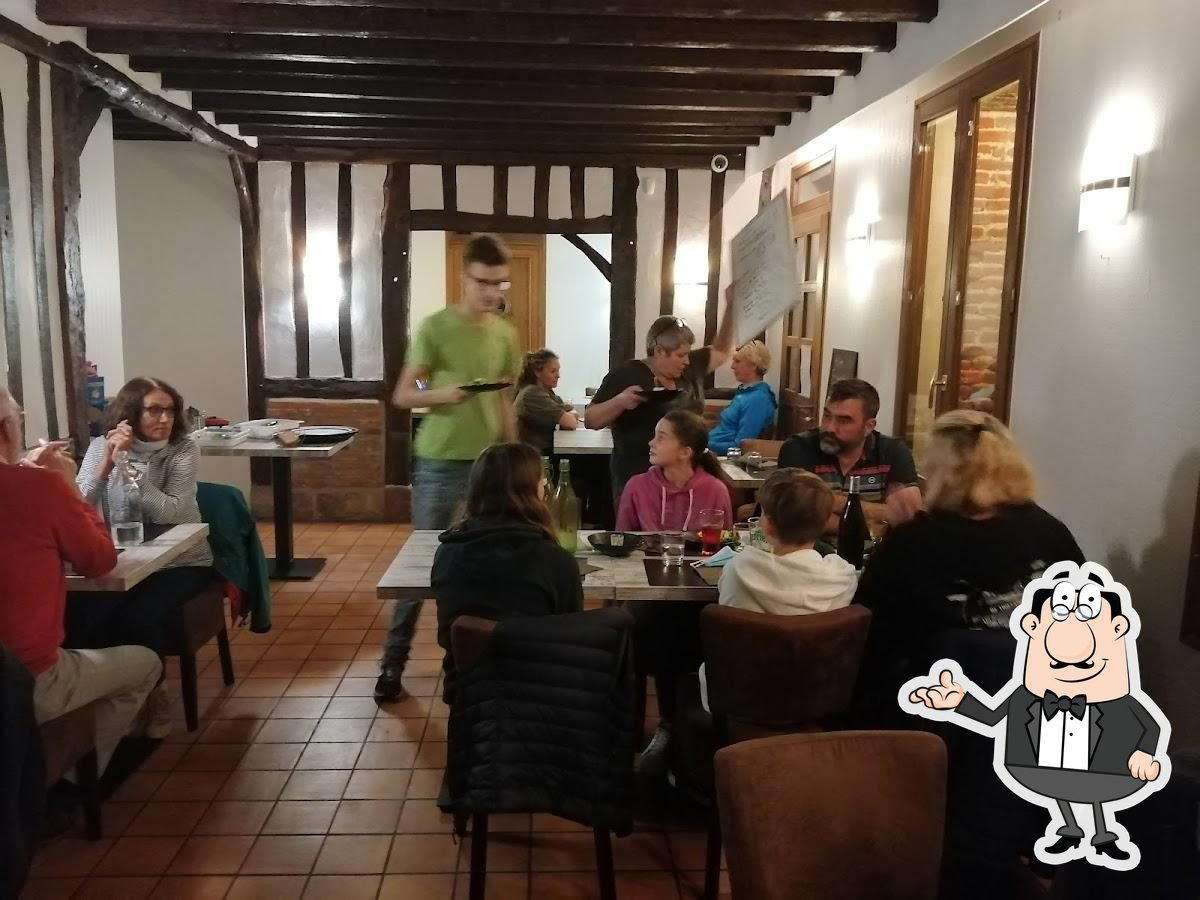
Relaxed and welcoming atmosphere with good humor, authentic village setting in a brick and slate building that contributes to a comfortable dining experience.