Our verdict
The restaurant takes its name from the town's prized indigenous breed, the Houdan hen, a dual-purpose bird with a culinary reputation stretching back centuries. For those tracing France's provincial cooking from source to plate, this address is a fixed reference point.

Pearl is the En Primeur Club membership app — saves, bookings, and concierge access live there. Same editors, same standards.
- Address
- 24 Av. de la République, 78550 Houdan, France
- Phone
- +33130596050
- Hours
- Mon–Wed ClosedThu–Fri 11:30 AM–3 PM, 7:30–10 PMSat 11:30 AM–3 PM, 7:30–10:30 PMSun 10 AM–4 PM
- Website
- alapoularde.com
- Directions
- Get directions
The menu
What to order
- Pâté-Croûte de Houdan
- Salade de Homard Tiède
- Cuisse-au-Pot de Poulette au Jus de Truffes
A Town, a Bird, and a Long Culinary Argument
Houdan, a market town roughly 55 kilometres west of Paris in the Yvelines department, has given its name to one of France's oldest recognised poultry breeds. The Houdan hen, distinguishable by its crest and five-toed foot, was a fixture on Parisian tables through the 19th century, prized for flesh that cooks and food writers of the period described as dense-textured and markedly flavoured compared to the lighter commercial birds that would eventually displace it. That displacement is the central tension any restaurant bearing this bird's name must answer.
France's broader conversation about ingredient sourcing has accelerated in the decades since nouvelle cuisine encouraged chefs to look at their suppliers as collaborators. The restaurants now considered benchmarks in that tradition, places like Bras in Laguiole, where the Aubrac plateau is the kitchen's primary reference, or Mirazur in Menton, where the restaurant's own gardens and coastal geography shape the menu, have demonstrated that place-specific sourcing is not a marketing position but a structural one. It changes what a kitchen can and cannot cook. For a smaller provincial address like La Poularde de Houdan, that principle operates at closer range: the bird is local, the tradition is local, and the cooking exists to make that visible.
The Houdan Breed as a Sourcing Category
Understanding why a restaurant built around a single breed matters requires a brief step back into French agricultural classification. The Houdan is listed among France's heritage poultry breeds and was at various points in the 19th century one of the most commercially significant birds sent to Les Halles in Paris. Its fall from commercial prominence followed the same pattern seen across artisan livestock categories throughout the 20th century: industrial farming favoured faster-growing, higher-yielding breeds, and the slower, more expensive heritage birds retreated to specialist producers and regional kitchens. The recovery of such breeds since the 1990s has been uneven, driven partly by AOC and Label Rouge frameworks that created protected status for specific production methods in French poultry, most famously the Bresse chicken, and partly by chef demand for differentiated product.
In that context, a restaurant in Houdan working with its namesake bird occupies a niche that the largest French tables in Paris, like Alléno Paris au Pavillon Ledoyen, would likely source as a single line item rather than a conceptual anchor. Provincial restaurants with deep roots in a specific ingredient category tend to operate differently: the sourcing is not a selling point layered over a broader menu but the structural premise of the whole operation. This is the tradition La Poularde de Houdan sits within, alongside establishments like Georges Blanc in Vonnas, where Bresse poultry and Burgundy-adjacent terroir have defined the kitchen's identity across generations, or Auberge de l'Ill in Illhaeusern, where Alsatian produce and a singular regional product base have sustained the restaurant's authority for decades.
Approaching the Address
Houdan's town centre retains the proportions of a Île-de-France market town: modest in scale, anchored by its covered market hall, and oriented around agricultural commerce rather than tourism infrastructure. That continuity between address and agricultural identity matters for how the meal reads: the bird on the plate and the town around the table are in direct conversation. For visitors driving from Paris, the A13 and then the D983 provide the most direct route, placing the restaurant within a comfortable lunch drive from the western edge of the city. Houdan does not have a train station on the main RER network, so a car or taxi from Versailles or Montfort-l'Amaury is the practical option for those without a vehicle.
Provincial restaurants operating at this price positioning and format, where the cooking is structured around a named regional product rather than around a chef's tasting menu ambitions, tend to work leading when visited with an understanding of what the format delivers. It sits closer to the tradition of the auberge: ingredient-first, region-rooted, and measured against depth of product knowledge rather than technical innovation. That comparison holds across French provincial cooking from Alsace to the Atlantic coast; Auberge du Vieux Puits in Fontjoncouse and Christopher Coutanceau in La Rochelle operate in the same broad tradition of place-specific sourcing, though with different price tiers and recognition levels. For further reference on the broader French dining scene, see our full Houdan restaurants guide.
Internationally, the closest analogues for this style of place-and-ingredient-specific commitment, where one sourcing decision shapes the entire culinary identity, can be found in kitchens as different as Le Bernardin in New York City, built entirely around the discipline of seafood, or AM par Alexandre Mazzia in Marseille, where a specific coastal and cultural geography drives every plate. The scale and ambition differ, but the underlying logic, that an ingredient or place can be the architecture rather than the decoration, is consistent. Also worth noting in this context: La Marine in Noirmoutier-en-l'île, L'Oustau de Baumanière in Les Baux, Paul Bocuse - L'Auberge du Pont de Collonges in Collonges-au-Mont-d'Or, Au Crocodile in Strasbourg, Troisgros - Le Bois sans Feuilles in Ouches, and Atomix in New York City each represent, in their own regional or international context, the discipline of letting sourcing set the terms of the menu.
What to Expect When You Sit Down
What the restaurant's name and location do confirm is a strong presumption toward the namesake poultry, prepared in the classical French tradition that Houdan's agricultural heritage suggests: roasting, slow cooking methods that honour the breed's denser muscle structure, and saucing that reflects the Île-de-France's proximity to both Normandy's dairy production and the Loire's vegetable-growing zones. Heritage-breed poultry cooked at this level of regional specificity tends to reward patience at table, as the preparation times are longer and the results are structural rather than delicate. Visitors accustomed to the speed and architectural plating of Paris tasting menus should calibrate their expectations toward a slower, more classically-paced service.
Planning Your Visit
Given the town's profile and the restaurant's name recognition within regional French gastronomy circles, reservations in advance are advisable, particularly for weekend lunch, which is the dominant format for destination dining of this type in provincial France. Phone and website details should be verified directly before travelling.
Frequently asked questions
Is La Poularde de Houdan suitable for children?
The restaurant's premise centres on classic French poultry preparation rooted in a specific regional breed, which translates to a fairly traditional, sit-down dining format typical of Île-de-France market town restaurants. That context suits families comfortable with a structured meal rather than a casual drop-in setting. Houdan itself is a quiet town, so the pace is unhurried. For specific children's menu options, contacting the restaurant directly at its address on Avenue de la République is the reliable route.
What kind of setting is La Poularde de Houdan?
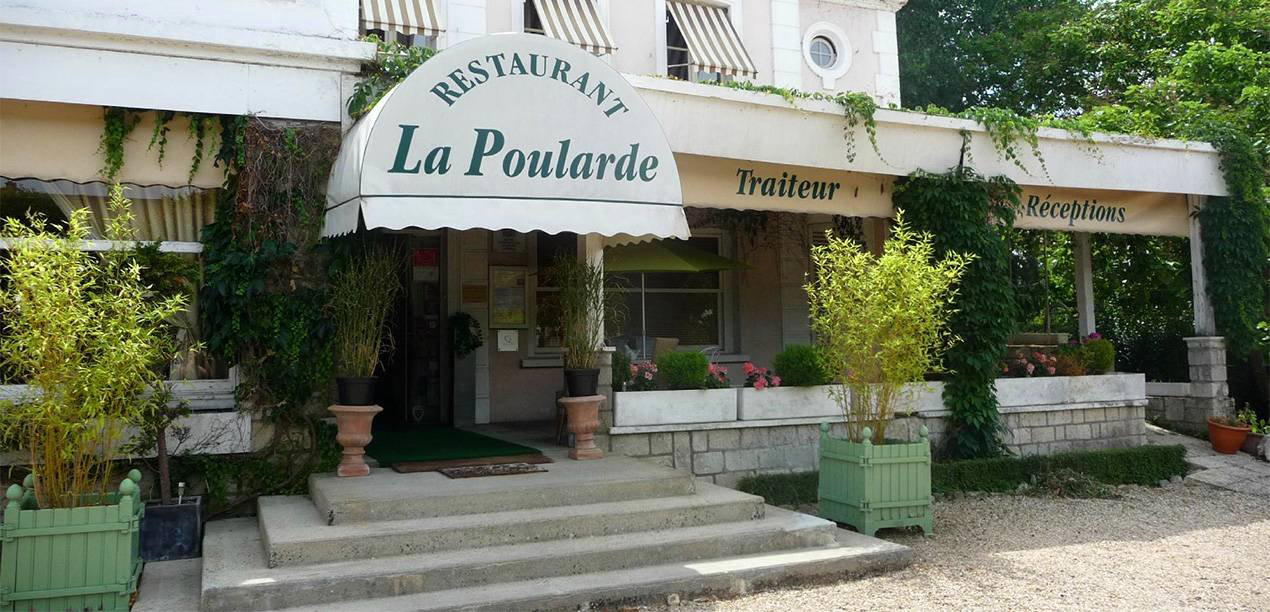
The restaurant sits at 24 Avenue de la République in Houdan, a modest market town in the Yvelines department roughly 55 kilometres west of Paris. Market towns of this scale in Île-de-France typically anchor their dining rooms around the weekly market rhythm, producing a room that reads as local institution rather than destination showcase. Expect proportions and formality consistent with a well-established provincial French table.
How far is La Poularde de Houdan from Paris, and is it worth the trip as a standalone destination?
Houdan sits approximately 55 kilometres west of Paris in the Yvelines department, reachable by car in under an hour from the capital depending on traffic. The restaurant's identity is built around the Houdan poultry breed, a classification with genuine agricultural standing in French culinary tradition, which gives the address a clearer reason-to-travel than a generic regional table would. Pairing the meal with Houdan's covered market — the town's historic commercial anchor — makes the excursion coherent as a half-day out of Paris.
What dish is La Poularde de Houdan famous for?
The name is the signal: the Houdan breed, one of France's oldest officially recognised poultry varieties, is the organising principle of the menu. The poularde — a fattened hen prepared according to classical French technique — is the reference point the restaurant is built around. The Houdan bird carries a specific agricultural classification that distinguishes it from generic Label Rouge poultry, making breed provenance a sourcing argument, not just a marketing note.
Where is La Poularde de Houdan in Houdan?
La Poularde de Houdan is located at 24 Av. de la République, 78550 Houdan, France, Houdan.
A Quick Peer Check
Comparable venues nearby, for context on price, style, and recognition.
| Venue | Cuisine | Price | Awards | Notes |
|---|---|---|---|---|
| La Poularde de HoudanThis venue — the venue you are viewing | Traditional French Gastronomic with Houdan Poultry | $30–50 | Not listed | Not listed |
| Bienheureux | Modern French Creative | Not listed | Michelin Plate | Wasquehal |
| Momento | Modern French-Mexican Fusion | $50–100 | Star Wine List | Bué |
| Brumaire | Modern French Brasserie | $50–100 | Not listed | Parc de Saint-Cloud |
| Pasco | Mediterranean-Influenced French Bistronomic | $30–50 | Not listed | Gros-Caillou |
| Momen | Modern French Bistronomy | $50–100 | Not listed | Paris 08 |
Continue exploring
More in Houdan
Restaurants in Houdan
Browse all →
Hotels in Houdan
Browse all →
Wineries in Houdan
Browse all →
Details
- Classic
- Elegant
- Rustic
- Special Occasion
- Business Dinner
- Terrace
- Historic Building
- Local Sourcing
- Organic
- Garden
- A La Carte
Current opening hours
- Monday
- Closed
- Tuesday
- Closed
- Wednesday
- Closed
- Thursday
- 11:30 AM–3 PM, 7:30–10 PM
- Friday
- 11:30 AM–3 PM, 7:30–10 PM
- Saturday
- 11:30 AM–3 PM, 7:30–10:30 PM
- Sunday
- 10 AM–4 PM
Hours can change for holidays and private events. Last verified .
Elegant and refined atmosphere in a stone pavilion with lush park surroundings, offering a civilized, old-fashioned charm and cozy classic cellar.