Our verdict
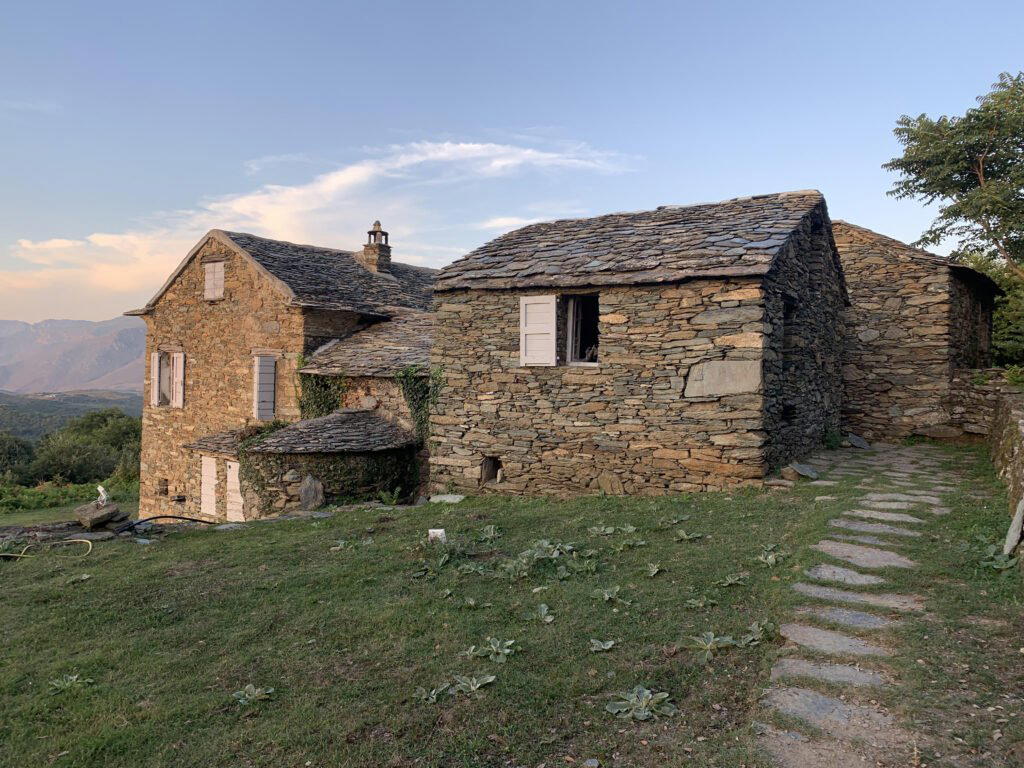
Ferm Campo di Monte sits in the hill village of Murato, in Haute-Corse, where the sourcing of ingredients from the surrounding Corsican terrain shapes the kitchen's identity as much as any technique. The address alone, Campo di Monte, at the edge of one of the island's most historically rooted communes, signals a deliberate orientation toward place. For travellers tracing France's tradition of rurally anchored, ingredient-led cooking, Murato offers a counterpoint to the mainland circuit.

Pearl is the En Primeur Club membership app, where members save venues, book tables and use the concierge.
The menu
What to order
- Zuppa corsa
- Charcuterie
- Beignets de fromage frais
Murato and the Logic of Eating Where Things Grow
Corsica's interior has never competed for the same dining attention as the island's coastal resorts or its larger towns like Bastia and Ajaccio. That gap is partly practical, the mountain communes are harder to reach, seasonally variable, and rarely the subject of the editorial coverage that drives reservation queues. But it also reflects a genuine difference in culinary logic. Where coastal Corsica trades on seafood and tourist throughput, the inland villages of Haute-Corse operate on a slower axis: chestnut groves, maquis-fed livestock, aged cheeses, and a farming calendar that still dictates what appears on the table. Ferm Campo di Monte, addressed at Campo di Monte in the commune of Murato at 20239, sits inside that tradition rather than adjacent to it.
Murato itself is a village of modest scale, positioned at roughly 500 metres above sea level in the Nebbio region, a pocket of Corsica characterised by schist ridgelines, olive cultivation, and a density of agricultural production that punches above the area's population size. The church of San Michele de Murato, a 12th-century Pisan Romanesque structure in green and white polychrome stone, is the most visited landmark, and the village draws visitors who are already oriented toward landscape and history rather than resort amenity. That is the reader profile arriving at a table here: not someone passing through for a quick meal, but someone who has made Murato a destination.
Ingredient Sourcing as the Central Argument
The tradition of French country cooking that runs from Bras in Laguiole to Auberge du Vieux Puits in Fontjoncouse shares a structural conviction: that place-specific ingredients, sourced at short distance, produce cooking that cannot be replicated by importing the same techniques to a different address. Corsica's terrain makes that argument even more pointed. The island's livestock breeds, its indigenous chestnut flour traditions, its wild herbs, brocciu cheese from Corsican sheep and goat milk, figatellu cured pork sausage, nepita (a local variety of calamint used the way mainland France uses thyme), are not items available from a national wholesaler. They are specific to the island's microclimate and smallholder economy.
Restaurants in Haute-Corse's rural communes that take this seriously occupy a distinct tier in French regional dining: not the starred urban rooms of Alléno Paris au Pavillon Ledoyen in Paris or the resort destination model of Le 1947 à Cheval Blanc in Courchevel, but something more akin to what L'Oustau de Baumanière in Les Baux represents in Provence: a table whose authority derives from its agricultural surroundings as much as from kitchen craft. The comparison matters because it frames the appropriate expectations. You are not arriving at a cosmopolitan room. You are arriving at a place where the sourcing radius defines the menu.
The Broader French Rural Dining Tradition
France's culinary identity at the institutional level is anchored in grand maisons: the lineages of Paul Bocuse - L'Auberge du Pont de Collonges in Collonges-au-Mont-d'Or, the generational continuity of Auberge de l'Ill in Illhaeusern, the regional ambassadorship of Georges Blanc in Vonnas. But alongside that canon runs a parallel tradition of smaller, place-embedded tables that have never sought or received that level of institutional recognition, and that draw a different kind of traveller precisely because of it. Maison Lameloise in Chagny and Troisgros - Le Bois sans Feuilles in Ouches represent the former category; a ferme-restaurant in a Corsican hill commune represents the latter.
The ferme-restaurant format, a working or formerly working farm property that opens a table anchored in its own production, is not unique to Corsica, but the island gives it a particular intensity. The compressed geography and the relative difficulty of importing mainland supply chains mean that sourcing from the immediate territory is less a philosophy than a practical starting point. For the reader comparing options against Mirazur in Menton or Flocons de Sel in Megève, Ferm Campo di Monte sits at a different point on the axis: less technically elaborate, more territorially specific, and operating at a scale where the sourcing story is legible at the table.
Getting to Murato: Planning Notes
Murato is approximately 20 kilometres south of Bastia, the principal city of Haute-Corse and the island's main ferry port for connections from Marseille, Nice, and Genoa. Bastia also has its own airport (Aéroport de Bastia-Poretta), with seasonal direct flights from Paris Charles de Gaulle and several other French cities, making late spring through early autumn the most accessible window for international visitors. The road from Bastia into the Nebbio hills takes under 30 minutes by car; there is no practical public transport link to Murato village, so a rental car or private transfer is the standard approach. For a broader orientation to the dining options in the area, our full Murato restaurants guide maps the local context in more detail. Those travelling between Corsica and the French Riviera coast may also consider Mirazur in Menton as a mainland reference point before or after the island portion of a trip.
Frequently asked questions
Is Ferm Campo di Monte good for families?
A farm-based setting in the village of Murato, roughly 20 kilometres south of Bastia, points toward an informal, unhurried format that tends to suit families better than formal tasting-menu restaurants. The rural Corsican interior context suggests space and pace over city-restaurant compression. check the venue's official channels to confirm seating arrangements and any children's options before visiting.
What's the vibe at Ferm Campo di Monte?
The address at Campo di Monte, 20239 Murato places this firmly in Corsica's quiet interior hill country, away from the coastal resort circuit. The setting reads as agricultural and grounded rather than polished or theatrical. Expect a register closer to a working farm table than a destination dining room.
How far is Ferm Campo di Monte from Bastia, and what is the best way to reach it?
Ferm Campo di Monte is located at Campo di Monte, 20239 Murato, approximately 20 kilometres south of Bastia, which is the principal ferry and transport hub of Haute-Corse. The route runs through hill road terrain typical of Corsica's interior, so a hire car is the practical option. Bastia also connects by ferry from Marseille, Toulon, Genoa, and Livorno, making it the logical arrival point for visitors combining this area with broader island travel.
What should I order at Ferm Campo di Monte?
In Corsica's hill villages, that typically means charcuterie, local cheese, foraged herbs, and meat from animals raised on-site or nearby. Verify current offerings directly with the venue.
Where exactly is Ferm Campo di Monte?
Ferm Campo di Monte is located at Campo Di Monte, 20239 Murato, France, Murato.
Do I need a reservation for Ferm Campo di Monte?
Farm restaurants in rural Corsica, particularly those operating in small interior villages like Murato, almost universally require advance booking given limited covers and supply tied to daily harvest.
What do critics highlight about Ferm Campo di Monte?
Its position in Murato, a village that sits outside the main Corsican dining commentary focused on Bastia and Ajaccio, means it operates largely below the institutional radar. That absence from the awards circuit is itself a signal about the kind of place it is: local, functional, and not optimised for critical attention.
At-a-Glance Comparison
| Venue | Cuisine | Price | Awards | Notes |
|---|---|---|---|---|
| Ferm Campo di MonteThis venue (the venue you are viewing) | Traditional Corsican Farmhouse | $50–100 | Not listed | Not listed |
| Mirazur | Modern French Fine Dining | $300–500 | 3 Michelin Stars · World's 50 Best #1 | Modern French, Creative |
| Alléno Paris au Pavillon Ledoyen | Modern French Fine Dining | $150–200 | 3 Michelin Stars · World's 50 Best #79 | Creative |
| Kei | Modern French with Japanese Influences | $300–500 | 3 Michelin Stars · World's 50 Best #93 | Contemporary French, Modern Cuisine |
| L'Ambroisie | Classic French Haute Cuisine | $300–500 | 2 Michelin Stars · World's 50 Best #23 | French, Classic Cuisine |
| Le Cinq - Four Seasons Hôtel George V | Modern French Fine Dining | $300–500 | 3 Michelin Stars · World's 50 Best #24 | French, Modern Cuisine |
Continue exploring
More in Murato
Restaurants in Murato
All restaurants in Murato →
Hotels in Murato
Browse all →
Wineries in Murato
Browse all →
Details
- Rustic
- Cozy
- Intimate
- Scenic
- Special Occasion
- Family
- Garden
- Local Sourcing
- Mountain
- Street Scene
- Set Menu
Warm and authentic atmosphere in small, simple, stylish rooms of converted farm buildings with garden aperitifs.