LA Cha Cha Cha

<strong>LA Cha Cha Cha</strong> belongs to the Los <strong>Angeles Mexican</strong> conversation that treats masa, regional technique, and contemporary dining room polish as compatible rather than competing ideas. Its 2026 <strong>Opinionated About</strong> Dining <strong>Casual Recommended</strong> citation places it in a peer set beyond neighborhood utility, while the <strong>Arts District</strong> address puts it near one of the city’s densest restaurant corridors.
 Discover on Pearl
Pearl is the En Primeur Club membership app — saves, bookings, and concierge access live there. Same editors, same standards.
Arts District Mexican dining through the lens of masa
East 3rd Street in Los Angeles changes texture block by block: former industrial buildings, gallery traffic, destination restaurants, and the practical churn of downtown logistics all sit close together. That physical context matters for Mexican dining here, because the Arts District has become one of the city’s clearest tests of how a cuisine rooted in corn, fire, and regional memory behaves inside a polished urban dining format. LA Cha Cha Cha, at 812 East 3rd St, enters that conversation as a Mexican restaurant with Alejandro Guzman named as chef and a 2026 Opinionated About Dining Casual in North America Recommended citation. The useful question is not whether Los Angeles needs another Mexican restaurant. It is what kind of Mexican restaurant can hold attention in a city where tacos, mariscos, moles, carnitas, and masa culture already have deep, demanding audiences.
In Los Angeles, corn is not a decorative reference. It is the grammar. The city’s Mexican cooking is shaped by taquerias that prove the value of a properly handled tortilla, by Yucatecan kitchens where achiote and citrus carry regional logic, by carnitas specialists that treat texture as a craft, and by contemporary restaurants trying to bring that vocabulary into rooms built for longer meals. The better contemporary Mexican tables in the city are judged less by ornament and more by whether masa, salsa, char, acidity, and heat retain their force when service, design, and drinks become part of the equation.
That is where the Arts District format becomes interesting. A restaurant in this part of Los Angeles cannot rely only on nostalgia, because the audience includes locals who know the city’s Mexican food culture intimately and visitors using downtown as a dining base. It also cannot abandon the fundamentals in pursuit of a sleek room. Masa is the pressure point. Nixtamalization, the alkaline cooking process that turns corn into dough with aroma, nutrition, and elasticity, sits behind tortillas, tostadas, sopes, tamales, and countless regional forms. When a contemporary Mexican restaurant takes corn seriously, the meal reads differently: sauces have structure, grilled proteins have a proper vehicle, and the table feels anchored rather than assembled from fashionable parts.
Why corn still decides the room
Los Angeles has helped make masa literacy part of mainstream dining discussion. Diners now ask whether tortillas are made in house, whether heirloom corn is being used, whether the masa has the pliability and fragrance to carry a dish rather than act as filler. Those questions were once reserved for specialists and Mexican households; now they shape how a casual-but-ambitious Mexican restaurant is read by critics and regulars alike. The shift has been good for the city, because it rewards craft that was long treated as invisible labor.
The OAD Casual Recommended designation in 2026 is a trust signal, but it should be read carefully. Opinionated About Dining’s casual category does not imply fine-dining formality; it points to restaurants whose cooking, coherence, and overall experience justify attention within a broader North American field. In a Los Angeles context, that places LA Cha Cha Cha closer to the city’s contemporary Mexican peer group than to purely utilitarian taco-counter culture. It is a different lane from the carnitas devotion at Carnitas El Momo, the live-fire meat focus at Carnes Asadas Pancho Lopez, or the regional Yucatecan clarity at Chichen Itza. Those comparisons matter because Los Angeles Mexican dining is not a single hierarchy; it is a set of overlapping specialties.
The contemporary dining-room version also carries a burden. When Mexican food moves into higher-design urban rooms, the risk is that the tortilla becomes a prop and the cuisine is flattened into a generalized idea of Latin style. The stronger version does the opposite: it uses the room to slow the meal down while keeping the agricultural and regional foundations legible. A corn-forward editorial lens is therefore not romantic. It is practical criticism. If the masa, salsas, acidity, and sequencing feel coherent, the restaurant has earned its format. If they do not, polish can make the problem louder.
Los Angeles peers, from downtown dining rooms to specialist counters
Downtown and the east side have become useful territory for comparing Mexican formats because they compress so many versions of the cuisine into a manageable radius. The afterlife of modern Mexican dining in Los Angeles includes the influence of places such as Broken Spanish, which helped make Mexican cooking a serious subject in the city’s higher-profile restaurant discourse. Westside and coastal formats, including Chulita, tend to read differently, often shaped by neighborhood rhythm, cocktails, and daytime-to-evening flexibility. The downtown table has to absorb a more concentrated restaurant audience: office-adjacent diners, Arts District regulars, hotel guests, and people crossing the city for a specific reservation.
That competitive set is not limited to Mexican restaurants. Los Angeles diners increasingly compare a Mexican dining room with any other serious casual restaurant in the city, asking whether the cooking has the same clarity of intent found in Japanese, Korean, Italian, Californian, or Middle Eastern rooms. That pressure can be productive. It pushes Mexican restaurants away from the false choice between street-food authenticity and tasting-menu ambition. The better middle tier is neither museum nor spectacle; it is a restaurant where masa, seafood, meats, vegetables, cocktails, and service move with enough discipline to justify a night out.
National comparisons sharpen the point. Mexico City’s contemporary Mexican conversation, represented internationally by Pujol — Mexican in Mexico City, has made heirloom corn, indigenous technique, and modern presentation part of a global dining language. In the United States, restaurants such as Alma Fonda Fina — Mexican in Denver show how regional Mexican ideas can gain attention outside the coastal capitals. Los Angeles, however, is judged by a stricter internal standard because Mexican food is not imported prestige here. It is daily culture, family culture, street culture, and restaurant culture at once.
What the OAD citation tells a serious diner
The 2026 Opinionated About Dining Casual in North America Recommended listing gives a clear, verifiable marker without overstating the case. It does not supply a rank in the data, and the price range is not listed, so the sensible reading is qualitative rather than numerical: this is a restaurant that has entered a North American conversation about casual dining worth tracking. For Los Angeles, that matters because the city’s restaurant attention is fragmented. Michelin, local critics, national magazines, social media, and specialist lists often reward different things. OAD’s casual category is useful because it can capture restaurants that do not fit the white-tablecloth model yet have enough identity to matter.
Alejandro Guzman’s name appears in the OAD record as chef, and that credential should be kept in proportion. Chef attribution helps establish authorship, but the more interesting story is how a Mexican restaurant in the Arts District participates in the city’s broader masa-era shift. The chef’s role, in this reading, is not a personal mythology. It is evidence that the kitchen has a named culinary lead inside a category where execution and consistency are heavily scrutinized.
Compared with tasting-menu institutions such as Benu in San Francisco, Le Bernardin in New York City, The French Laundry in Napa, Single Thread Farm in Healdsburg, and Smyth in Chicago, the casual Mexican dining room operates by different rules. Precision is not expressed through choreographed luxury signals alone; it is expressed through whether foundational elements arrive with purpose and whether the format lets guests eat naturally. A restaurant like Emeril’s in New Orleans offers another useful contrast: city identity can support a restaurant for decades, but only if the kitchen’s grammar remains legible to people who know the local language.
Planning the meal in downtown Los Angeles
The practical data is limited, which is itself useful for planning. The venue record lists the address as 812 East 3rd St in Los Angeles, California, but does not provide phone number, website, hours, dress code, seat count, booking method, or price range. That means diners should verify current operating details directly through current public channels before setting plans around a specific evening. In downtown Los Angeles, traffic patterns and event schedules can alter arrival time sharply, so the smarter approach is to treat the Arts District as a full-neighborhood outing rather than a last-minute cross-town dash.
Price is not available in the database, so it should not be assumed. The OAD casual recognition suggests the restaurant belongs to a quality-conscious dining tier rather than a purely budget-driven stop, but that is not the same as a published check average. Families, groups, and visitors should read the absence of listed price data as a reason to confirm menus and policies in advance. For broader planning across the city, Our full Los Angeles restaurants guide is the natural companion, while travelers building a downtown stay can cross-reference Our full Los Angeles hotels guide, Our full Los Angeles bars guide, Our full Los Angeles wineries guide, and Our full Los Angeles experiences guide.
For readers deciding whether this is the right Mexican meal in Los Angeles, the key is category fit. Choose LA Cha Cha Cha when the brief is contemporary Mexican dining in the Arts District, with enough recognition to justify attention from travelers who follow restaurant lists. Choose a specialist counter or regional institution when the goal is a narrower study of carnitas, carne asada, Yucatecan cooking, or another form with fewer design-room expectations. Los Angeles rewards both approaches, but confusing them leads to bad comparisons.
- aguachiles
- rockfish al pastor tacos
- Pollo tacos
- Chorizo tacos
- Hongos mushroom tacos
- churro dessert
Continue exploring
More in Los Angeles
Restaurants in Los Angeles
Browse all →
Bars in Los Angeles
Browse all →

Hotels in Los Angeles
Browse all →

Wineries in Los Angeles
Browse all →
At a Glance
- Trendy
- Lively
- Scenic
- Industrial
- Romantic
- Energetic
- Date Night
- Group Dining
- Celebration
- Special Occasion
- After Work
- Private Event
- Rooftop
- Terrace
- Panoramic View
- Design Destination
- Standalone
- Craft Cocktails
- Local Sourcing
- Skyline
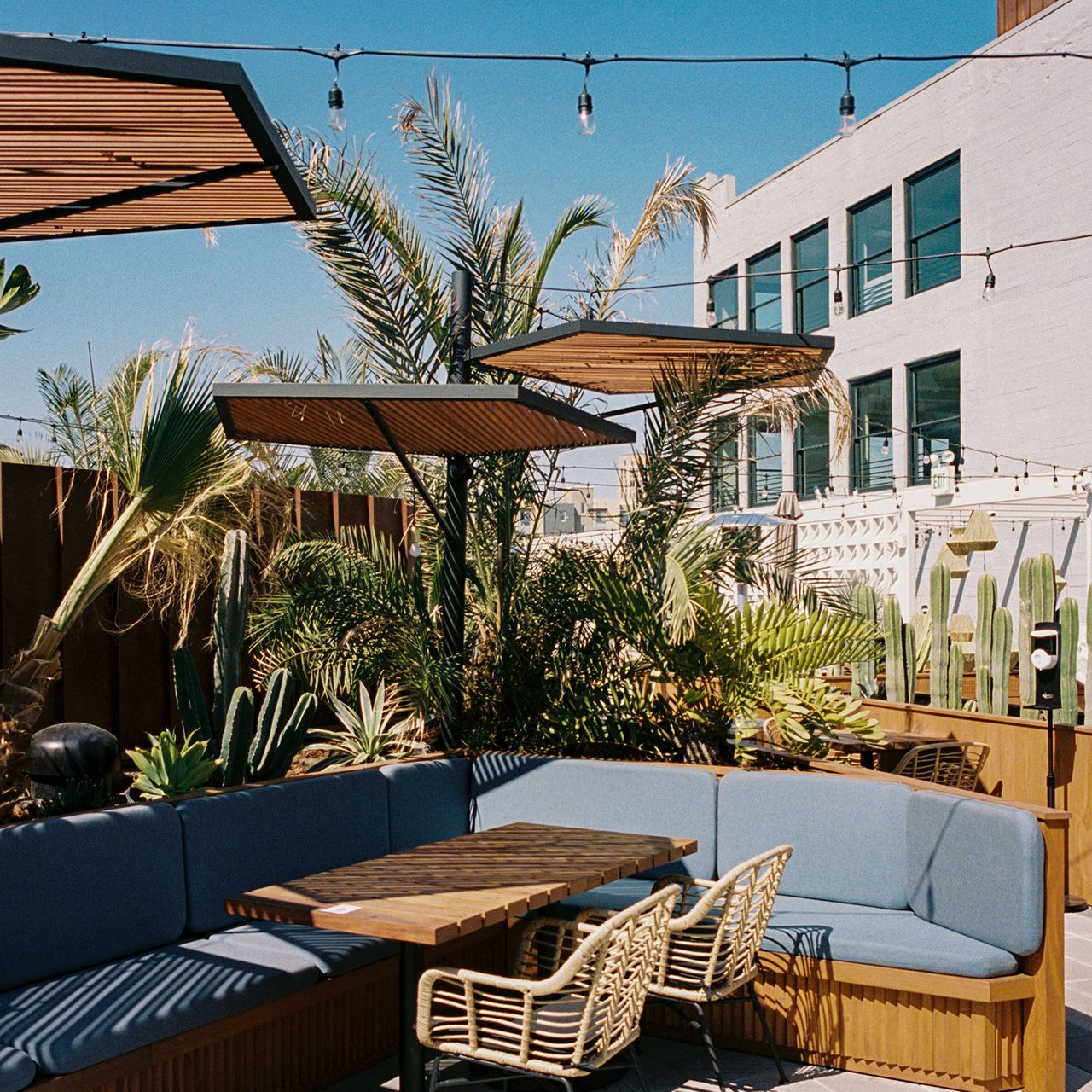
Vibrant and greenery-filled rooftop with Mexican-style lamps, city skyline views, and a buzzy, social atmosphere that feels like a stylish Mexico City terrace transplanted to the LA Arts District.
- aguachiles
- rockfish al pastor tacos
- Pollo tacos
- Chorizo tacos
- Hongos mushroom tacos
- churro dessert